
Real vs Faux Leather: The Complete Feel & Durability Guide
This post contains affiliate links. As an Amazon Associate, we earn from qualifying purchases.
Faux leather and real leather solve the same problem, durable, flexible material for furniture, clothes, and bags. Real leather is animal hide tanned for breathability and decades of use, developing a unique patina. Faux leather is fabric coated with polyurethane (PU) or other plastics for a uniform look at a lower cost, but it fails through cracking and peeling as the coating degrades.
The debate isn’t about which is better in a vacuum. It’s about matching the right material to the right use case for your budget, lifestyle, and values. Leather isn’t magic; it’s collagen fibers from a hide tanned to stop decay. Faux leather isn’t evil; it’s plastic laminated to cloth for a specific look. Both have a job. Both have a failure mode you can predict.
What follows: a breakdown of what each label actually means, the documented chemical and mechanical performance you can expect, and the real cost per year of ownership. You’ll get three specific tests to tell them apart instantly, and the one question that decides which one you should actually buy.
Key Takeaways
- Real leather can last 20-30+ years with proper care and can be repaired; quality faux leather lasts 3-8 years before the plastic coating succumbs to hydrolysis (water breakdown) and peels.
- Breathability and feel diverge immediately. Real leather warms to your touch, molds to your body, and lets moisture vapor pass. Faux leather stays cool, can feel sticky, and traps heat.
- The upfront price tag is a lie. A $500 real leather jacket worn twice weekly for 15 years costs about $0.32 per wear. A $60 faux jacket replaced every two years costs over $0.50 per wear over the same period, and you never get a broken-in favorite.
- Both materials carry environmental costs. Faux leather is petroleum-based, sheds microplastics as it wears, and does not biodegrade. Real leather is a meat industry byproduct, but tanning can be chemically intensive unless you seek vegetable-tanned options.
- Maintenance is different. Real leather needs periodic conditioning to stay supple. Faux leather just needs wiping down, but once it peels, it’s trash. Conditioning plastic does nothing.
What Does the Label “Faux Leather” Actually Mean?
Most faux leather is a fabric sandwich. The bread is a polyester or cotton backing. The filling is a polyurethane (PU) or polyvinyl chloride (PVC) plastic coating embossed with a leather-like grain. The definition of faux leather is simply any synthetic material designed to look like leather.
Technical Snippet: High-quality faux leathers like Nevotex Fjord use 100% solvent-free, water-based polyurethane (PU) on a fabric base. They achieve certifications like OEKO-TEX® for low chemical impact and are engineered for specific applications like boat upholstery or healthcare settings, where resistance to cleaning agents is critical.
Not all faux leather is created equal. A cheap PVC jacket feels plasticky and stiff. A premium PU like Nevotex Illusion 3.0 is softer, designed for high-traffic healthcare furniture, and passes stringent cleaning standards. The difference is in the polymer formula and the bond to the backing. But the core vulnerability remains: it’s a plastic layer glued to cloth. That bond is the failure point.
The marketing term “vegan leather” usually points to these same PU or PVC materials. It’s an ethical claim, not a durability one. For a true vegan leather comparison that considers environmental impact, you need to look at newer plant-based options like cactus or mushroom leather, which are a different category altogether from the standard synthetic leather on most mass-market furniture.
How Real Leather Builds Its Reputation
Real leather is skin, a complex matrix of collagen fibers. Tanning, whether with chromium salts (chrome tanning) or natural tannins (vegetable tanning), stabilizes those fibers against rot. This structure is why leather behaves the way it does.
Let me share what I’ve learned. That fibrous network is porous. It’s why a leather jacket breathes, letting water vapor from your back escape while blocking wind. It’s also why leather absorbs conditioner and changes with time. The fibers relax at stress points, elbows, shoulders, conforming to the wearer. A faux leather jacket never does that; it stays a stiff factory shape until the coating cracks.
The highest quality real leather is full-grain leather, which keeps the hide’s original surface and develops the richest patina. Lower grades like top-grain leather are sanded and corrected, and genuine leather is a broad term that can include split layers. The performance gap between a premium full-grain and a cheap genuine leather is vast, which is why knowing the leather grades matters more than the word “real.”
Mechanical Performance: Numbers Don’t Lie
The difference shows up in lab tests. A mid-grade real leather might be tested to >10N tensile strength (resists pulling apart) and >20N tear resistance. It will survive 30,000 flex cycles without cracking. This isn’t marketing. These are standardized industry tests (UNI EN ISO series) that manufacturers run to sell to contract furniture companies or automotive suppliers.
Faux leather has different strengths. Its water resistance is excellent because the plastic coating is a barrier. A silicone-based faux leather like LebaTex Maxim passes NFPA 260 and Cal 117 fire safety standards for upholstery, a must for public spaces. But its weakness is hydrolysis.
Where this goes sideways: Hydrolysis in PU-based faux leather. Water molecules, accelerated by heat and humidity, break the chemical bonds in the polyurethane coating. The plastic becomes brittle, the bond to the fabric fails, and the material delaminates. You’ll see small cracks appear at the seam of a sofa cushion around year 3, followed by a patch of peeling that spreads. Once it starts, you can’t stop it.
High-quality faux aims to delay this. The Nevotex Fjord uses a “thermoflex” coating designed not to change hardness in cold temperatures. But the lifespan estimates are telling: low-quality faux, 1-3 years; mid-quality, 3-5 years; high-quality, 5-8 years. Real leather furniture, conditioned occasionally, regularly sees 20+ years.
The Sensory and Practical Experience
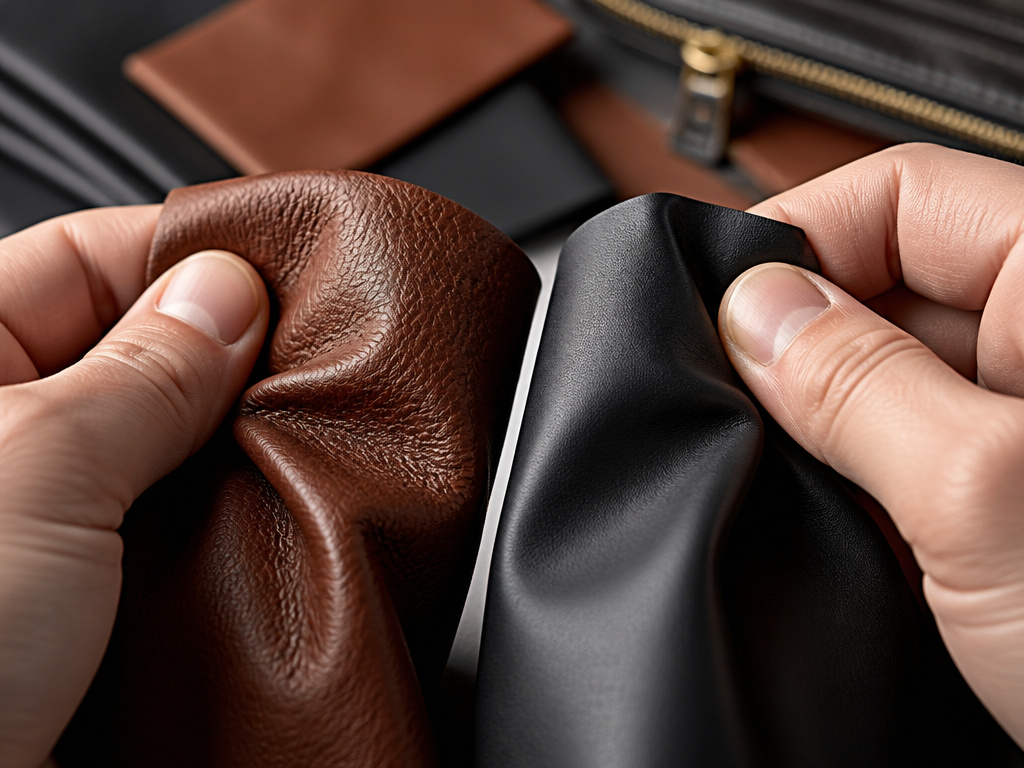 You don’t need a lab report. Your hands and nose will tell you the story long before a receipt fades.
The Smell Test: Unzip a new bag. Real leather has an earthy, organic scent from the tannins. Faux leather smells faintly chemical, like a new shower curtain or a vinyl car interior. That chemical smell fades, but the memory of plastic remains.
The Touch and Temperature Test: Lay your palm flat on the material. Real leather feels warm almost immediately, as it doesn’t insulate against your body heat. It’s also supple; when you pinch it, it wrinkles softly. Faux leather stays cool to the touch for longer and feels slicker. Pinching it creates a sharp, plastic crease that wants to spring back.
The Edge Inspection: Find a seam or cut edge. Real leather shows a fibrous, slightly fuzzy cross-section, like a dense felt. Faux leather shows a clean, woven fabric edge topped with a distinct plastic film. This is the most foolproof check.
I’ve watched clients rub a thumb over a sample, trying to feel the difference. The leather will tell you what it needs. If it drinks in a drop of water and darkens slightly, it’s hide. If the water beads on top like on a waxed car, it’s coated.
Care and Repair: One Ages, The Other Degrades
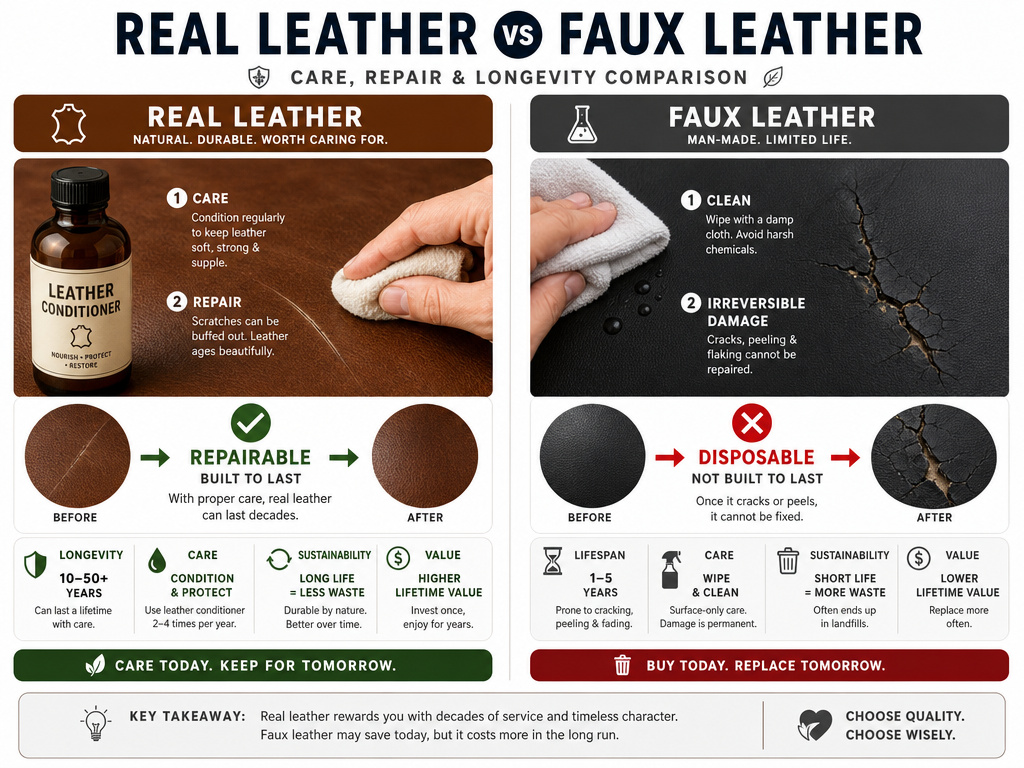 This is the most practical divergence. Your relationship with the material changes completely after purchase.
Caring for Real Leather: It needs hydration. The oils that keep collagen fibers supple slowly evaporate. A light application of a conditioner with a high concentration of dimethicone (think of it like making a roux, low heat, right fat, patient building) every 6-12 months replaces them. Scratches can often be buffed out with the warmth of your finger. A torn seam can be re-stitched. Faded color can be professionally re-dyed. The object is repairable.
Caring for Faux Leather: You wipe it down with a damp cloth. That’s it. Do not use leather conditioner; the oils can’t penetrate plastic and may degrade the adhesive. Do not use harsh chemicals. Protect it from direct sunlight and heat vents to slow hydrolysis. When the inevitable scuff or peel happens, you’re looking at cosmetic patches or complete replacement. The object is disposable.
| Aspect | Real Leather | Faux Leather |
|---|---|---|
| Daily Care | Dusting, occasional conditioning | Wiping with damp cloth |
| When Damaged | Scratches buff out; tears/seams professionally repaired | Peeling/cracking is irreversible; patching is temporary |
| Lifespan Signal | Develops a darker, richer patina | Coating becomes dull, then cracks |
| End of Life | Can be refurbished or recycled as scrap | Landfill (plastic-coated textile) |
Here’s a straightforward guide. If you want an heirloom, something that tells the story of your life in its wrinkles and sheen, you maintain leather. If you want a trendy piece for a few seasons with zero upkeep, you replace faux.
The Environmental and Ethical Trade-Off
Let’s be clear about one thing: neither option is impact-free. The choice is between two very different kinds of cost.
Faux Leather (PU/PVC): It’s a petroleum-derived plastic. Its production involves fossil fuels and chemistry. As it wears, and especially as it degrades, it sheds microplastic fibers. It does not biodegrade. The ethical win is clear: no animal products are used. But calling it “green” ignores its entire lifecycle as a persistent synthetic material.
Real Leather: It is, by definition, an animal product. However, over 99% of leather comes from hides of animals raised for meat; it’s a byproduct utilization. The environmental burden shifts to tanning. Chrome tanning is efficient but can involve heavy metals. Vegetable tanning uses natural extracts (e.g., tree bark) and is far cleaner but more expensive and time-consuming. A vegetable-tanned, full-grain leather bag is biodegradable at end of life and develops a gorgeous patina. The trade-off is the initial animal use and higher price.
Common mistake: Choosing PU faux leather solely for “eco” reasons. A PU jacket replaced three times creates more plastic waste and carbon footprint than one real leather jacket worn for fifteen years. For true low-impact, non-animal materials, look to waxed canvas or the new generation of plant-based leathers.
How to Choose: The One Question That Decides It
Forget the marketing. Ask yourself this: “Do I want this item to be mine in five years?”
If the answer is yes, invest in real leather. Look for full-grain or top-grain leather. Feel its warmth. Smell it. Budget for a conditioner and accept that it will age uniquely. Your $300 bag or $800 sofa becomes a personal artifact. It’s the choice for daily drivers: boots, belts, work bags, favorite jackets, and the sofa you live on.
If the answer is no, faux leather is a valid tool. Accept the 3-8 year lifespan. Enjoy the easy cleaning and the lower upfront cost. Just don’t condition it, and don’t expect it to become a companion.
The middle ground is where most people get frustrated. Buying a “genuine leather” item expecting decades of performance, or buying a pricey “designer faux leather” item expecting it to magically defy its plastic nature. That’s how you end up disappointed.
Frequently Asked Questions
Is faux leather good quality?
It can be, for its intended purpose. High-quality faux leather like performance PU is excellent for healthcare upholstery, boat seats, or places requiring specific fire ratings (NFPA 260, Cal 117). For a family sofa used daily, its 5-8 year lifespan before potential peeling is its quality ceiling.
How long does faux leather last?
Lifespan is tied directly to quality and environment. Low-cost PU/PVC: 1-3 years. Mid-market PU (like many furniture brands): 3-5 years. High-performance PU (Nevotex Fjord/Illusion 3.0): 5-8 years. Heat, sunlight, and humidity accelerate failure.
Can you repair peeling faux leather?
No, not truly. You can apply vinyl repair kits or glue flaps down, but these are cosmetic, temporary fixes. The chemical degradation of the coating (hydrolysis) has already occurred throughout the material. The repair won’t restore flexibility or prevent further peeling nearby.
Why is real leather so expensive?
You’re paying for the raw material (a byproduct with its own costs), the energy- and time-intensive tanning process, and the material’s inherent durability. A hide is also irregular, leading to waste when cutting patterns. The price reflects a decades-long service life, not just the square footage.
The Bottom Line
It’s not that one is universally better. It’s that each serves a different master. Real leather serves time. Faux leather serves the moment.
For a wallet, boots, a chair you’ll work in for a decade, or a jacket you want to live in, the economics and experience of real leather are unbeatable. The patina is the receipt for a life well-lived. For a trendy accent chair, a kids’ play furniture, or a short-term rental, faux leather does the job without the commitment or cost.
Understand leather better to make confident choices. Feel the material, check the edge, and ask about the grade. Then match that knowledge to your genuine intent for the item. That’s how you avoid the landfill and find the piece that actually becomes yours.
