Top Grain vs Genuine Leather Comparison: Which is Better?
This post contains affiliate links. As an Amazon Associate, we earn from qualifying purchases.
The difference between top grain and genuine leather is structural. Top grain is the strong, outer layer of the hide, lightly sanded and finished for a uniform look. Genuine leather is the weaker, lower split layer, which requires a thick plastic or polyurethane coating to hold together. The coating is what eventually peels.
That structural gap isn’t academic. It decides whether your bag, wallet, or jacket ages gracefully for decades or disintegrates into flakes within a year or two. Most of the confusion stems from the term “genuine,” which sounds premium but is often a commercial label for the lowest grade of real hide.
Let me share what I’ve learned from years of working with hides. This is a straightforward guide to the mechanics behind the labels. We’ll look at where each type comes from on the animal, why one fails predictably, and how to spot the difference with your own hands.
Key Takeaways
- “Genuine leather” is a material label, not a quality grade. It legally means “real leather” but in sourcing, it almost always refers to coated split leather.
- The key difference is the layer of the hide. Top grain is the outer grain layer; genuine leather comes from the lower, fibrous split.
- Genuine leather’s coating is structural, not cosmetic. When the polyurethane topcoat on split leather cracks or peels (usually within 6-18 months), the material underneath has no structural integrity.
- Top grain leather develops a patina; genuine leather shows wear. A quality top-grain finish will resist stains and look consistent, while a genuine leather item will show catastrophic failure once the coating goes.
- The feel and smell are reliable tests. Top grain feels substantial and smells earthy; genuine leather often feels stiff or plastic-like and may have a chemical odor.
The Anatomy of a Hide: Why Layer Matters
You can’t understand leather grades without knowing what you’re cutting. A raw cowhide arrives at a tannery as a thick slab, up to 10mm thick. To make it workable, it’s run through a machine that slices it horizontally into layers, like splitting a log.
The outermost slice contains the grain layer. This is the skin’s surface that faced the elements, the part with hair, scars, and insect bites. Its collagen fibers are densely packed, providing natural strength, moisture resistance, and breathability. This layer becomes full-grain or top-grain leather.
The lower slice is called the split. It consists of loose, open fibers with no natural grain surface. It’s weaker, absorbs moisture easily, and lacks structural integrity on its own. This is what becomes “genuine leather” in most commercial contexts.
The Federal Trade Commission guides state that “unqualified terms suggestive of leather” are deceptive unless the product is “composed in all substantial parts of leather.” The term “genuine leather” meets the legal minimum but says nothing about which part of the hide was used, creating a vast gap between consumer expectation and material reality.
The industry has a language problem. “Genuine” sounds like an endorsement, but in a factory quote, it’s often a price point. Understanding leather grain is the first step to cutting through that noise.
Top Grain Leather: The Refined Workhorse
Top grain leather starts with that premium outer grain layer. The key differentiator is a finishing step: the very top surface is lightly sanded or buffed to remove natural imperfections. A finish coat, often a pigmented layer or protective spray, is then applied.
This process gives top grain its signature smooth, uniform appearance. The sanding removes a fraction of a millimeter of the strongest fibers, but the leather remains structurally sound. The finish seals the pores, which makes it more resistant to stains and spills. That’s why you see it used heavily by brands like Michael Kors or Kate Spade, where color consistency across thousands of handbags is essential.
I once believed top-grain leather was inherently inferior to full-grain. Examining hundreds of samples changed my mind. A quality top-grain finish from a reputable tannery offers something full-grain can’t: predictable performance for specific goods. For a sleek wallet or a piece of furniture that needs to look pristine, the stain resistance and uniformity of a good top grain are functional benefits, not compromises.
The trade-off is breathability and patina development. The sealed surface blocks the natural exchange of oils and moisture that creates a rich, personal patina over decades. A top-grain bag will look great for years, but it won’t tell your unique story in the same way. For a more detailed look at its strengths and weaknesses, our guide on the pros and cons of top-grain breaks it down further.
| Characteristic | Top Grain Leather | Genuine Leather (Coated Split) |
|---|---|---|
| Source Layer | Outer grain layer | Lower split layer |
| Surface | Sanded, then finished | Artificial grain stamped onto coating |
| Primary Failure Mode | Finish may crack over many years | Coating delaminates from split (6-18 months) |
| Breathability | Moderate (reduced by finish) | Poor (coating seals surface) |
| Patina Development | Minimal | None |
| Best For | Furniture, fashion handbags, items needing uniform color | Budget to lower mid-market goods where “leather” label is key |
Genuine Leather: The Coated Compromise
Here’s where the marketing sleight-of-hand occurs. In the leather industry, quoting “genuine leather” for a handbag almost always means coated split leather. It’s the material made from that lower, weaker split layer.
Since the split has no natural grain or strength, it can’t be used as-is. Manufacturers coat it with a thick layer of polyurethane or plastic, then emboss that coating with an artificial grain pattern. This coating isn’t just for looks; it’s doing structural work, holding the loose fibers together.
This is the core of the difference. With top grain, you have a strong hide with a protective finish. With genuine leather, you have a weak hide dependent on a synthetic coating for its integrity. The coating is the product.
The result is a predictable and common failure mode: delamination. The plastic coating bonds poorly to the loose split fibers. With regular flexing, exposure to UV light, or temperature changes, the coating begins to separate. You’ve seen it, the “peeling bag” effect. Once that coating starts to go, the item is finished. There’s no repairing the non-structural material underneath.
The disadvantages of genuine leather are significant, but so is its low cost. It serves a market segment. The problem arises when it’s sold with the implication that it shares the longevity of top grain. For a look at an even more compromised material, see how it compares to bonded leather, which is essentially leather dust in a plastic binder.
Common mistake: Believing “genuine leather” is a step below top grain but still durable. In practice, it’s a different category of material where the expected lifespan is 1-3 years with daily use, not decades.
How to Spot the Difference: A Practical Guide

You don’t need to be an expert. Your senses are the best tools you have. Next time you’re shopping, ignore the tag and do these three things.
1. Feel the surface and edges.
Run your thumb across the leather. Top grain should feel like dense, supple skin, even with a finish. Genuine leather often has a stiff, plastic-like or rubbery feel, that’s the thick coating. Now look at a cut edge, like a belt hole or a wallet’s open seam. Top grain will show a consistent, fibrous cross-section. Genuine leather may show a painted edge or a distinct, glued-on layer.
2. Perform the bend test.
Flex the material gently. Quality top grain will crease smoothly, like bending a thick piece of paper. Genuine leather may resist bending, or you might see fine cracks appear immediately in the coating along the flex line. That’s a dead giveaway.
3. Trust your nose.
Bring the item close and take a deep breath. Full-grain and top-grain leather have a rich, earthy, slightly sweet smell, the scent of tanned hide. Genuine leather often smells like chemicals, plastic, or nothing at all. Your nose rarely lies. For more systematic methods, our guide on how to test leather quality covers these steps in detail.
Why This Distinction Matters for Your Money
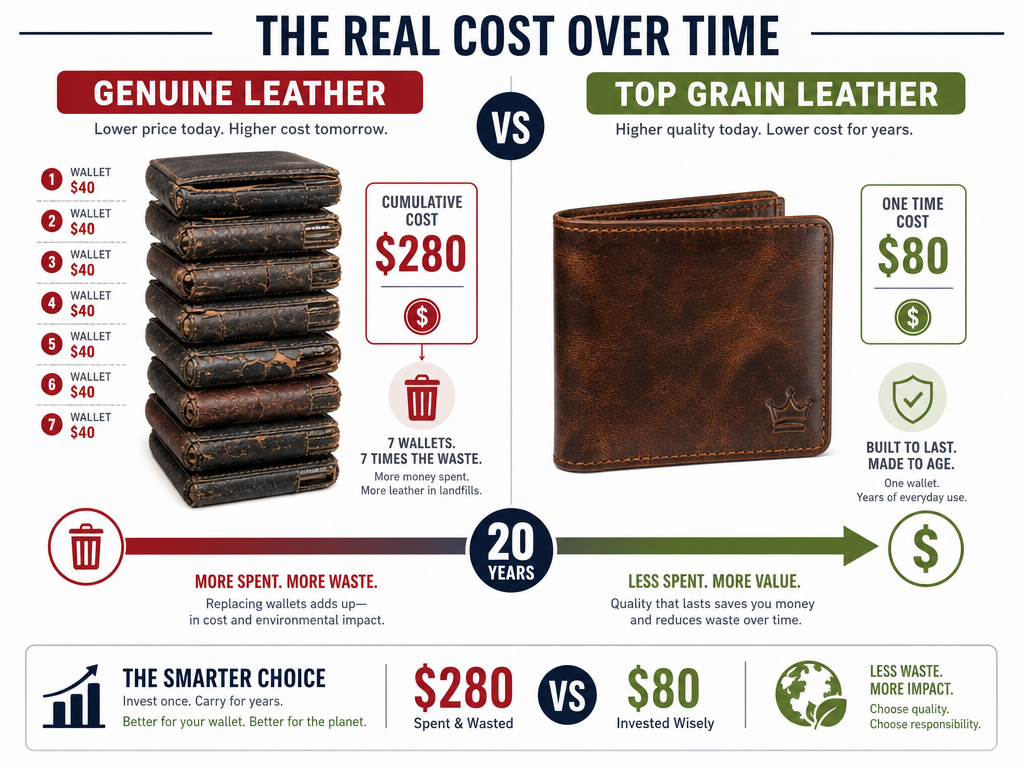
This isn’t about leather snobbery. It’s about value and waste. Let’s be clear about one thing: a genuine leather belt that cracks in a year isn’t a bargain at forty dollars. It’s a subscription fee.
The practical calculus is straightforward. A genuine leather wallet costs $40-$60 and lasts 1-3 years. Over twenty years, you’ll buy 7 to 20 of them, spending $280 to $1,200. A top-grain leather wallet costs $80-$150. With minimal care, it will last those same twenty years, developing character instead of disintegrating.
The same math applies to bags, jackets, and furniture. The cheap option is rarely cheap. It’s a short-term rental disguised as a purchase. This is the cornerstone of the “buy-it-for-life” philosophy. If you want an item to last, you must start with a material engineered to last. Understanding the official leather grades is part of that, but the layer of the hide is more telling than the grade stamp.
Corrected Grain: The Middle Ground
You might hear the term “corrected grain.” This is essentially a type of top-grain leather that’s been sanded more aggressively to remove significant imperfections, then re-embossed with a consistent grain pattern. Brands use it to achieve a specific aesthetic, like the iconic Saffiano cross-hatch.
It’s a legitimate technique that yields a durable, uniform product. The important distinction is that corrected grain starts with a strong base layer (the top grain), unlike genuine leather which starts with a weak base (the split). The embossing is for looks, not structural support. If you’re curious about this specific process, we have a full article explaining what is corrected grain leather.
The Bottom Line: Choosing What’s Right for You
So, top grain or genuine leather? The answer depends entirely on your goal.
Choose top grain leather if: You want an item that will last for years, look consistent, and offer good stain resistance. It’s the default for quality furniture, durable work bags, and any accessory where you want the assurance of real hide strength without the high maintenance of full-grain. For a direct comparison with its un-sanded counterpart, see our guide on full-grain vs top-grain.
Understand genuine leather for what it is: A budget-material option with a severely limited lifespan. It’s a valid choice for a seasonal fashion item you don’t expect to wear for years, or for low-cost accessories where the “leather” label itself is the primary selling point. Just know the coating will likely fail, and that failure is structural.
The leather will tell you what it needs. Top grain needs occasional conditioning to keep the underlying hide supple, though less often than full-grain. Genuine leather can’t be conditioned meaningfully, the coating blocks absorption. Any care is just preserving the plastic shell.
Ignoring the marketing copy and understanding split leather and its limitations is how you make confident choices. You invest in the layer, not the label.
Frequently Asked Questions
Does “genuine leather” mean it’s fake?
No, it means it’s made from real animal hide. The problem is it’s often the lowest, weakest part of the hide (the split), which requires a heavy coating to be usable. It’s real, but low-quality.
Can you repair peeling genuine leather?
No, not permanently. Once the polyurethane coating delaminates from the split leather base, the material underneath has no strength. Patching the coating is a temporary, cosmetic fix. The structural failure is total.
Why does top grain leather cost more?
It comes from the smaller, prime outer layer of the hide and undergoes more finishing. More importantly, a square foot of top grain yields a product that lasts 5-15 years, while a square foot of coated split yields a product that lasts 1-3. The cost reflects the material’s inherent lifespan.
Is top-grain leather always better than full-grain?
Not always. “Better” depends on the use. Full-grain is stronger and develops a patina, but it’s more susceptible to stains and shows natural markings. Top-grain is more uniform and stain-resistant, making it “better” for a sleek handbag or a light-colored sofa. It’s a matter of selecting the right tool for the job.
How can I be sure I’m getting real top grain leather?
Buy from brands that name their tanneries and are specific about their materials. Look for descriptions like “top-grain cowhide” or “corrected grain leather.” Be skeptical of descriptions that only say “genuine leather” or “real leather.” Price is also a clue, real top-grain has a minimum material cost that filters out the cheapest products.
