
Vegan Leather vs Real Leather: The 5-Year Test Brands Hide
This post contains affiliate links. As an Amazon Associate, we earn from qualifying purchases.
The core difference between vegan leather and real leather is lifespan: most plastic-based vegan leathers (PU, PVC) are built for 2-5 years before peeling or cracking, while quality full-grain real leather is built for 30+ years with proper care and develops a valued patina. Vegan leather is a broad label for materials that mimic leather without animal hide, spanning from petroleum-based plastics (polyurethane/PU) to newer plant-based options. Real leather is tanned animal hide, valued for its durability, breathability, and ability to age gracefully. The choice isn’t just ethical; it’s a practical calculation between short-term cost and long-term value.
That lifespan gap is the predictable outcome of two different material chemistries breaking down under daily stress. A polyurethane coating bonded to fabric behaves one way; a dense layer of collagen fibers behaves another.The trade-offs touch everything from how a chair feels after a decade to what happens in a landfill after you’re done with a bag.
This guide walks the practical differences. We’ll look at what each material actually is, how they age, what they cost over time, and where the new generation of plant-based options fits. The goal is to give you the specifics, the failure modes, the test results, the repair realities, so your choice matches your actual use.
Key Takeaways
- The 2–5 Year Ceiling: Standard PU/PVC vegan leather has a functional lifespan of 2-5 years before peeling or cracking, driven by plastic degradation, not care.
- Patina vs. Failure: Real leather develops a valued patina with use; vegan leather shows cosmetic failure (cracks, peeling) that is largely unrepairable.
- “Vegan” ≠ Sustainable: Most vegan leather is plastic-based (PU/PVC), a petrochemical product that does not biodegrade and can shed microplastics.
- Repairability Decides Longevity: Real leather can be conditioned, patched, and re-dyed; peeling vegan leather often requires complete replacement.
- Check the Source, Not the Label: The FTC’s Part 24 Guides for Leather govern terms like “genuine leather,” but “vegan leather” is an unregulated marketing term that can hide plastic content.
What Are We Actually Comparing?
Let’s be clear about one thing. “Vegan leather vs real leather” is a category, materials that look like leather, against a specific material, tanned animal hide. Confusion starts when we treat “vegan leather” as a single thing.
Real Leather is tanned animal hide. Its performance is defined by the hide’s origin (cow, goat, buffalo), the tanning method (vegetable, chrome), and the cut (full-grain, top-grain). A full-grain, vegetable-tanned cowhide is the benchmark for durability and aging. Its structure is a dense, breathable matrix of collagen fibers.
Vegan Leather is any material designed to mimic leather without using animal skin. This breaks into two broad families:
The Technical Snippet: Polyurethane (PU) leather, the most common vegan leather, is a fabric base (polyester, cotton) coated with a plastic polymer layer. Performance hinges on the plastic’s flexibility and its bond to the fabric. Failure occurs when this bond breaks (delamination) or the plastic itself cracks from repeated flexing and UV exposure.
The first family is Plastic-Based Synthetics. This includes PU leather (polyurethane) and PVC leather (polyvinyl chloride). These are what most people encounter as faux leather. They are petroleum products.
The second is Emerging Plant-Based Materials. These include Piñatex (pineapple leaf fiber), Desserto (cactus leather), apple peel leather, and mushroom leather. They are often combined with a plastic binder or backing to achieve usable strength.
The third, often lumped in, is Microfiber Leather (like Alcantara), a synthetic microfiber leather made from polyester and polyurethane. It’s a different beast, engineered for specific tactile and wear properties in automotive and tech.
When someone says “vegan leather is less durable,” they are usually talking about the plastic-based family. When a brand says “our vegan leather is sustainable,” they might be talking about a plant-based option. Your first question should always be: “What is it actually made from?”
| Material Type | Core Composition | Primary Failure Mode | Typical Lifespan (Daily Use) |
|---|---|---|---|
| Real Leather (Full-Grain) | Animal hide (collagen fibers) | Dryness, scratches (repairable) | 20-30+ years |
| PU/PVC Vegan Leather | Plastic coating on fabric | Coating peeling (delamination) | 2-5 years |
| Plant-Based (e.g., Cactus) | Plant fibers + plastic binder | Surface cracking, binder failure | 5-10 years (varies widely) |
| Microfiber Leather | Ultra-fine synthetic fibers | Pilling, matting from abrasion | 5-15 years |
The Durability Gap: Why 2-5 Years Isn’t a Defect, It’s a Design Limit
A high-quality full-grain leather bag can last 30 years. A PU vegan leather bag from Matt & Nat often starts showing wear in two. This isn’t about one being “better.” It’s about their fundamental construction meeting physical limits.
Real leather fails slowly. The collagen fiber structure is tough and can absorb impact, flex, and abrasion. When it does show wear, it’s often surface-level. A scratch can be blended with conditioner. A scuff becomes part of the patina. Dryness leads to cracks, but those cracks happen deep into the material’s life, and conditioning can often reverse early-stage damage.
Plastic-based vegan leather durability hits a wall. The polyurethane coating is a thin film. Every bend, every temperature change, every exposure to sunlight stresses the bond between that film and the fabric underneath. Once the bond breaks, you get delamination, the coating lifts and bubbles. Once the plastic itself loses its plasticizers from UV exposure, it becomes brittle and cracks.
Where this goes sideways: Storing a PU leather jacket in a hot car over a summer. The heat accelerates plasticizer loss, and the first time you put it on in the fall, the elbows or shoulder seams crack audibly. The damage is immediate and cosmetic, the jacket is now “worn out” in a way leather wouldn’t be for decades.
The difference is repairability. Leather is a three-dimensional material. You can sand a scratch, fill a gouge, re-dye a faded section, and condition the whole piece. The repair blends in. With peeling bonded leather or PU, the damage is to a surface film. You can’t glue the coating back down without a visible seam. The fix is often a cosmetic patch that lasts months, not years. This is why the cost to professionally repair a peeling vegan leather sofa often exceeds the cost of a new cover.
How Do They Age? Cracking vs Patina
Aging is the most honest comparison. One material tells a story of use. The other announces its expiration date.
Real Leather Patina: This is the gradual, even darkening and softening of the leather’s surface from exposure to oils, light, and air. It’s a sign of life. The leather becomes uniquely yours, with soft wrinkles forming at stress points. The color deepens. The hand-feel turns from stiff to supple. This process is why vintage leather goods are sought after. A patina isn’t damage; it’s maturity.
Vegan Leather Aging: There is no patina. The material is designed to look consistent. Aging is purely degenerative. First, you might see a loss of sheen or color fading. Then, in high-flex areas (bag corners, sofa seats, shoe creases), micro-cracks appear in the coating. These cracks gather dirt and widen. Finally, the coating layer starts to separate from the base fabric, the tell-tale peeling.
The sensory difference is unmistakable. An old leather jacket feels warm, dry, and alive. An old PU jacket feels cool, slightly sticky, and plasticky. The sound matters, too. Flex a leather belt, it’s a soft, muted creak. Flex a worn PU belt, it’s a sharper, plastic-on-plastic crackle.
Can Plant-Based Options Age Better?
Emerging materials are trying to solve this. A recent RSC peer-reviewed vegan leather research article on gluten-based leather showed tunable mechanical properties that could, in theory, allow for more leather-like aging. But these are lab-scale proofs of concept. Commercial plant-based leathers today, like cactus or pineapple, still rely on plastic binders and coatings for durability. They might resist cracking longer than pure PU, but they still face the same delamination risk at the binder-fiber interface. They don’t develop a patina; they just degrade more slowly.
The Sustainability & End-of-Life Reality
The marketing says vegan leather is the sustainable choice. The chemistry says it’s complicated. This is where the conversation gets real.
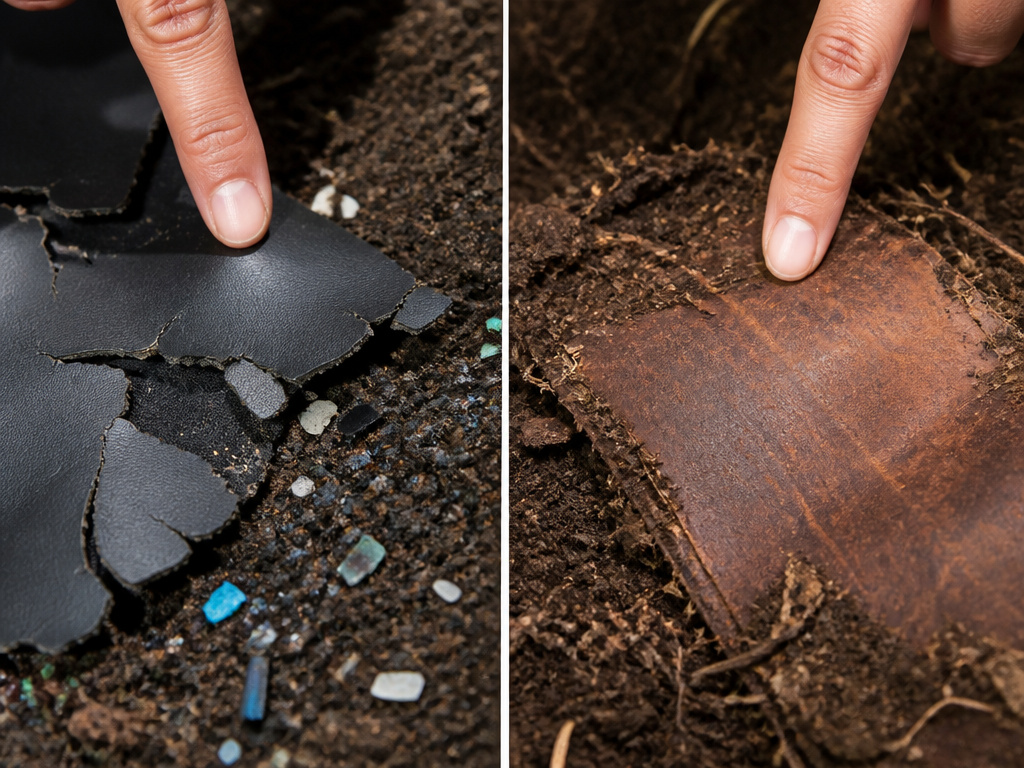
Most vegan leather is plastic. PU and PVC are petrochemicals. They do not biodegrade. In a landfill, PU can take centuries to break down, potentially leaching chemicals. As it fragments, it contributes to microplastic pollution. A “vegan leather” bag dying after two years is a plastic item entering the waste stream very quickly.
Real leather is a natural material. It will biodegrade over time, especially if vegetable-tanned. The environmental cost is front-loaded: livestock methane emissions and the chemical or plant-based tanning process. However, because a leather item serves for decades, its per-year environmental impact can be lower than that of multiple disposable vegan replacements.
Common mistake: Assuming a “plant-based” label means compostable. A cactus leather bag with a polyester backing and PU binder is not home-compostable. It will not break down in a landfill any faster than regular plastic. The plant fibers are trapped in a plastic matrix.
Circularity is the true test. Can the material be easily recycled or repurposed at end-of-life? Leather can be ground and used as filler or upcycled. Mixed-material vegan leathers (fabric + plastic + plant fibers) are a recycling nightmare. They are destined for landfill.
So, which is more sustainable? If you measure by years of service per unit of resource, a long-lasting real leather item often wins. If you measure strictly by animal product avoidance, vegan leather wins, but you must accept its plastic footprint and shorter life. There’s no universal answer, only a clearer set of trade-offs.
The Cost & Environmental Math
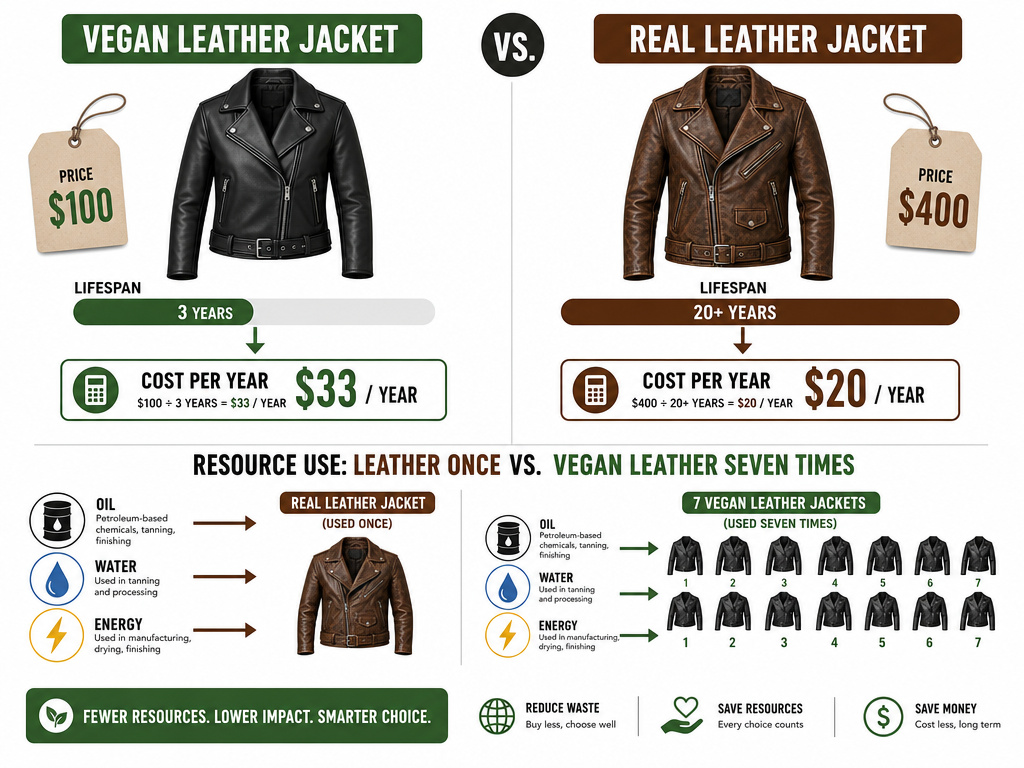
The price tag lies. A $100 vegan leather jacket and a $400 real leather jacket seem like a straightforward choice. The real math is cost-per-year.
Let’s say the vegan jacket lasts 3 years before it becomes too cracked to wear. Its cost-per-year is about $33. The real leather jacket, with basic care, lasts 20 years. Its cost-per-year is $20. The leather jacket is cheaper over time. This doesn’t even factor in the residual value, a well-aged leather jacket can be sold, while a peeling synthetic jacket has zero resale value.
The environmental math mirrors this. The resources (oil, water, energy) to produce one leather jacket are spent once over 20+ years. The resources to produce seven vegan jackets to cover the same period are spent seven times, plus the waste and transport for each replacement.
This is why high-wear items, sofas, work bags, boots, car interiors, are where the choice matters most. For a seldom-wear fashion item, the short lifespan of a vegan leather material might be acceptable. For a daily-driver bag, it’s a false economy.
| Application | Real Leather Rationale | Vegan Leather Rationale |
|---|---|---|
| Sofa | Can last 20-30+ years, repairable, develops character. | Lower upfront cost, easier to clean spills, but high risk of peeling on cushions in 5-7 years. |
| Everyday Handbag | Cost-per-year wins, patina tells your story, handles/straps repairable. | Vegan ethics, often lighter weight, bright color consistency. Accept 2-5 year replacement cycle. |
| Work Boots | Breathable, molds to foot, can be resoled. | Often waterproof out of the box, lower cost. Won’t breathe, may crack at flex points within a year of heavy use. |
| Car Interior | BMW’s high-quality Sensatec (a microfiber leather) can rival leather, but many budget “vegan” interiors are vinyl that cracks in sun. | No animal products, often standard in EVs. May feel rubbery and show wear on bolsters faster. |
Making Your Choice: A Practical Framework
Ignore the marketing. Start with these three questions.
1. What is your actual use case? Is this for daily, heavy use (work bag, wallet, sofa) or occasional, light use (decorative pillow, seasonal jacket)? Heavy use demands durability and repairability, lean real. Light use opens the door to more materials.
2. What is your lifespan expectation? Do you want this item to last a decade, or are you okay with replacing it in a few years? Be honest. If you want a forever item, the durability of vegan leather is a gamble.
3. What are your essential values? Is avoiding animal products an absolute priority? If so, vegan leather is your path, but seek out the most durable plant-based options and understand their care. Is longevity and reducing waste your priority? Then quality real leather, preferably vegetable-tanned, aligns better.
Here’s the practical takeaway. For most core items meant to be used hard and kept long-term, boots, belts, durable bags, furniture, the proven performance of real leather is hard to beat. For fashion-forward, trend-driven items you don’t expect to wear out, modern vegan materials offer ethical and stylistic choices.
The middle ground is where it gets interesting. Materials like high-grade microfiber leathers or emerging, genuinely durable plant-based composites are bridging the gap. They’re not there yet for heirloom-quality goods, but they’re changing the landscape.
Frequently Asked Questions
Is vegan leather just plastic?
Most of it is. The majority of products labeled “vegan leather” are made from polyurethane (PU) or polyvinyl chloride (PVC), which are plastic polymers derived from petroleum. Some newer versions incorporate plant fibers, but these are usually still bound together with plastic resins.
Can vegan leather be repaired?
Effectively, no. Once the surface coating cracks or peels, repairs are cosmetic and temporary. Leather fillers or glues don’t bond well to the plastic coating, and the damage tends to spread. Real leather, in contrast, can be sanded, patched, re-dyed, and conditioned to address many forms of wear.
Which lasts longer, vegan or real leather?
Quality real leather lasts significantly longer. Full-grain leather goods routinely last 20-30 years with care. Standard PU/PVC vegan leather has a typical lifespan of 2-5 years before showing significant peeling or cracking. The comparison between faux leather vs real leather hinges on this lifespan gap.
Is vegan leather eco-friendly?
It’s complex. While it avoids animal products, most vegan leather is plastic-based, non-biodegradable, and contributes to microplastic pollution. Its short lifespan means more frequent replacement and waste. A long-lasting real leather item can have a lower per-year environmental impact. True eco-friendliness depends on the specific material and its full lifecycle.
How can I tell if it’s real leather?
Use the smell and edge tests. Real leather has a distinctive, rich, earthy smell. Synthetic leather smells like plastic or chemicals. Look at an unfinished edge: real leather will have a fibrous, suede-like back; synthetic leather will show a woven fabric backing. Our guide on how to tell real from fake leather has more detailed methods.
Before You Go
Let’s be clear about one thing. This is about matching material to mission.
If your mission is a bag that will look better in a decade than it does today, that can be scuffed and conditioned back to health, that carries the warmth of a natural material, your path leads to real leather. Look for full-grain or top-grain, and understand the pros and cons of genuine leather as a starting point.
If your mission is strictly avoiding animal products and you accept a shorter, more disposable product cycle, vegan leather is your choice. But push past the label. Ask what it’s made from. Seek out brands using higher-durability synthetics or pioneering plant-based composites without greenwashing.
The most sustainable choice, regardless of material, is the one you’ll use until it truly wears out. Buying for durability beats buying for disposability every time. The leather, real or otherwise, will tell you what it needs. Your job is to listen.
