
How Is Leather Graded | Behind the Grade Stamps
This post contains affiliate links. As an Amazon Associate, we earn from qualifying purchases.
Leather is graded through two separate systems: quality (based on defects and usable area) and size (based on surface area or weight). The ISO 11457:2018 standard defines five quality grades (I-V) by the percentage of defect-free area, while commercial labels like “full-grain” describe the post-tanning surface treatment of the hide.
That’s the formal answer. Let’s pull on the thread of “defect-free area.” In the tannery, that single number decides whether a hide becomes a high-margin luxury good or gets downcycled into a budget material.
What follows: a walk through the ISO checklists graders use, the real difference between commercial labels, and a test you can do with a drop of water to check a seller’s claims.
Key Takeaways
- Grading happens twice: first as raw material (ISO quality/size grades), then as commercial product (full-grain, top-grain labels).
- The top ISO Grade I allows defects on no more than 10% of the hide’s surface. Grade V leather can be 85% defective.
- “Full-grain” means the hide’s natural surface is intact. “Top-grain” means it’s been sanded and refinished. Both can come from the same high-quality hide.
- The most reliable test for full-grain leather is the water bead test, drops should bead up, not soak in immediately. Ignore the term “genuine leather” as a reliable indicator of full-grain or top-grain construction. It’s a legal description, not a grade.
The Two-System Grading Landscape
You’re looking at two different report cards. The first is written in the tannery for the raw material. The second is stamped on the product you buy.
The raw material grade is a technical spec, governed by standards like ISO 11457:2018. It answers a simple industrial question: how much of this hide is usable for cutting premium parts? A grader assesses the percentage of defects, brand marks, scars, insect bites, wrinkles, against the total area. That yields a Grade I through V. This grade determines the hide’s price per square foot and which manufacturer will buy it. A furniture maker needing large, unblemished panels will pay a premium for Grade I. A maker of small leather goods might happily take Grade III.
The commercial grade is a marketing and craftsmanship label. It describes what’s been done to the hide’s surface after it meets a certain quality threshold. Full-grain leather is the highest commercial grade because it retains the hide’s natural, unaltered outer layer. But that full-grain leather could have come from an ISO Grade I, II, or even III hide, the commercial label doesn’t tell you the raw material score. This disconnect is where confusion lives.
ISO 11457:2018 specifies that Grade I leather must have a clear portion (defect-free area) in eight out of nine designated zones on the hide, with total defects not exceeding 10% of the surface. This is the baseline for the most premium raw material.
The grading principles behind these systems are documented in resources like the UNIDO leather quality manual, which outlines the international framework for assessing hides.
Decoding the ISO Quality Grades
The ISO system is brutally numeric. It’s not about “looks nice.” It’s about usable square inches. Let’s translate the five grades.
Grade I (85–100% usable): This is the elite athlete. Defects can’t cover more than 10% of the total area. The grain must be fine and smooth, the texture compact. Think of the flawless panels used for a designer handbag’s front. There’s no room for major scars or grain distortion here.
Grade II (70–84% usable): Defects can occupy 10–20% of the area. You might find minor, healed defects on the less critical parts of the hide (like the neck or belly). The grain is still fine, but a slight tightness might appear on the neck. This hide is perfectly suited for a high-quality briefcase where smaller pieces can be cut around the imperfections.
Grade III (55–69% usable): Here, 20–40% of the surface can have defects. The clear portion is now limited to the prime areas (the back and sides). You might see scattered “pocca” (small pockmarks) or vein marks, but not on the prime sections. This leather often becomes the back face of a belt or the interior lining of a jacket.
Grade IV (40–54% usable): Defects jump to a permitted 70%. The leather will have a drawn, tight grain and visible imperfections. It’s relegated to low-cost goods where durability matters more than aesthetics, think work gloves or tool pouch reinforcements.
Grade V (25–39% usable): The threshold is 85% defects. This leather is thin, weak, with heavy grain distortion and open flaws. It’s the raw material for bonded leather or other reconstituted products.
| ISO Grade | Maximum Defect % | Usable Area % | Best For |
|---|---|---|---|
| I | 10% | 85–100% | Luxury goods, premium furniture, high-end bags |
| II | 20% | 70–84% | Quality footwear, structured bags, belts (front) |
| III | 40% | 55–69% | Casual jackets, wallet interiors, belt backs |
| IV | 70% | 40–54% | Workwear, protective gear, low-cost accessories |
| V | 85% | 25–39% | Reconstituted materials (bonded leather), filler, non-critical applications |
Where this goes sideways is assuming a high commercial grade means a high ISO grade. A “full-grain leather” wallet could be cut from a small, perfect section of a Grade III hide. The product is good, but the raw hide was middling. The official Indian Standard IS 12435 provides a complementary framework for grading based on mass and size, another layer to this raw material assessment.
The Size and Weight Report Card
While quality grading asks “how good,” size grading asks “how big.” For tanneries and manufacturers, both numbers are needed to calculate cost and yield.
For bovine hides (cows, buffalo), size is often measured by surface area in square decimeters (dm²) or square feet. A heavier, larger hide generally yields more usable material, but only if the quality is there. Standards like ISO/TR 2822-3:2017 provide the basis for these size categories. A “heavy hide” might be 251–300 dm², while a “calf skin” falls under 150 dm². The size grade directly impacts what products the hide can supply, you can’t cut a car seat from a small hide.
For sheepskins, the grading changes. ISO 17551:2018 details grading for pickled sheep pelts, where the pH must be a precise 2.0 ± 0.2 before evaluation. Size is then determined by measuring the total area of a batch of 12 pelts, classifying them as Extra Large (>10 m²) down to Extra Small (<3.4 m²).
Buffalo hides add another variable: weight. ISO 28499-2:2009 specifies that raw buffalo hides are weighed to the nearest 0.5 kg, and calf skins to the nearest 0.1 kg, with allowances for dung and flesh still attached. A heavier hide might be stronger and thicker, which is a desirable trait for saddlery or heavy-duty luggage.
Common mistake: Equating thickness with quality. A thick hide can be Grade V, loaded with scars and weak spots, while a thinner, tight-grained hide can be Grade I. Thickness is a choice for the end product, not an indicator of the raw grade.
From Raw Grade to Commercial Label
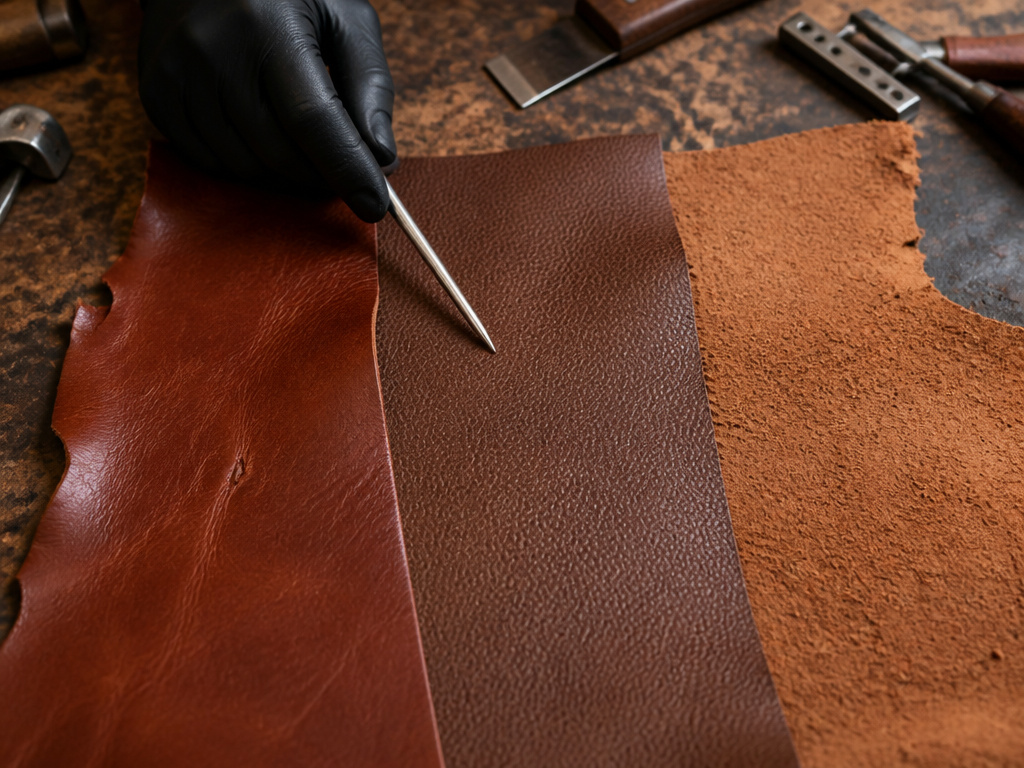
This is where the tannery’ work meets the sales floor. A hide that achieves a high ISO grade now has options. The path it takes defines the commercial label you see.
If the natural grain is nearly perfect, the tannery will likely preserve it. The hide is tanned, dyed, and lightly finished. This becomes full-grain leather. It shows the hide’s natural markings, a faint hair cell pattern, maybe small scars that add character. It’s the most durable and breathable form, developing a rich patina over time. This is the highest grade leather in the commercial sense.
If the hide has a few more surface imperfections, the tannery might sand it down. A light sanding removes the topmost damaged cells. A heavier embossing roller then presses a new, uniform grain pattern into the surface. This is corrected grain leather, often sold as top-grain leather. It’s more uniform in appearance and easier to clean, but the sanding removes the densest, most durable fibers. It’s still a high-quality product, often from a Grade I or II hide.
Now, take the lower splits of the hide, the fibrous layers beneath the grain. These can be sanded to create a soft, napped surface: suede. Or, they can be coated with a polyurethane layer and embossed to look like grain leather. This is a split leather product. It’s less durable than top-grain but can be quite soft and affordable.
Finally, gather the dust, scraps, and tiny leftovers from all these processes. Grind them up, mix with latex or PU, and press them onto a fabric backing. This is bonded leather. It might contain some leather fibers, but it lacks the strength and longevity of a true hide. Its raw material source is often Grade V hides or tannery waste.
| Commercial Label | Source | Surface Treatment | Feel & Look |
|---|---|---|---|
| Full-Grain | Outer layer (grain) of high-grade hide | Minimal; natural grain intact | Natural, develops patina, shows imperfections |
| Top-Grain (Corrected) | Outer layer of good-grade hide | Sanded, dyed, embossed | Uniform, consistent, easier to clean |
| Suede | Lower split layer | Napped (sanded) to raise fibers | Soft, velvety, matte finish |
| Bonded | Leather scraps & dust | Pulverized, bonded to fabric, coated | Stiff, plastic-like, uniform, prone to peeling |
The practical takeaway? The commercial label tells you about craftsmanship and intended use, not the raw hide’s inspection score. This is why testing leather yourself is so powerful.
How to Spot the Real Grade Before You Buy
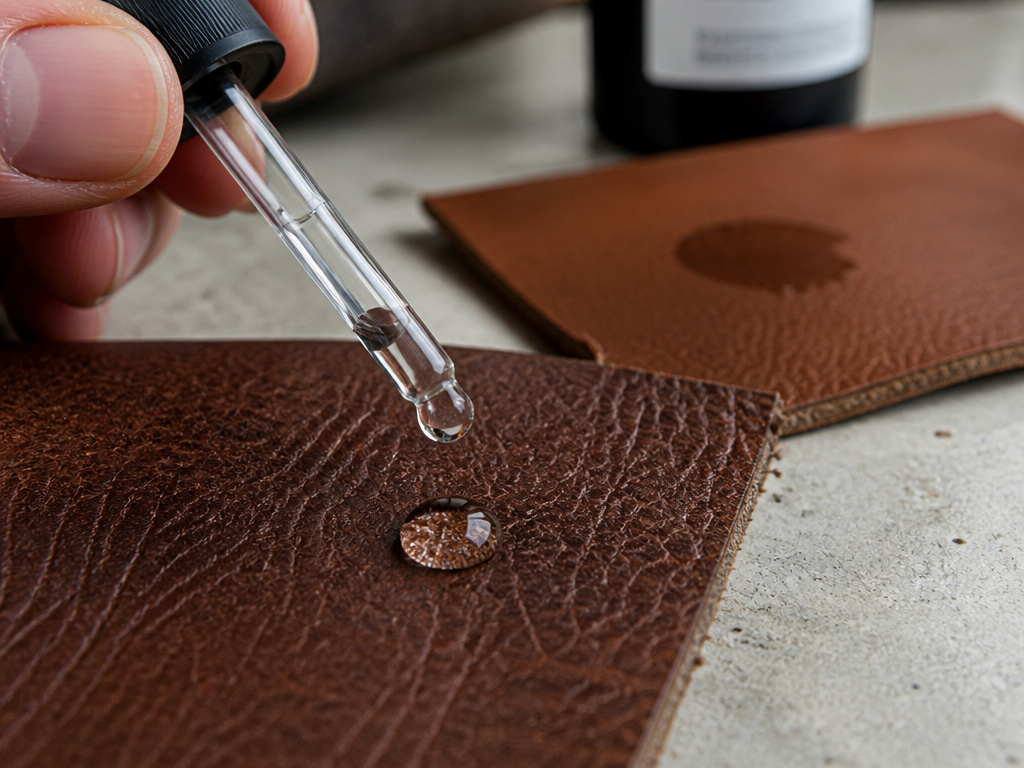
Forget trusting the tag alone. Your hands and a simple test will tell you more than any marketing copy.
First, look at the back. Real, high-quality leather (full or top-grain) has a rough, fibrous backside, the corium layer. Bonded or synthetic leather will have a uniform fabric or knit backing. Feel the surface. Full-grain leather should feel warm and supple, not cold and plasticky. Bend it. Good leather will crease softly and naturally; low-grade or coated leather will show a white, cracked line along the bend (the finish is breaking).
Now, the water test. This is the closest you can get to a DIY grading assay. Place a single drop of water on an inconspicuous spot. On true full-grain leather, the water will bead up and sit on the surface for minutes before slowly absorbing. The natural, tightly packed grain fibers resist immediate penetration. On corrected grain or heavily finished leather, the drop will darken the spot and soak in much faster, sometimes within seconds. The finish has opened the pores.
Why does this matter? Because it directly relates to durability and care. Leather that absorbs water instantly will also absorb oils, dirt, and sweat quickly, leading to faster staining and degradation. Leather that beads water is more resilient and will develop a patina, not just get dirty.
I learned this lesson the hard way with a suede jacket early on. I used a standard leather conditioner, assuming all leather was the same. The conditioner matted the delicate nap and left a permanent, dark stain. Suede needs specific, gentle care. Not all leather is treated the same because not all leather shares the same grade or structure. That experience taught me to verify the material first.
Here’s a straightforward guide for your next purchase: 1. Check the back for a natural, rough texture. 2. Bend the leather to check for finish cracking. 3. Ask the seller: “Is this full-grain, top-grain, or suede?” Their confidence in answering is a data point. 4. If possible, perform the water bead test.
The Limits of Grading and What It Doesn’t Tell You
A Grade I stamp doesn’t guarantee a perfect sofa. Here’s what the systems leave out.
The grading happens on individual hides. A single roll of leather for furniture might contain pieces from multiple hides, each with a different grade. The final product is only as good as its weakest panel. Grading also assesses the raw, untanned hide or the semi-processed “crust” leather. The final dyeing, finishing, and softening processes, which add significant value, aren’t captured in the ISO grade.
Also, grading is largely visual and tactile. It doesn’t measure chemical integrity. A hide can be Grade I but tanned poorly with weak chromium bonds, leading to low shrinkage temperature. ISO 5433:2022 for bovine wet blue leather sets a minimum shrinkage temperature of 100°C for full chrome tannage. A hide can look perfect but fail this chemical test, causing it to shrink and harden excessively if exposed to heat.
Finally, the most important factor: craftsmanship. A master cutter can “nest” pattern pieces on a Grade III hide to maximize yield and produce a beautiful bag. A poor cutter can waste 40% of a Grade I hide. The skill in the cutting room is the final, ungraded variable that determines what you actually hold.
Where this goes sideways: Buying based solely on a commercial label like “Genuine Leather.” This term is a legal definition meaning the product contains some leather, but it offers zero insight into quality, durability, or the raw material grade. It could be a thin veneer of corrected grain over a Grade V split.
Frequently Asked Questions
What is the highest grade of leather?
In commercial terms, full-grain leather is considered the highest grade. It uses the hide’s natural, unaltered outer layer and comes from the best raw material. In industrial ISO grading, Grade I is the highest raw material grade.
Is genuine leather good quality?
“Genuine leather” is not a quality grade recognized by the Leather Working Group or the Society of Leather Chemists. It’s a descriptive term meaning the product contains some leather, but it could be the lowest quality corrected grain or even a thin split leather. It often indicates a lower-tier product compared to items specifically labeled full-grain or top-grain.
How can you tell if leather is high quality?
Perform the water bead test (water should bead up), examine the back (should be rough and fibrous), and bend the leather (should crease softly without the finish cracking). High-quality leather also has a distinct, rich smell and feels supple, not stiff or plasticky.
What does Grade A leather mean?
“Grade A” is not a standard ISO term. It’s an informal, often misleading marketing label used by some retailers to imply high quality. Always look for specific descriptions like “full-grain” or ask for the leather type. Rely on physical tests, not arbitrary letter grades.
Why is full-grain leather more expensive?
Full-grain leather requires the highest quality raw hides (typically ISO Grade I or II), uses no sanding or corrective finishes to hide defects, and is the most durable and breathable. Its production has less waste but a higher material cost, and it develops a unique patina over time, adding to its value.
Before You Go
The most useful rule isn’t about remembering grade percentages. It’s this: trust the physical test over the label.
If you’re comparing two brown leather chairs, put a drop of water on each. The one where the water beads and sits is the one that will age with you, not just wear out. The one where it soaks in and darkens the spot is already telling you it’s more finish than fiber.
Grading tells the hide’s story at the tannery gate. Your job is to read the story the finished product is telling you now. Look at the back, feel the surface, smell it. That investigation will tell you more about quality and longevity than any stamped grade or marketing slogan ever could. The leather will tell you what it needs.
