
Expert Tips: How to Choose Leather for Upholstery Projects
This post contains affiliate links. As an Amazon Associate, we earn from qualifying purchases.
To choose leather for upholstery, match the leather type to its intended use. For high-traffic family rooms, a pigmented or semi-aniline leather is the practical choice due to its protective coating and durability. For a formal living room with less use, a full-aniline leather offers unmatched natural beauty but requires more care. The selection hinges on three factors: the leather’s finish, its physical specifications from standards like ISO 16131, and the specific part of the hide used.
The standards provide a map, not a destination. They list test methods and recommended values, like a minimum tear strength of 20 Newtons, but they don’t decree what sofa you should buy. That final call rests on how you live with the piece.
What follows is a breakdown of the three main leather types, the specs that matter, and how to decode industry jargon. You’ll learn why the butt of a hide outlasts the flank, what a “dry flex resistance” test actually measures, and how to spot a leather that’s dressed for success versus one that’s just dressed up.
Key Takeaways
- Pigmented leather is the workhorse for everyday furniture, offering the highest durability and stain resistance due to its polymer surface coating.
- Aniline leather is a luxury material best for low-traffic settings; its unprotected surface shows natural markings but is susceptible to stains and fading.
- Industry standards (ISO 16131, EN 13336) are guidelines, not guarantees; they provide test methods (e.g., tear strength ≥20 N) but the final suitability for your sofa depends on your household’s use.
- Where the leather comes from on the hide matters; the dense butt section is far more durable than the softer, stretchier flank or belly.
- Always test cleaners and conditioners on a hidden area first; a quick check on a seam or underside can prevent a permanent finish disaster on the main surface.
The Three Leather Types: More Than Just a Look
Open any furniture catalog and you’ll see “aniline,” “semi-aniline,” and “protected” or “pigmented.” These aren’t just marketing terms. They describe how much of the hide’s natural surface is left exposed versus how much is covered by a protective topcoat. Getting this wrong is the most expensive mistake you can make.
I learned this lesson the hard way with a suede jacket years ago. I used a standard leather conditioner, assuming all “leather” care was the same. It matted the delicate nap and left dark, greasy stains that never came out. Upholstery finishes are just as specific. Applying the wrong expectation, like putting a fragile aniline leather in a kid’s playroom, is a recipe for heartache.
Aniline Leather: The Purist’s Choice
This is leather at its most natural. Only the very best hides are selected, dyed with transparent aniline dyes, and left without a pigmented topcoat. You see the hide’s true character, the grain, the pores, even minor scars. The feel is incomparably soft.
Aniline leathers are more susceptible to light and liquid absorption because of the natural porosity of the hide and there may be a slight variation in colour across the hide.
That’s the trade-off. Sunlight will fade it. A spilled glass of red wine will stain it, often permanently. The AHFA standards frankly note it “requires a high degree of preventative maintenance” and is “susceptible to surface scratches.” This isn’t a defect; it’s the nature of the material. Choose it for a formal sitting room or a master bedroom chair that sees gentle use. It’s a showcase piece, not a daily driver.
Semi-Aniline Leather: The Smart Compromise
Here’s the sweet spot for most homes. The leather is still aniline-dyed through, but it receives a very light surface coating. This layer evens out the color, reduces visible imperfections, and adds a crucial layer of protection against spills and scuffs.
The result is a material that retains about 80% of aniline’s soft, natural hand but gains several hundred percent in practical durability. Light fastness improves, and everyday grime wipes off more easily. For anyone choosing leather furniture for a living room or family room, semi-aniline is the most rational place to start your search.
Pigmented (Protected) Leather: The Family-Proof Finish
This is the most durable and common upholstery leather. The surface is buffed, then built back up with a base coat and a colored polymer topcoat containing opaque pigments. Finally, it’s embossed with a consistent grain pattern.
That topcoat is everything. It acts as a shield. Spills bead up. Friction from jeans doesn’t wear through the dye. It resists fading. According to ISO 16131, pigmented leather must also pass a cold crack resistance test at -15 °C to ensure the finish doesn’t become brittle and crack. This is the leather for the sectional that hosts movie nights, the dining chairs, or any leather recliner that gets daily use.
| Leather Type | Best For | Key Limitation |
|---|---|---|
| Aniline | Formal spaces, adult-only use, showcasing natural beauty | High maintenance, stains easily, fades in sunlight |
| Semi-Aniline | Living rooms, family rooms, balancing feel with durability | Less natural character than full aniline, higher cost than pigmented |
| Pigmented | High-traffic areas, homes with kids/pets, maximum durability | Can feel less “leathery,” grain pattern is often artificial |
How Do You Match Leather Type to Your Lifestyle?
The labels are useful, but your life is the final test. A leather that works in a sun-drenched Florida room fails in a damp, cool basement. Think about three forces acting on your sofa: abrasion, light, and moisture.
For a couch facing a large window, prioritize lightfastness. The ISO standard demands a higher rating (blue scale ≥4) for pigmented leather than for aniline (≥3). If your household includes claws, canine or feline, abrasion resistance is key. The dense fiber structure of leather from the hide’s butt section fares better than the soft flank. For a dining area or a leather sectional in a basement den, moisture resistance is essential. Here, the sealed surface of a pigmented leather is the only sensible choice.
Where this goes sideways: Putting an aniline leather sofa in a direct sunlight spot. The fading starts within months, and it’s irreversible. The arm facing the window will be a noticeably different shade by the end of the first year.
Let’s be clear about this. The “best” leather isn’t a universal truth. It’s the one whose performance profile matches your specific chaos. A published peer-reviewed leather properties analysis underscores this, stating that testing planned leather is always recommended to assure quality for the intended product. The standards give you the test results; you have to do the matchup.
Decoding the Spec Sheet: What the Numbers Actually Mean
When a manufacturer or a high-end retailer references ISO 16131:2012 or EN 13336:2022, they’re pointing to a framework for selection. These documents don’t say “this leather is good for a sofa.” They say, “if you want a leather for a sofa, here are the characteristics you should evaluate, and here are the test methods to use.”
FIRA, the Furniture Industry Research Association, explicitly notes that BS EN 13336 “does not set end-use criteria.” They use it, combined with in-house expertise, to judge suitability. You should think the same way. Here are the key specs that turn abstract quality into something you can measure.
Tear Strength: The 20-Newton Floor
This is a fundamental metric. The standard sets a minimum tear strength of 20 Newtons for both aniline and pigmented leathers. To visualize that, imagine the force needed to lift a 2-kilogram bag of sugar. The leather must resist tearing under at least that much force in a standardized test (ISO 3377-1).
Leather from the dense butt of the hide will far exceed this. Leather from the stretched flank might just meet it. This number is why cheap furniture sometimes fails at the seams, it’s made from weaker parts of the hide, stressed beyond their mechanical limit.
Color Fastness: Will It Rub Off?
This two-part test checks if color transfers. The dry rub test (50 cycles) and wet rub test (20 cycles) use a white felt pad rubbed against the leather. The graying of the felt is compared to a scale. A rating of ≥3 is required, meaning minimal color transfer.
You can do a crude version of this at home. Take a clean, white cotton cloth, dampen a corner, and vigorously rub a hidden spot (like under a cushion). If you see any dye on the cloth, the color fastness is poor. This leather will stain light-colored clothing.
Dry Flex Resistance & Cold Crack
These tests check the finish’s integrity, not the leather itself. Dry flex resistance (a new parameter in the 2022 EN standard) repeatedly bends the leather to see if the finish cracks. The cold crack test chills the leather to -15°C and then bends it.
A failure here means the topcoat is brittle. In your home, this manifests as tiny, spider-web cracks in the finish along crease lines, like on the seat cushion after a few years of use. It’s a sign of a poor-quality finish application.
| Characteristic | Test Standard | Typical Requirement | What a Failure Looks Like |
|---|---|---|---|
| Tear Strength | ISO 3377-1 | ≥ 20 N | Seams splitting under normal sitting stress. |
| Color Fastness (Rub) | ISO 11640 | Grey Scale ≥ 3 | Dye transfers to your clothes or light fabrics. |
| Finish Adhesion | ISO 11644 | ≥ 2 N/10 mm | Topcoat peels or flakes off in patches. |
| Cold Crack Resistance | ISO 17233 | No cracking at -15°C | Fine cracks appear in finish along permanent creases. |
Beyond the Surface: Hide Parts and Composite Materials
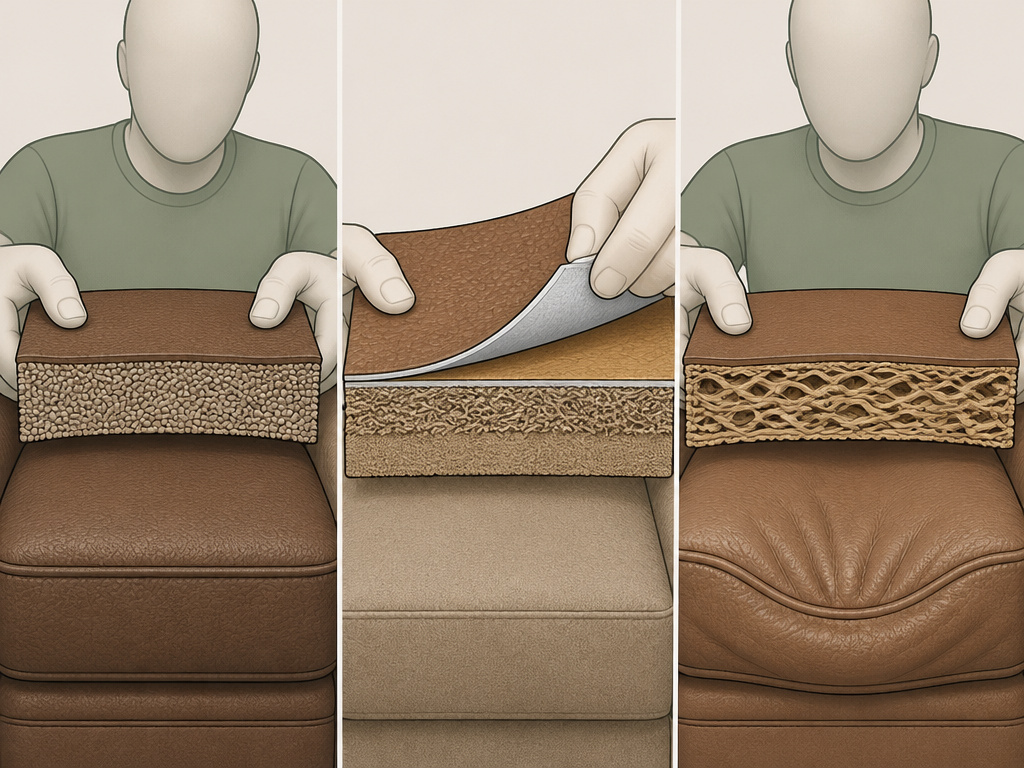
The conversation about “full-grain” or “top-grain” is about the surface. But what’s underneath? The hide isn’t a uniform sheet. Its structure changes dramatically from back to belly, and manufacturers sometimes use composites that aren’t leather in the traditional sense.
Butt vs. Flank: The Durability Divide
The butt is the area along the animal’s back. The fibers here are densely packed, resulting in the strongest, most durable leather. The flank or belly is thinner and the fibers are looser. It’s much softer and more pliable, but also far more prone to stretching and tearing.
A sofa should use butt leather for critical stress points: seat cushions, armrests, and back cushions. The flank might be used for non-structural panels. A lower-quality piece might use flank leather throughout to cut costs. Over time, the seat will stretch and sag.
The Truth About Splits and Bicast
When a hide is split horizontally, the top layer (with the grain) is “full-grain” or “top-grain.” The lower layers are flesh splits. These can be sanded and finished with a heavy polyurethane coating to look like grain leather, but they lack the natural fiber strength.
Bicast leather is a specific type of split leather. A polyurethane film is laminated onto its surface. It’s often glossy and uniform. The problem is performance. FIRA notes it “lightens when stretched and is easily scuffed,” and recommends testing to ensure suitability. In practice, it cracks and peels with age. It’s crucial to understand bicast leather so you aren’t disappointed when a “leather” chair fails in a few years.
The Practical Buyer’s Checklist
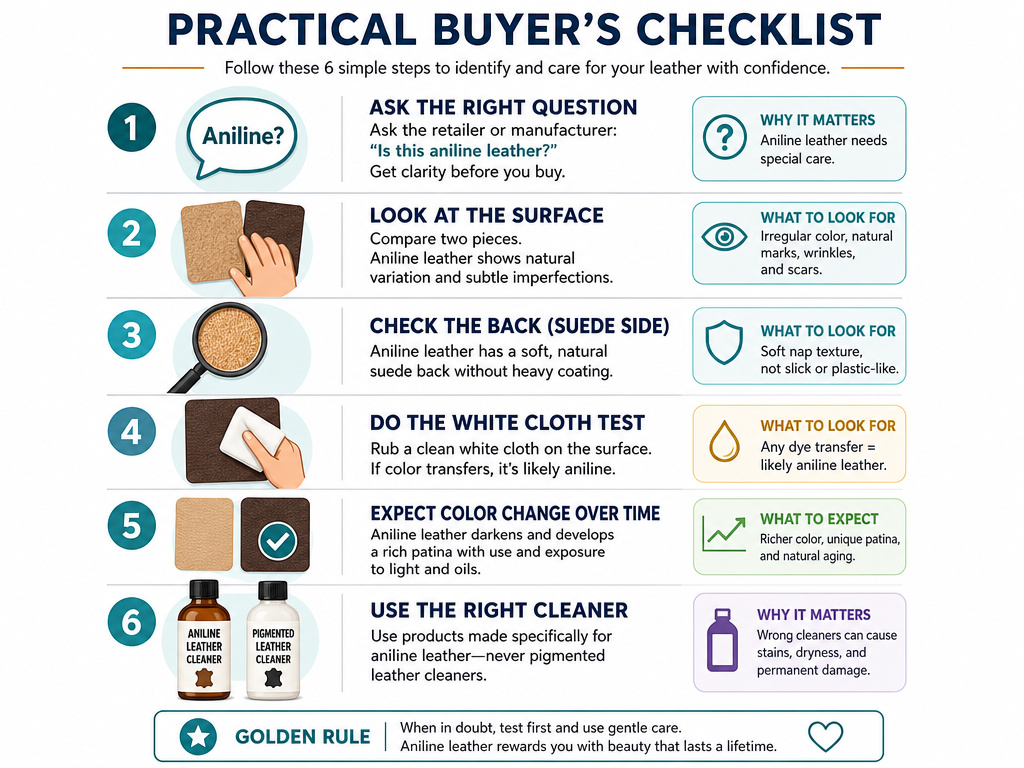
Theory is fine, but you need a plan for the showroom floor. Here’s how to translate everything into action when you’re selecting leather for a project as big as a sofa.
- Ask Directly About the Finish. Don’t settle for “premium leather.” Ask: “Is this aniline, semi-aniline, or pigmented?” If they don’t know or hedge, be wary.
- Feel the Difference. Compare samples. Aniline will feel like warm skin. Pigmented will feel smoother, with a more uniform texture. Semi-aniline is in between.
- Check the Underside. Look at the back of a sample or an inconspicuous area. Is it suedy (the flesh side), indicating a split? Or does it have a fibrous, rough back, indicating a full-thickness hide? The latter is generally stronger.
- Perform the Rub Test. With permission, use a clean white cloth on a hidden spot. Check for color transfer, especially with dark-colored leathers.
- Consider the Color. Darker, semi-aniline or pigmented leathers are more forgiving of stains and wear. Light aniline leathers will show every mark, developing a patina that not everyone loves.
- Think About Your Cleaning Kit. Your choice dictates your care. Aniline needs specific, pH-balanced cleaners like the Colourlock Furniture Kit. Pigmented leather is more forgiving and can often be maintained with a simple cleaner like Leather Master Strong Cleaner. Have your plan ready.
Easy to miss: The sides and underside of cushions. These hidden areas absorb body oils and dirt from your arms and legs. Cleaning them once a year does more to preserve the leather’s longevity than conditioning the top surface every month.
Frequently Asked Questions
Is aniline leather the best quality?
It’s the most natural and expensive, but “best” depends on use. For durability and easy care in a active home, a high-quality semi-aniline or pigmented leather is often the better, more practical choice. Aniline is best where preservation of its natural state is the priority.
What does “top-grain” leather mean for upholstery?
Top-grain means the top, grain layer of the hide is used. It’s a step above “genuine leather” (which often means lower splits), but it doesn’t tell you the finish. A top-grain leather can be aniline, semi-aniline, or pigmented. Always ask for the finish type.
How can I tell if leather is good quality in a store?
Use your senses. Good leather shouldn’t smell like plastic. It should feel substantial, not paper-thin. The color should be even (unless it’s aniline), and the grain pattern should have some natural variation. Pull on a corner gently; it should have some resistance and spring back, not stretch limply.
Is leather from certain countries better?
Origin is less important than the tannery’s standards and the specifications met. High-quality leather is produced all over the world. Focus on the manufacturer’s transparency about the leather type, finish, and the standards it complies with, rather than the country of origin.
Can you repair scratched or stained leather upholstery?
Yes, professional repair is often possible. Scratches on aniline leather can sometimes be lessened with specific creams. Stains may be treated. For pigmented leather, color-matched dyes can refurbish worn areas. For major damage on valuable pieces, seek a professional furniture restorer. The key is to address issues early.
Before You Go
Choosing upholstery leather is a balance between romance and reality. The romance is in aniline’s untouched beauty. The reality is that a pigmented finish will survive a spilled juice box without a crisis.
Here’s a rule I follow: if you’re investing in a primary piece of furniture for a room you live in daily, let durability lead the decision. The softness of semi-aniline is a worthy compromise. Reserve the full aniline experience for accent chairs or formal spaces where its care can be a ritual, not a chore.
Finally, remember the standards are your translation guide, not your final answer. A tear strength of 20 Newtons is a minimum checkpoint, not a promise of immortality. Your lifestyle, the sunlight, the pets, the Friday night popcorn, is the ultimate test. Match the leather’s specs to that test, and you’ll have a piece that looks better with age, not in spite of it.
