
How to Size a Leather Dog Collar Using the Two-Finger Test
This post contains affiliate links. As an Amazon Associate, we earn from qualifying purchases.
This post contains affiliate links. As an Amazon Associate, we earn from qualifying purchases.
To size a leather dog collar, measure your dog’s neck circumference with a soft tape, add 1-2 inches for comfort and the buckle, then verify the fit with the two-finger test. A quality vegetable-tanned leather collar from a brand like Loyal Canine or Mendota Pet will hold its shape, but its thickness, often 8mm or more, reduces the effective inner diameter, so a 40cm collar fits a 37cm neck.
That last point about thickness is where most guides stop. They give you the “add two inches” rule and send you on your way. The reality is more like woodworking: you’re building a circle around a cylinder, and the thickness of your material changes the math. A thick, padded collar needs a different flat length than a thin, rolled one for the same dog.
What follows is the three-step process that accounts for that. We’ll cover the direct measurement, the translation to a size chart (with the thickness variable explained), and the final physical test that overrules any number on a tape. By the end, you’ll know how to read any manufacturer’s chart and spot the ones that have already done the math for you.
Key Takeaways
- Measure the neck, not the old collar. Brands like TYRAS Dog Gear explicitly warn against using an old collar as a reference, as material and buckle placement differ. A soft measuring tape behind the ears gives the only reliable baseline.
- Collar thickness steals interior space. An 8mm thick collar reduces the effective inner circumference by about 2.5cm (1 inch). A collar listed as 40cm long will only fit a ~37cm neck comfortably. The two-finger test is essential.** You should be able to slide two flat fingers snugly between the collar and your dog’s neck after buckling. One finger is too tight; three is too loose.
- Size up for puppies and thick coats. For dogs under 18 months, choose a size where their current neck sits in the lower half of the range. For breeds with seasonal undercoats, the winter setting will be 1-2 notches tighter.
- Vegetable-tanned leather is the default for durability. It’s stronger, lacks the irritants of cheap chrome-tanned leather, and develops a better patina. This is the material to choose a leather dog collar made from.
The Direct Measurement: Finding True Neck Circumference
Forget the old collar for a moment. Even if it fits, its length includes the buckle tongue and the specific hole used, data that doesn’t cleanly transfer to a new piece. The only way to start from zero is with a flexible tape measure.
Have your dog stand normally. Locate the spot where the collar will sit, typically at the narrowest part of the neck, just behind the ears and jawbone. Wrap the tape snugly, as if it were the finished collar itself. Now, perform the two-finger check with the tape: slide two fingers flat between the tape and your dog’s skin. The number where your fingertips meet is the target neck circumference.
Common mistake: Measuring with the dog sitting or lying down. The neck skin and posture change, adding half an inch or more of error. Always measure standing.
If you don’t have a seamstress tape, use a non-stretch string or a charging cable, mark it, and then measure the length against a ruler. Do this three times and take the average. Consistency is your friend here. This number is your foundation. Write it down.
The Two-Finger Test: What “Snug” Actually Means
Every source, from vets to high-end manufacturers, cites the two-finger rule. Let’s be clear about what that means, because doing it wrong is the difference between safe and dangerous.
The test uses two of your fingers, held flat together, not pinched or angled. After buckling the new collar, you should be able to wedge them under the leather all the way to the second knuckle. You should feel a definite, even pressure on both sides of your fingers. If you can’t get them in without forcing, the collar is too tight. If they slide in and out with zero resistance, it’s too loose.
A properly fitted collar should not rotate freely around the neck, nor should it be able to slip over the dog’s head if they back up suddenly. The two-finger space accounts for normal neck expansion during breathing, drinking, and pulling.
This isn’t just about comfort. A too-tight collar can cause hair loss, skin irritation, and even tracheal damage over time. A too-loose one is a flight risk. The test overrules everything. If the size chart says “Medium” but you can only fit one finger, the chart is wrong for your dog. This is why the final in-person fit check is mandatory, even for custom orders. It’s the final step in learning how to care for a leather dog collar properly, starting with a correct fit.
How Collar Thickness Changes the Math
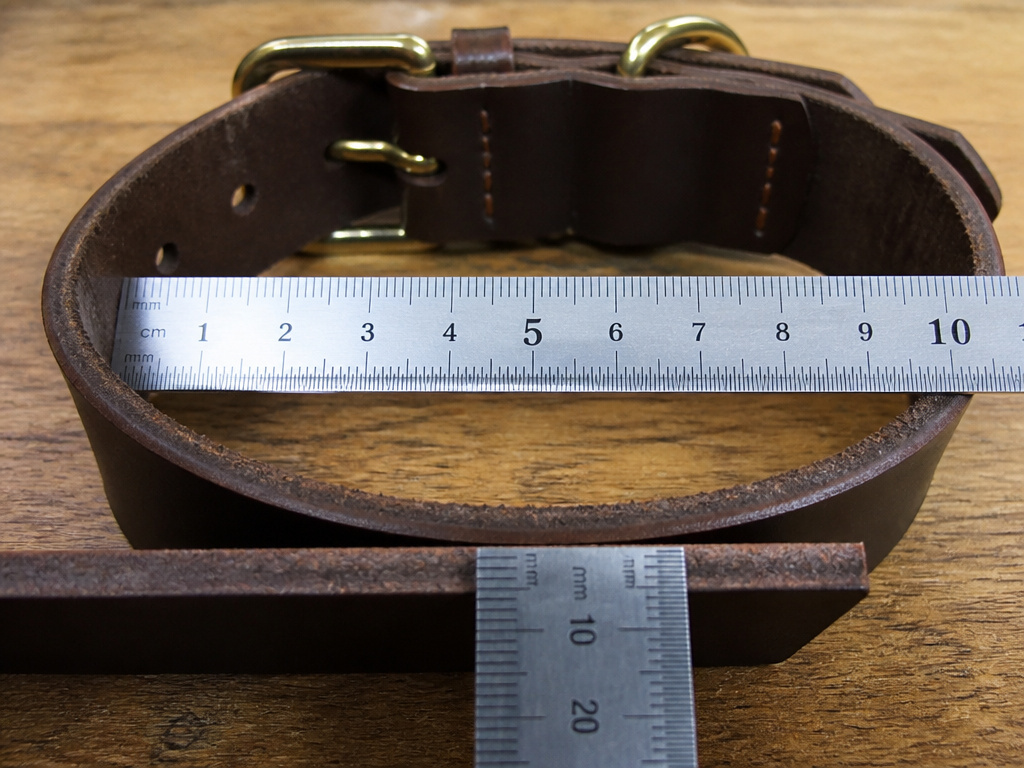
Most articles miss. A collar is not a two-dimensional ribbon. It has thickness, and that thickness consumes interior space when it’s curved into a circle.
William Walker’s engineering breakdown makes it concrete. A collar that measures 40cm laid flat does not create a 40cm inner circle. The thickness of the leather reduces the inner diameter. Their example: an 8mm thick collar reduces the inner diameter by that 8mm, which works out to roughly 2.5cm (about 1 inch) less circumference. So their 38-44cm collar is designed for a 33-39cm neck.
This is why you can’t just measure an old nylon collar and buy the same length in leather. The leather is likely thicker. This table shows how to translate:
| Collar Type | Typical Thickness | Circumference Reduction | If Neck Measures… | Buy Flat Length Of… |
|---|---|---|---|---|
| Thin Rolled Leather | 3-4mm | ~1cm (0.4″) | 16″ (41cm) | 17″ (43cm) |
| Standard Flat Leather | 5-6mm | ~1.5cm (0.6″) | 16″ (41cm) | 17.5″ (44.5cm) |
| Thick Padded Leather | 8-10mm | ~2.5cm (1″) | 16″ (41cm) | 18″ (46cm) |
Reputable brands bake this math into their size charts. When you see “Fits neck 33-39cm” next to “Collar length 38-44cm,” they’ve already accounted for the thickness. Your job is to trust their chart and provide your accurate neck measurement. This thickness is also a factor in durability, a key point when you look at the best leather dog collars on the market.
Navigating Manufacturer Size Charts (They’re Not All the Same)
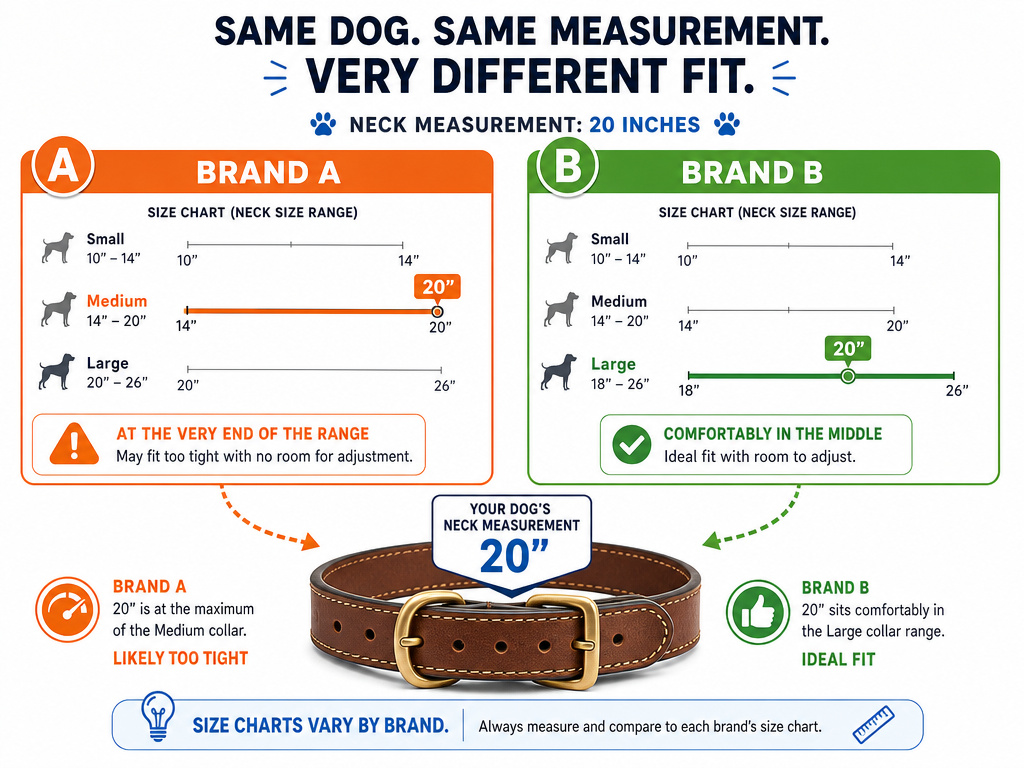
Once you have your dog’s neck measurement, you hit the size charts. This is where standardization ends. One brand’s “Medium” is another’s “Large.” This isn’t incompetence; it’s a reflection of different designs, thicknesses, and buckle placements.
Look for charts that provide a range for both neck size and flat collar length, like TYRAS Dog Gear’s system: – G2: 16 – 20 in (41 – 51 cm) – G3: 19 – 23 in (48 – 58 cm)
If your dog’s neck is 42cm (16.5″), the G2 is the pick. It allows for a comfortable fit in the middle of the range. The goal is to use the middle hole on a new collar. This gives you room to tighten if your dog loses weight or loosen for a winter coat, extending the collar’s usable life before you need to condition a leather dog collar to maintain flexibility.
Where this goes sideways: Choosing the size where your dog is at the maximum of the range. If their neck is 20″ and the collar max is 20″, you have zero room for adjustment or growth. You’ve bought a collar that’s already too small.
Some brands, like Charley Chau, offer “House Collar” sizing, which is intentionally looser. Their rule: for a neck over 16″, add 3 inches. Pay attention to these notes. They exist because a collar meant only to hold an ID tag has a different function than a walking collar. Understanding the types of leather used can also help, stiff full-grain may need more break-in room than supple top-grain.
Special Cases: Puppies, Thick Coats, and Wide Heads
The standard advice assumes a fully-grown dog with a steady weight and a normal coat. Life is rarely that simple.
For a puppy under 12 months, you’re sizing for growth. Choose a size where their current neck measurement is at the bottom of the chart’s range. A 12-month-old dog with a 16.5″ neck should be in a G2 (16-20″), not a G1 (13-17″). Their neck and chest keep developing until about 18 months. You’ll use the tighter holes now and gradually move out. It’s a temporary fit, but better than buying a new collar every three months.
Dogs with dense double coats (Huskies, Malamutes, German Shepherds) can change size seasonally. The winter undercoat might add a full inch to their neck. In fall, size the collar so you’re on the middle holes. By mid-winter, you’ll be on the loosest hole. Come spring, you’ll tighten it back up. This regular adjustment is part of the routine, much like knowing how to clean a leather dog collar after muddy walks.
Dogs with wide heads relative to their neck (Greyhounds, Bulldogs) present a challenge. The collar must be loose enough to slip over the head but snug enough not to slip off when relaxed. For these breeds, a martingale-style collar or a specially designed sighthund cut is often safer than a standard buckle collar. If you’re handy, you could even explore how to make a leather dog collar with a custom taper.
The Final Fit Check and Break-In Period
You’ve measured, consulted the chart, and the collar has arrived. The process isn’t over. Try it on. Perform the two-finger test. Observe your dog.
Does the collar sit high behind the ears without sliding down? Good. Can you fit only one finger underneath? Too tight, you need the next size up or need to punch an extra hole. Does it spin easily? Too loose. Check that the D-ring for the leash is centered on top of the neck, not off to the side.
A new vegetable-tanned leather collar will be stiff. It needs a break-in period of a week or two of regular wear to soften and conform to your dog’s neck. Don’t mistake initial stiffness for poor fit. If it’s still causing discomfort after the break-in, or if you need to soften a leather dog collar significantly, the size or width may be wrong. A collar that’s too wide for a slender neck can chafe at the edges.
Listen for coughing or gagging when the leash is attached and tension is applied. That’s a sign of pressure on the trachea. For strong pullers, consider a harness for walks and reserve the collar for holding ID tags. A rolled leather dog collar is an excellent choice for long-haired breeds, as it minimizes fur matting and breakage.
Frequently Asked Questions
Can I just measure my dog’s old collar?
Sometimes, but it’s risky. This method only works if the old collar is the same thickness, width, and has an identical buckle placement as the new one. As TYRAS Dog Gear states, you should not determine size based on the current collar. A direct neck measurement is always more reliable.
How often should I check the fit?
Check the fit every month. Puppies should be checked every two weeks. Always re-check at the start of a new season if your dog has a seasonal coat. Weight gain or loss of just a pound or two can change neck circumference.
My dog is between sizes. Which should I choose?
If your dog is still growing, choose the larger size. If they’re an adult, consider their coat and activity level. For a mostly indoor dog with a thin coat, the smaller size might be perfect. For an active dog with a thick coat, the larger size offers more flexibility. Some artisans, like Charley Chau, offer custom half-sizes.
Is a wider collar more secure?
Not necessarily. Security comes from correct circumference and sturdy hardware. A collar that’s too wide for a dog’s neck can be uncomfortable, restrict movement, and even cause chafing under the jaw. Match width to dog size: 3/4″ for small dogs, 1″ for medium, 1.5″ for large.
How do I size a collar for a dog that pulls hard?
The sizing principles are the same, but material choice is critical. For heavy pullers, prioritize a strong, thick vegetable-tanned leather and a welded, reinforced D-ring. Make sure the fit is snug (two fingers tight) to prevent any extra force that could hurt their neck. A front-clip harness is often a better training tool for pulling.
Can I add a nameplate later?
Usually, yes. Most leather dog collars with nameplates are designed with the plate in mind, but you can often have one riveted onto a plain collar by a leatherworker or purchased as a separate slide-on tag. Just ensure it doesn’t interfere with the buckle or create an uncomfortable lump.
The Bottom Line
Sizing a leather dog collar boils down to three numbers: your dog’s neck circumference, the thickness of the leather, and the two-finger gap. Ignore any one of them, and the fit will be off.
Start with a soft tape measure and an honest two-finger test. Then, find a quality brand that uses vegetable-tanned leather and provides a clear size chart that accounts for material thickness, like Loyal Canine or an Etsy artisan using Hermann Oak. Fit the collar to the middle hole on day one. That gives you a margin for error in both directions.
Finally, remember that a collar is not a set-and-forget item. Check it monthly. Condition it when it feels dry, especially under the buckle. A well-sized, well-maintained leather collar isn’t just a piece of gear; it’s a record of your shared walks that will last for years. That’s the point of getting it right.
