
Bonded Leather vs Genuine Leather | What Actually Peels
This post contains affiliate links. As an Amazon Associate, we earn from qualifying purchases.
The difference between bonded leather vs genuine leather is a structural question, not a matter of preference. Bonded leather is a composite of leather dust, polyurethane adhesive, and a fabric backing, designed to look like leather but built to fail in 2-5 years. Genuine leather is tanned animal hide, ranging in quality from durable full-grain to the lower-quality split leathers often sold under the “genuine” label.
That gap, between a composite sheet and a whole hide, decides whether your sofa lasts five years or twenty. The failure isn’t random wear; it’s a predictable chemical process written into the bonded material at the factory. Understanding this means you stop comparing apples to oranges and start looking at what you’re actually buying.
What follows: a breakdown of what each term legally means, the sourced timeline for bonded leather’s inevitable delamination, and a direct comparison of why one can be repaired for decades while the other is trash after the first peel. The goal is to give you the tests you can use before you buy.
Key Takeaways
- Bonded leather is not a type of leather; it’s a composite material containing 10-30% leather fibers bound with polyurethane glue to a backing. Its failure is chemical, not physical.
- “Genuine leather” is a legal truth-in-labeling term (per the FTC) meaning the product is made from animal hide, but it includes low-quality, coated split leathers prone to their own peeling.
- The primary failure mode for bonded leather is hydrolysis: moisture attacks the polyurethane topcoat, making it brittle and causing the adhesive layer to fail, leading to sheets peeling off.
- Expect bonded leather on daily-use furniture to begin peeling within 12-60 months. Genuine leather (even lower-grade) can last 10-20 years with proper care.
- No repair is possible once bonded leather starts peeling. The adhesive failure occurs between incompatible layers, making any filler temporary at best.
What Is Bonded Leather? (And What It Is Not)
Let’s be clear about one thing. Bonded leather is not leather in any structural sense. Calling it a type of leather is like calling particleboard a type of solid oak, it contains wood, but it doesn’t behave like wood.
Bonded leather is a manufactured composite of ground leather scraps (10-30% by weight), polyurethane binder, and a fabric or paper backing, topped with an embossed polyurethane coating. Its tensile strength (8–15 N/mm²) is less than half that of genuine leather (20–40 N/mm²), confirming its lack of a continuous, strong fiber network.
The process is industrial recycling. Off-cuts and dust from real leather production are pulverized, mixed with liquid polyurethane adhesive, spread onto a cloth sheet, and run through a press. A final polyurethane film is laminated on top and stamped with a fake grain pattern. The result is a sheet material sold by the yard.
This construction creates its fundamental weakness. In real leather, collagen fibers are interlocked in a three-dimensional matrix. That matrix is what gives leather its strength, breathability, and ability to flex without cracking. In bonded leather, those fibers are isolated fragments suspended in glue. There is no interconnected structure to distribute stress. The Wikipedia entry on bonded leather notes the material can vary widely, and higher-quality versions exist, but the core limitation remains.
Where does it fit, then? Its best uses are in low-stress, decorative applications: book covers (like those thin Bible covers), portfolio linings, or low-cost accessory details. It is entirely wrong for any item expecting sustained flexing, compression, or friction, sofa seats, office chair arms, or daily-wear belts.
The smell test never lies. Fresh bonded leather has a faint, sweet plastic odor, sometimes with a whisper of leather underneath from the embedded fibers. Real hide smells organic, tannic, and deep. Your nose knows the difference before your eyes do.
What “Genuine Leather” Actually Means (Legally and Practically)
If bonded leather is not leather, what does “genuine leather” guarantee? Less than you think, but more than bonded offers.
Legally, in the United States, the term is governed by the FTC leather labeling guides. “Genuine leather” means the product is made from animal hide. That’s it. It does not promise quality, durability, or that it’s made from the best part of the hide. It simply means it’s not synthetic.
In practice, “genuine leather” on a mid-market bag or sofa most often refers to coated split leather. Here’s the breakdown: a cowhide is split horizontally. The top, dense layer becomes full-grain or top-grain leather. The lower, spongier layer is the split. To make it usable, manufacturers sand it smooth and apply a heavy pigment or polyurethane coating to create a uniform surface. This is the material that leads to the “my bag is peeling” complaints after 6-18 months.
Common mistake: Buying a “genuine leather” item expecting heirloom quality. The term is a minimum content claim, not a quality grade. For durability, you need to ask for the next tier up: top-grain or full-grain.
So genuine leather is real hide, but it can be the weakest part of that hide, doctored to look presentable. It breathes better than bonded leather and can be conditioned. However, once that plastic-like coating cracks, and it will from flexing, the damage is severe because the loose fibers beneath have little strength. Understanding the genuine leather pros and cons is key to setting realistic expectations.
The European standard (EN 15987:2011) tries to clarify things. It states that “bonded leather” must contain at least 50% dry leather by weight. But in the US, no such minimum exists, which is why you find bonded products with as little as 10% leather content. The FTC only recommends disclosing percentages to avoid misleading consumers, a recommendation many brands ignore.
Side-by-Side: How They Fail (And Why One Is Irreparable)
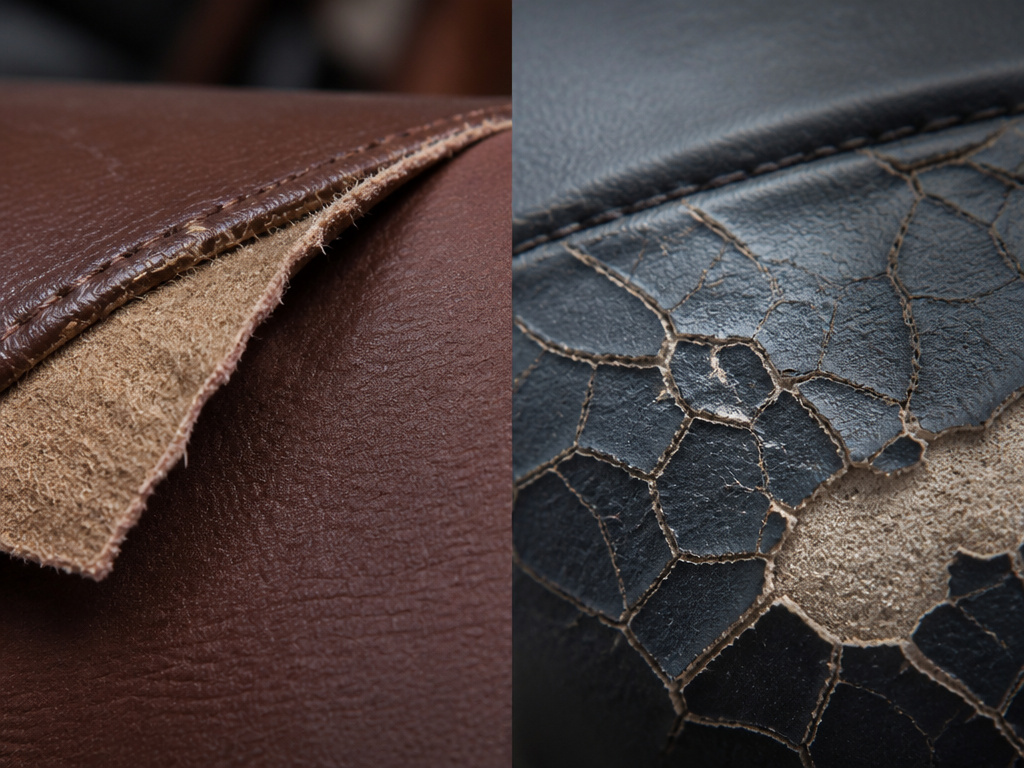
Both can peel. The difference is in the mechanism, the timeline, and the possibility of a fix.
Bonded Leather Failure: Chemical Delamination
The peeling is a foregone conclusion, a built-in chemical expiry date. The process is called hydrolysis. 1. Stage 1 – Hydrolysis: The polyurethane topcoat is an ester-based polymer. Ambient humidity, body moisture, or cleaning products provide water molecules that attack and break the polymer chains. The coating loses flexibility, becomes brittle, and micro-cracks. 2. Stage 2 – Adhesive Failure: Stress from sitting and flexing now transfers to the adhesive layer bonding the PU film to the backing. This industrial glue wasn’t designed for dynamic stress. It fails, and the top layer peels away in sheets, starting at high-stress points: seat edges, armrests, fold lines.
The timeline is sourced from furniture repair data: visible cracking can start in 12-24 months, with full peeling rendering the item unusable within 2-5 years. In humid climates, this accelerates. The process is exponential, once a corner lifts, peeling spreads fast.
Genuine Leather (Coated Split) Failure: Coating Fatigue
Here, the failure is mechanical, not chemical. The polyurethane or pigment coating is sprayed onto the surface of the split leather. Every time you flex the item, the coating stretches slightly less than the leather beneath. After thousands of flex cycles, the coating fatigues and cracks. Once it cracks, it exposes the weak, fibrous split beneath, which can then fray and peel back. This is the primary cause of leather peeling on lower-cost leather goods.
| Failure Aspect | Bonded Leather | Genuine Leather (Coated Split) |
|---|---|---|
| Primary Cause | Chemical hydrolysis of PU adhesive | Mechanical fatigue of surface coating |
| Onset | 12-60 months (humidity-dependent) | 6-18 months (use-dependent) |
| Repairable? | No. Adhesive failure between layers is permanent. | Possibly. Can be refinished if caught early, but coating must be stripped. |
| Post-Failure State | Layers separate; fuzzy backing exposed. | Coating cracks; fibrous, weak split layer exposed. |
The irreparability of bonded leather is critical. A repair technician’s filler bonds to the peeling PU layer. But that layer is no longer attached to the backing. The first time you sit down, the repair shears off. It’s like trying to plaster over a detached wallpaper flap.
The Real Lifespan & Cost Per Year

Forget the sticker price. The real cost is the price divided by the number of years you get to use it before it becomes trash. This is where the math becomes brutally clear.
Let’s run the numbers with sourced lifespans. A bonded leather sofa might cost $800. Industry data and repair logs show a typical lifespan of 3 years in daily use before delamination makes it unsightly. That’s a cost of $267 per year, and at the end of year three, you have zero residual value, just a bulky item for landfill.
A sofa in a decent top-grain leather might cost $2,500. With basic conditioning every 12-18 months, a realistic lifespan is 15 years. That’s $167 per year. At year 15, it’s still a functional, comfortable sofa, and it could easily last another decade. The per-year cost is lower, and you have an asset, not waste.
The cheapest option long-term is often the higher upfront investment. This is the economic trap of bonded leather: the apparent savings vanish when you factor in the replacement cycle. This is a key consideration when weighing the advantages and disadvantages of bonded leather.
Where this goes sideways: Buying bonded leather for a primary living space. You’re budgeting for a disposable item, not furniture. For a home office chair or a kid’s playroom, maybe that’s fine. For a main sofa you want for a decade, it’s a financial misstep.
This cost analysis also highlights why it’s worth learning the difference between full-grain and genuine leather. The higher initial cost of full-grain spreads over so many more years that its annual cost often beats bonded.
How to Spot Bonded Leather Before You Buy (5 Field Tests)
You don’t need to be an expert. You need a keen eye and two minutes in the showroom. Perform these tests on a sample swatch or an inconspicuous area.
- The Edge Test: Look at a cut edge or the underside of a cushion. Genuine leather shows a solid, consistent cross-section, like a slice of meat. Bonded leather shows distinct layers: a top film, a visible glue line, and a fabric or paper backing. The edge often looks fuzzy.
- The Grain Pattern Test: Crouch and look across the surface at a raking angle. Real leather has random, irregular pores and grain, no two panels are identical. Bonded leather has a perfectly uniform, repeating pattern stamped by a machine. Every inch looks the same.
- The Flex & Crease Test: Gently pinch and fold the material (ask permission first). Genuine leather forms soft, natural creases that relax. Bonded leather resists, then forms a sharp, whitish crease, the micro-cracks in the PU film. This is a dead giveaway.
- The Temperature Test: Place the back of your hand on the surface for 10 seconds. Leather, being a conductor of heat, warms up quickly from your body heat. Bonded leather, insulated by the plastic coating, stays noticeably cooler.
- The Question Test: Ask the salesperson directly: “Is this full-grain, top-grain, or bonded leather?” Watch their reaction. Hesitation, euphemisms like “leather match,” or a fallback to just “genuine leather” are red flags.
These tests will help you identify real leather and avoid the bonded trap. If you already own a peeling piece, understanding that it’s likely bonded confirms it’s not repairable, saving you the cost and hope of a futile repair attempt.
Better Alternatives: What to Buy Instead
If bonded leather is a short-term composite and “genuine” often means low-grade coated split, what should you actually look for? Your choice hinges on budget and longevity needs.
For Long-Term Durability & Value: * Full-Grain Leather: The outer layer of the hide, untouched. It develops a patina, shows natural markings, and has the highest tensile strength. It’s the benchmark. Brands like Wickett & Craig or Horween are tanneries known for quality. * Top-Grain Leather: The same outer layer, lightly sanded to remove imperfections and then dyed. It’s more uniform than full-grain but nearly as durable. This is the workhorse of quality furniture and bags.
For Budget-Conscious & Performance Needs: * Quality PU Leather: A 100% synthetic polyurethane material. Don’t confuse it with bonded. Modern PU leather is consistent, easy to clean, and won’t deluminate because it’s a single material. It’s a great choice for households with kids or pets, or for items like headphones or electronics cases where pure aesthetics matter. * Heavy-Duty Fabric: Don’t overlook high-performance textiles like Sunbrella or Crypton for upholstery. They often outlast bonded leather, are easy to clean, and won’t peel.
The middle ground, where bonded leather often lurks, is a no-man’s-land. You’re paying nearly as much as for low-end genuine leather or good PU, but getting the worst performance of both. Skip it. If your budget is tight, a good faux leather alternative or fabric will serve you better. If you want the real thing, save a bit longer for a true top-grain piece.
Here’s the practical takeaway. Bonded leather and genuine leather aren’t two points on the same spectrum. They’re different categories of material. One is a temporary composite; the other is a permanent, natural material that comes in different grades. Choose the category first, then the grade within it.
Frequently Asked Questions
Is bonded leather real leather?
Technically, yes, because it contains leather fibers. Structurally and functionally, no. It lacks the continuous collagen network that gives real leather its strength, breathability, and longevity. It behaves like a plastic composite, which is why it fails by peeling.
How long does bonded leather last?
Under daily use, expect visible cracking within 12-24 months and peeling that renders the item unusable within 2-5 years. Humidity, heat, and frequent use accelerate this timeline. It is a material with a planned, short lifespan.
Can you repair peeling bonded leather?
No. Once the adhesive layer fails and peeling starts, the material is irreparable. Any filler or paint bonds to the already-detached top layer, which will shear off again with the next flex. Professional repair shops consider it a terminal condition.
What’s the difference between bonded leather and bicast leather?
They are similar but distinct. Bicast leather starts with a solid split leather base, which is then coated with a thick polyurethane layer and embossed. Bonded leather starts with leather dust and glue. Both have a plastic topcoat and both delaminate, but bicast may feel more substantial initially.
Is vegan leather the same as bonded leather?
No. Vegan leather is a broad term for non-animal materials, most commonly PU or PVC. Bonded leather contains animal-derived fibers. Vegan leather is entirely synthetic, which can be more consistent and less prone to the specific hydrolysis failure of bonded materials.
The Bottom Line
The choice between bonded and genuine leather isn’t about good vs. Better leather. It’s about whether you’re buying a disposable composite or a maintainable natural material.
Bonded leather has one advantage: a low initial price. Every other metric, durability, repairability, comfort, and long-term value, favors skipping it. If your budget only allows for that price point, buy a synthetic or fabric from a brand like Carhartt instead. You’ll get more years for the same money.
Genuine leather, even in its lower-grade forms, is a real material that can be cared for and can last. Your job is to look past the “genuine” label and ask what’s underneath: is it a robust top-grain or a thin, coated split? That question matters more than the umbrella term.
The leather will tell you what it needs, and what it’s made of, if you know how to look. Spend those two minutes doing the edge test and the flex test. Your nose and your fingers are the best tools you have to avoid a purchase you’ll regret in eighteen months.
