
What Is Leatherette | The Plastic Fabric Behind the Name
This post contains affiliate links. As an Amazon Associate, we earn from qualifying purchases.
Leatherette is a specific type of artificial leather made by coating a fabric base, usually polyester, with a layer of plastic, most commonly polyurethane (PU) or polyvinyl chloride (PVC). It is designed to mimic the look and feel of real leather at a lower cost, but lacks leather’s natural breathability, durability, and ability to develop a patina.
That plastic coating is the whole game. It determines everything from how the material feels to how long it lasts before the surface cracks and flakes. Unlike a hide, which is a single, fibrous material, leatherette is a laminate. The fabric backing provides the structure, and the plastic topcoat provides the leather-like appearance. This construction creates inherent trade-offs in performance and longevity that you won’t find in genuine leather.
What follows is a breakdown of what leatherette actually is, not what marketers sometimes claim it to be. We’ll look at the two main types (PU and PVC), how they’re made, the standards that govern them, and how they stack up against both real leather and newer plant-based alternatives. By the end, you’ll be able to spot the difference instantly and understand exactly what you’re buying.
Key Takeaways
- Leatherette is a plastic-coated fabric, not a monolithic material like leather. Its performance hinges on the quality of that plastic layer.
- Polyurethane (PU) leatherette is generally more flexible and less prone to cracking than older Polyvinyl Chloride (PVC) versions, but both are petroleum-based and non-biodegradable.
- International standards like GB/T 8949-2025 define its production, while regulations like EN 15987 restrict misleading marketing terms in some regions.
- Its functional lifespan is often shorter than real leather; it typically fails via coating delamination or surface cracking, not wear.
- Understanding bonded leather composition helps clarify that leatherette is a different, often more durable, category of synthetic.
What’s In a Name? Decoding the Leatherette Label
The term “leatherette” itself is instructive. The “-ette” suffix denotes something small or imitative. It’s a direct label for an imitation product. You’ll also see it called faux leather, vegan leather, PU leather, or pleather. This isn’t just casual slang; in some jurisdictions, what you can call it is regulated. The European standard EN 15987 explicitly restricts the use of terms like “artificial leather,” “imitation leather,” and “synthetic leather” in commercial labeling to prevent consumer confusion. The goal is clarity: if it’s not from an animal hide, don’t use a name that implies it is.
The Wikipedia entry on leatherette provides a solid technical baseline, defining it as a material intended to substitute for leather where cost or ethical concerns are primary. But that definition covers a vast quality spectrum. A cheap PVC-coated book cover and a high-performance polyurethane used in automotive seating both fall under the leatherette umbrella, yet they will age and perform worlds apart. The common thread is the method: a fabric base plus a plastic skin.
The legal naming framework, such as EN 15987, exists because the surface finish of a high-quality PU can be visually convincing. Without clear labeling, a buyer might mistake a plastic product for a lower-grade genuine leather, which itself has a completely different aging profile and care regimen.
The Anatomy of Imitation: PU vs. PVC
Not all plastic coatings are equal. The two giants in leatherette production are Polyurethane (PU) and Polyvinyl Chloride (PVC). Understanding this split is the first step to judging quality.
Polyurethane (PU) Leatherette is the modern, more flexible standard for upholstery, clothing, and higher-end accessories. The polyurethane coating is typically applied in thinner, more pliable layers. It breathes slightly better than PVC (though still poorly compared to leather) and has a softer hand-feel. Over time, high-quality PU is more resistant to cracking because the polymer itself has more stretch. It’s the type referenced in the Chinese national standard GB/T 8949-2025 for polyurethane artificial leather, which specifies everything from thickness tolerance to testing methods for abrasion and cold resistance.
Polyvinyl Chloride (PVC) Leatherette is the older, more rigid cousin. You know it as “vinyl.” It’s cheaper to produce and gives a glossy, uniform finish that was popular in mid-century furniture and low-cost goods. The downside is plasticizers, chemicals added to keep it flexible. These can migrate to the surface or evaporate over years, leaving the material brittle. A stiff, vintage car seat or a cracking cheap purse is often a victim of dried-out PVC. It feels cold to the touch and has virtually no breathability.
| Coating Type | Best For | Key Limitation | Failure Mode |
|---|---|---|---|
| Polyurethane (PU) | Automotive interiors, footwear, modern upholstery | Can delaminate from fabric base under stress | Surface scuffs, then coating peel |
| Polyvinyl Chloride (PVC) | Low-cost goods, retro finishes, waterproof items | Becomes brittle as plasticizers evaporate | Deep cracks, color loss, stiffness |
The choice between them often comes down to budget and application. For a car seat that needs to withstand sun and friction, a premium PU is the industry pick. For a disposable fashion item, PVC might be the cost-effective choice. But neither develops character. They just degrade.
How It’s Made: The Layer Cake
Leatherette manufacturing is a process of assembly, not transformation. It starts with a roll of fabric, almost always a polyester knit or woven scrim. This provides the tensile strength. The fabric is fed through a coating line where liquid plastic, either PVC paste or PU in a solvent, is applied. For PU, this is often done with a release paper technique: the polymer is spread onto a patterned paper, partially cured, then laminated to the fabric. The paper grain transfers a leather-like texture to the surface.
This is where standards like GB/T 8949-2025 come into play. This standard doesn’t just say “make polyurethane leather.” It specifies the allowed deviation in thickness (you can’t have spots that are too thin), mandates no negative deviation in width or length (your roll can’t be undersized), and outlines how to test for everything from abrasion resistance to hydrolysis resistance. The existence of such a detailed standard tells you this is a precise industrial product, not a natural material with inherent variation.
The process concludes with finishing: embossing for texture, coloring, and sometimes a topcoat for scuff resistance. The entire operation is clean, repeatable, and scalable. It produces miles of consistent material with none of the scars, stretch marks, or natural grain variation that define full grain leather. That consistency is its greatest commercial strength and its biggest aesthetic giveaway to a trained eye.
The Standards That Define (and Test) It
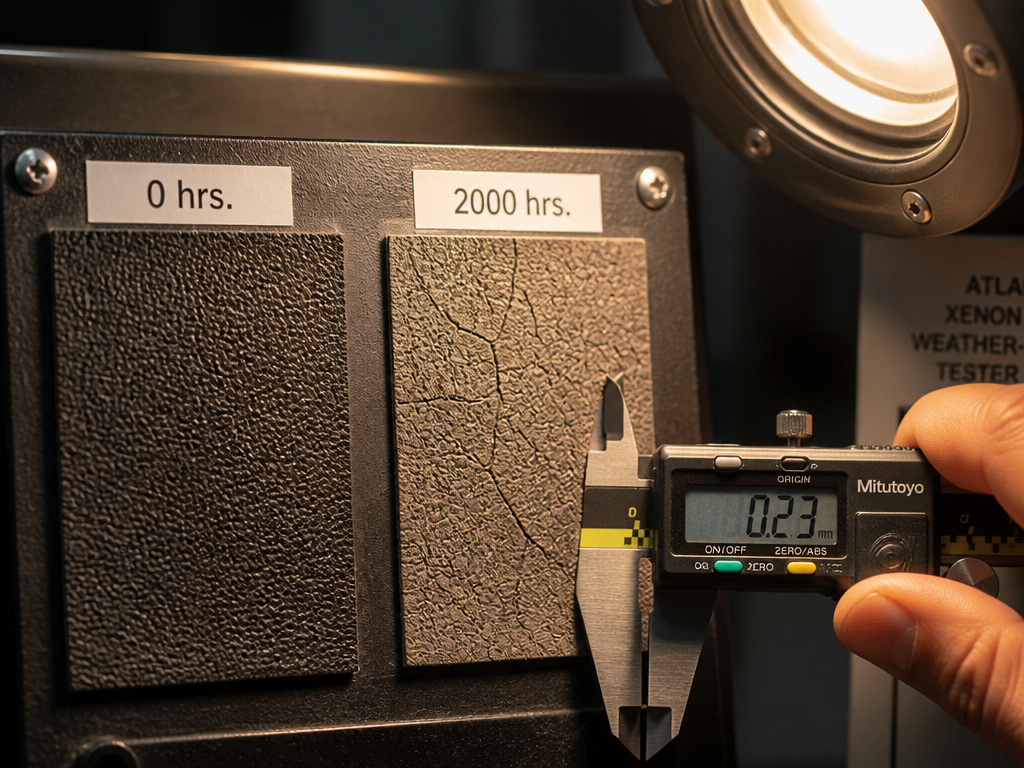
Because it’s a manufactured product, leatherette’s quality is quantified. You can’t talk about “good” leatherette without referencing the test methods that measure it. These standards are the language of durability.
- GB/T 8949-2025 (Polyurethane Artificial Leather): The complete Chinese standard. It’s a blueprint covering every production aspect.
- ASTM G 24 / SAE J2412: Weathering standards. ASTM G 24 covers natural weathering under glass, while SAE J2412 is for artificial weathering of automotive materials. These tests simulate years of sun and heat exposure in weeks. A material that passes will resist fading and cracking longer.
- ISO 20942: While focused on leather for footwear, its metrics are revealing. It sets a comfortable benchmark for breathability (water vapor permeability >>0.8 mg/(cm² × h)). Most leatherette fails this test miserably. Your feet sweat in faux leather shoes because the plastic doesn’t breathe.
The SAE technical paper on weathering directly compares how these materials degrade. The data shows that while modern PU performs admirably in accelerated tests, its failure mechanisms are different. Leather may soften and patina; leatherette’s coating may simply lose adhesion or develop micro-cracks that can’t be conditioned away.
Leatherette vs. The Leather World
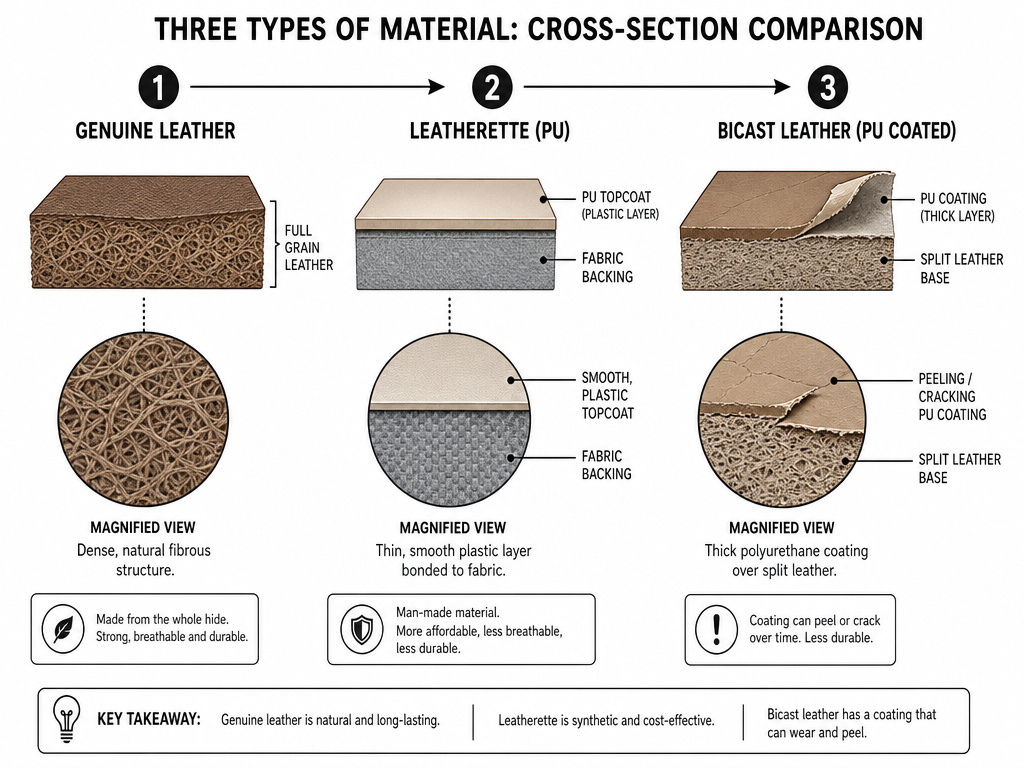
It’s easy to lump all non-hide materials together, but that’s a mistake. Leatherette occupies a distinct space compared to both genuine leather and other synthetic substitutes.
Vs. Genuine Leather: This is the core comparison. Leather is a collagen fiber network. It’s permeable, strong, and repairable. You can sand, dye, and refinish it. Leatherette is a composite. When the 0.5mm plastic topcoat wears through, you see the plain grey fabric underneath. There’s no patina, only wear. The differences between bonded and genuine leather are one thing, but leatherette is a different category entirely. It’s often more durable than the lowest-grade bonded leather, which can literally crumble, but it will never match the lifespan of a well-made top grain leather item.
Vs. Bicast Leather: Don’t confuse them. Bicast leather starts with a split leather base (real leather) and then coats it with a thick polyurethane layer to look like a better grade. It’s a hybrid, and its failure, the plastic peeling off the leather, is uniquely disappointing. Leatherette never pretended to have a leather core.
Vs. New-Gen Alternatives: Materials like Mirum (rubber-based) or cactus leather are often grouped under “vegan leather.” But their composition and end-of-life profile are fundamentally different. They are not plastic-coated fabrics. This is a crucial distinction that gets lost in marketing.
Performance Realities: Where It Works and Where It Fails
Let’s be clear about one thing: leatherette has its place. It’s a fantastic material for applications where consistency, cleanability, and low cost are paramount. But you have to match the material to the mission.
Where it works:
- Automotive Interiors: Modern automotive-grade PU leatherette is a minor miracle. It withstands UV, abrasion from sliding in and out, and temperature swings. It’s easy to clean and uniform across every seat in the production line. This is leatherette at its most engineered.
- Mass-Market Furniture: For a family sofa that needs to survive spills and kids, a durable PU is a pragmatic choice. It won’t develop the character of leather, but it also won’t show water rings.
- Protective Covers & Accessories: For items like camera cases or book covers, as noted in the Cambridge Dictionary definition, its water resistance and structural rigidity are assets.
Where it fails:
- High-Flex Areas: On footwear uppers or soft luggage that gets crumpled, the constant bending stresses the bond between coating and fabric. Delamination starts as bubbling.
- Long-Term Heirloom Items: If you want a bag or jacket that looks better in five years than it does today, this isn’t your material. It follows a one-way path to deterioration.
- When Treated Like Leather: This is the most common mistake. Using leather conditioner on leatherette does nothing for the plastic and can degrade the adhesives. It’s like oiling a plastic bag.
Common mistake: Assuming all “vegan leather” is the same. A polyurethane leatherette jacket and a waxed canvas jacket are both vegan, but one is a plastic laminate and the other is a natural, breathable, and repairable textile. Their care and lifespan are incomparable.
The advantages of bonded leather are largely economic, but the advantages of a PU leatherette with a high rub count and a polyurethane topcoat are functional: uniformity, colorfastness, and stain resistance. The disadvantages, however, are terminal. You can’t re-dye cracked plastic.
The Environmental and Ethical Equation
This is the most contested ground. The ethical appeal of leatherette is obvious: no animal use. The environmental reality is more complicated.
Most leatherette is fossil-based. Its fabric backing is polyester, a plastic. Its coating is polyurethane or PVC, more plastics. It is not biodegradable. At end-of-life, it’s a composite material that’s difficult to recycle, the fabric and plastic are fused. It often ends up in landfill where it will persist for centuries.
Compare that to vegetable-tanned leather, which is a by-product of the meat industry (the hide would otherwise be waste) and, while its tanning has an impact, the finished product is durable, biodegradable, and develops a patina that encourages long-term use. The most sustainable item is often the one you keep for decades.
This isn’t to say all leather is saintly or all synthetics are evil. It’s to underscore that “vegan” does not automatically mean “eco-friendly.” Some of the most promising developments are in next-gen materials like Mirum or mushroom leather, which aim for circularity and biodegradability without petroleum. They should be evaluated on their own specs, not lumped in with standard leatherette.
Caring for Plastic (Because That’s What It Is)
Care is where the imitation truly parts ways with the original. Forget oils and waxes.
Do:
- Clean with a damp microfiber cloth and a mild, non-abrasive detergent.
- Dry immediately to prevent moisture from seeping into fabric seams.
- Use protectants designed for vinyl or plastic if you want a barrier against stains.
Don’t:
- Use saddle soap, mink oil, or any leather conditioner. They will sit on the plastic, potentially making it greasy, and do nothing.
- Scrub with abrasive pads or stiff brushes. You’ll scratch the finish.
- Assume it will age gracefully. Protect it from excessive sun and heat to slow plasticizer loss and cracking.
Your goal isn’t nourishment; it’s surface preservation. Once that topcoat is breached, the countdown to total failure accelerates. This is the opposite of leather care, where the right products can actually restore and strengthen the material over time.
Frequently Asked Questions
Is leatherette the same as vegan leather?
Not exactly. “Vegan leather” is an umbrella term for any non-animal leather alternative. Leatherette specifically refers to plastic-coated fabrics (PU or PVC). Other vegan options include cork, pineapple leaf fiber (Piñatex), and mushroom leather, which have different compositions and environmental profiles.
How long does leatherette furniture last?
It depends on quality and use. A cheap PVC leatherette sofa might show significant cracking in 3-5 years with daily use. A high-quality automotive-grade PU used in a living room setting could last 7-10 years or more before noticeable wear. Sunlight and heat are its biggest enemies.
Can you repair torn or scratched leatherette?
Minor scratches can sometimes be masked with a colored vinyl repair kit, which is essentially a filler and matching paint. A torn or delaminated section is almost impossible to repair invisibly. Unlike leather, you can’t stitch a patch behind it and blend the repair; the plastic coating won’t accept traditional leatherworking techniques.
Is leatherette waterproof?
The plastic coating makes it highly water-resistant. A spill will bead up and wipe off the surface. However, water can still penetrate through stitching holes, zippers, or any unsealed edge and soak the fabric backing inside, which can lead to mildew or adhesive failure.
How can I tell if something is real leather or leatherette?
Use your senses. Look at the back: leather will have a fibrous, suede-like back, while leatherette will show a woven fabric. Feel it: leather will be warm and supple; leatherette often feels cooler and more uniformly smooth. Smell it: leather has a distinctive, organic smell, while leatherette smells like plastic or chemicals. The genuine leather tests are worth knowing.
The Bottom Line
Leatherette is a tool, not a treasure. It’s a manufactured material engineered for specific jobs where consistency, cleanability, and low initial cost are the driving factors. It will never breathe like leather, repair like leather, or age with anything but cosmetic decline.
For the buyer, the rule is simple: understand what you’re getting. If you need a spill-proof, easy-clean sofa for a busy home, a good PU leatherette is a rational choice. If you’re looking for a belt, bag, or jacket that you hope will last twenty years and tell a story, invest in quality genuine leather and learn its care.
The most sustainable choice is often the durable one you keep. Sometimes that’s a well-made plastic. Often, it’s not. Let the material’s true nature, not its imitation grain, guide your decision.
