
Key Types of Leather Boots: The Build Quality That Defines Them
This post contains affiliate links. As an Amazon Associate, we earn from qualifying purchases.
Types of leather boots are defined by three things: the leather grade (full-grain, suede, etc.), the construction method (Goodyear welt, Blake stitch, cemented), and the intended purpose (work, dress, hiking). The construction method is the single biggest predictor of lifespan, a welted boot can be resoled and last decades, while a cemented boot is often disposable after 2–4 years.
That lifespan gap isn’t theoretical. It’s the difference between a purchase and an investment. Most guides list styles and stop there. They don’t explain why a $300 boot can cost less per year than a $150 boot, or how to spot the difference before you buy.
What follows is a breakdown of the leathers, the constructions, and the specs that actually matter. By the end, you’ll be able to read any boot’s product description in ten seconds and know exactly what you’re getting into.
Key Takeaways
- Construction decides everything. Look for visible stitching around the welt, that’s your sign of a resoleable, long-term boot (Goodyear welt, Blake stitch). No stitching means cemented construction and a planned expiration date.
- Full-grain leather is the default for durability. It’s the top layer of the hide, untouched. For outdoor and work boots, look for sourced specs: thickness over 1.8mm, tensile strength ≥20 N/mm², and tear resistance ≥260 N.
- Cemented boots have a hard lifespan cap. The adhesive bond typically fails after 2–4 years of regular use, making resoling impractical. For fashion boots you’ll replace soon, that’s fine. For daily drivers, it’s a deal-breaker.
- Suede and nubuck need a different calculus. They’re softer and more breathable but less abrasion-resistant. They’re suitable for casual and light hiking use but often require reinforcements for heavy-duty mountain or work boots.
- Your purpose narrows the field instantly. Need physical protection and all-day support? That’s a work or hiking boot, demanding full-grain leather and a welted or stitchdown construction. Need a versatile office boot? A Blake-stitched Chelsea or chukka boot covers it.
Leather Types: It’s About Layers and Treatment
Forget exotic names for a second. All boot leather starts as an animal hide, and the part of the hide used, plus how it’s finished, defines its character and capability.
Full-grain leather is the top layer of the hide, with the natural grain completely intact. It hasn’t been sanded or buffed. This is the most durable grade you can get. The fibers are dense and tightly packed, which translates directly to higher abrasion resistance and better natural water resistance. Over time, it develops a patina, a rich, darkened sheen from use and care that tells the story of the boot.
Technical Snapshot: For mountain boots, tanneries like Perwanger specify full-grain leather at 2.5mm thick, with a tensile strength ≥20 N/mm² (UNI EN ISO 3376:2020) and tear resistance ≥260 N (UNI EN ISO 3377-2:2016). These aren’t marketing terms; they’re verified performance ceilings.
Top-grain leather is full-grain that’s been lightly sanded to remove surface imperfections, then given a protective finish coat. It’s more uniform in appearance and slightly softer out of the box, but that sanding removes some of the toughest, densest fibers. It’s a common choice for mid-range dress boots where a pristine look is prioritized over maximum longevity.
Suede is cut from the inner layer of the hide (the “split”). This creates its signature soft, napped surface. It’s lightweight, breathable, and has a distinct casual elegance. The trade-off is immediate: the deeper split has a lower fiber density.
Where this goes sideways: Using suede for a heavy-duty work boot. The Leather Naturally processing guide and tannery specs note that suede’s lower density means limited abrasion resistance. For serious outdoor use, it usually requires combination with synthetic reinforcements, and its service life under heavy load is shorter.
Nubuck is often confused with suede, but it’s different. It starts as full-grain leather, and the grain side is then lightly sanded to create a velvety nap. You get the soft feel of suede with much higher durability because you’re starting with the tough top layer. It’s a premium choice for quality hiking boots and rugged casual styles.
| Leather Type | Source Layer | Surface | Best For | Key Trait |
|---|---|---|---|---|
| Full-Grain | Top (grain) | Smooth, natural | Work, hiking, heritage | Maximum durability, develops patina |
| Top-Grain | Top (sanded) | Smooth, uniform | Dress, casual | Balance of looks and durability |
| Nubuck | Top (sanded grain) | Velvety nap | Hiking, casual | Durability of full-grain with soft feel |
| Suede | Inner (split) | Soft nap | Casual, fashion | Lightweight, breathable, classic look |
Here’s the thing. A “genuine leather” label is virtually meaningless for judging quality. It’s a technical term for real leather, but it encompasses everything from thin splits to coated composites. It tells you it’s not plastic, but it doesn’t tell you how long it will last. When you’re selecting the right boots, look past that label and ask for the specific type.
Boot Construction Methods: Goodyear Welt, Blake Stitch, and Cemented
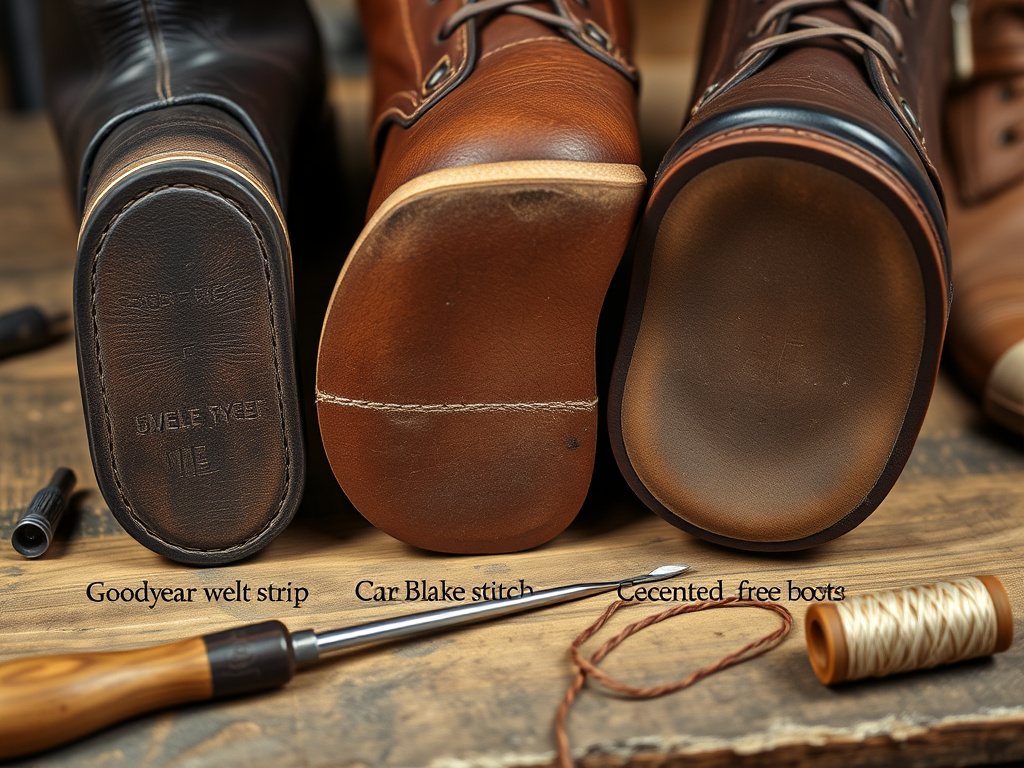
This is the section that separates a lifetime boot from a seasonal one. The way the sole is attached to the upper is the single most important factor determining longevity, water resistance, and ultimately, cost per wear.
Goodyear Welt is the gold standard for resoleability and durability. A strip of leather (the welt) is stitched to the upper and the insole. The outsole is then stitched to the welt. This creates two separate stitch lines, and the gap between them is often filled with a cork midsole that molds to your foot.
- The result: The sole can be worn down, cut off, and a new one stitched on without damaging the upper. This process can be repeated 3-5 times.
- How to spot it: Look for a visible stitch running along the perimeter of the boot, connecting a strip of material (the welt) to the sole.
- The feel: It has a more substantial, structured feel. Break-in takes longer, think 80-100 hours of wear.
- Best for: Work boots, heritage boots, hiking boots, and any style you plan to wear for years.
Blake Stitch offers a sleeker, more flexible profile. A single stitch runs directly through the insole, connecting the upper to the outsole. There’s no exterior welt, so the silhouette is trimmer and closer to a dress shoe.
- The result: It is resoleable, but it requires a specialized machine that not every cobbler has. The direct stitch can be slightly less water-resistant than a Goodyear welt.
- How to spot it: Look for a single, often finer, stitch visible on the sole’s edge, directly connecting to the upper with no intervening welt strip.
- The feel: Softer and more flexible from day one, with minimal break-in.
- Best for: Dress boots, Chelsea boots, and sleek Italian-style boots where a low-profile look is key. It’s a hallmark of many high-quality Italian leather boots for women and men.
Cemented (Adhesive) Construction is the most common method in mass-market footwear. The sole is bonded to the upper with industrial-strength adhesive. There is no structural stitching.
- The result: When the sole wears out or the adhesive bond fails, the boot cannot be economically resoled. Its life ends with the sole.
- How to spot it: The sole edge is clean. There is no visible stitching connecting the sole to the upper.
- The feel: Lightweight and comfortable immediately.
- The timeline: The adhesive bond typically degrades and fails after 2–4 years of regular use. Extreme heat or chemical exposure can accelerate this.
Common mistake: Buying a cemented construction boot for daily heavy use. You’re locking in a replacement cycle of a few years. For a fashion boot worn occasionally, that’s a reasonable trade-off for lower cost and lighter weight. For a boot you’ll rely on, it’s a false economy.
The math is straightforward. A $350 Goodyear-welted boot resoled three times over 15 years costs about $65-$90 per year. A $150 cemented boot replaced every three years costs about $50 per year, but you never own a broken-in, molded pair, you’re always breaking in a new one. The welted boot is the cheaper, better long-term play.
Matching Boot Type to Purpose: A Decision Matrix
You don’t buy a racing bike for a mountain trail. Boots are the same. The style name gives you a shape, but the purpose dictates the required materials and construction. This is where your boot selection guide becomes actionable.
Let’s break down three major categories.
Work & Logger Boots: Built for Abuse
The priority here is protection, support, and sheer durability over a 12-hour shift. Everything is amplified.
Essential specs: Full-grain leather (2.2mm+ thickness), Goodyear welt or stitchdown construction, a defined safety toe (steel, alloy, or composite meeting ASTM F2413-24), and a thick, lugged rubber sole (like Vibram). * Why it matters: The leather thickness handles abrasion from tools and debris. The welted construction allows repeated resoling as the lugs wear down from concrete. The safety toe is certified PPE. When choosing work boots, these aren’t nice-to-haves. * Lifespan expectation: With proper care and periodic resoling, 10-15 years of professional use is realistic. For casual wear, 25-30 years.
Hiking & Trail Boots: The Balance of Support and Climate
A hiking boot must be tough, waterproof, and breathable. It’s a climate-control system for your foot.
- Key features: Full-grain leather or high-quality nubuck, often paired with a waterproof membrane (e.g., Gore-Tex). Construction is typically stitchdown or Norwegian welt for maximum water resistance and flexibility over uneven terrain. Aggressive Vibram-style lug soles are standard.
- The trade-off: The focus is on technical performance over formal aesthetics. The leather is often oiled or waxed for water repellency, giving it a rugged, non-shiny look. Our guide on selecting hiking boots dives deeper into fit and ankle support.
- Lifespan expectation: 5-10 years of active trail use, extendable with resoling. The uppers often outlast the midsoles.
Dress & Casual Boots (Chelsea, Chukka, Dress)
This category is about versatility and style, bridging the gap between formal and casual.
- Chelsea Boots: The elastic-sided ankle boot. For quality, look for full-grain or top-grain calfskin with a Blake or Goodyear welt. A well-made Goodyear-welted boot is a 10-15 year investment. A fast-fashion cemented version is a 2-year purchase.
- Chukka/Desert Boots: Typically ankle-high with 2-3 eyelets, often in suede with a crepe sole. Their lifespan hinges on construction. A welted suede chukka can be resoled; a cemented one cannot when the soft crepe wears through.
- Dress Boots: Essentially a dress shoe that covers the ankle. Look for sleek Blake stitch construction and highly polishable full-grain calfskin. They should last 8-15 years with care.
The pattern is consistent. Identify your primary use case first. That will point you to the necessary construction and leather grade, which then filters the style options. Looking for best leather Chelsea boots? Start by filtering for welted construction, it instantly separates the long-term options from the disposable ones.
How to Read a Boot: The 60-Second Quality Check
You don’t need to be an expert. You just need to know where to look. Before you get lost in color or brand hype, do this.
- Flip it over. Look at the welt. Is there a visible stitch running around the boot where the sole meets the upper? If yes, you’re holding a resoleable boot (Goodyear, Blake, stitchdown). If the seam is smooth and stichless, it’s cemented. This is the most important check.
- Check the interior label and product description. What does it actually say? “Genuine leather” is a start, but dig for “full-grain leather” or “top-grain calfskin.For work boots, look for the ASTM F2413 safety standard code.
- Examine the leather. Full-grain will have natural markings and variations, that’s a sign of authenticity, not a defect. A perfectly uniform, plastic-like surface often indicates corrected-grain leather.
- Feel the weight and flex. A Goodyear-welted boot will feel substantial and stiff when new. A Blake-stitched boot will have more immediate flex. A cemented boot often feels suspiciously light and uniformly flexible.
- Research the brand’s reputation for recrafting. Do they offer a resole service? Brands that build lifetime boots, like many of those in our best quality boots roundup, often have recrafting programs. This is a strong signal they stand behind their construction.
This process turns an overwhelming wall of options into a simple filtering exercise. It’s how you find the top-rated leather boot recommendations that actually match your needs.
Frequently Asked Questions
What type of leather boot is most durable?
For overall durability, a boot made with full-grain leather and Goodyear welt construction is the benchmark. The full-grain leather provides the highest abrasion and tear resistance, while the welted construction allows the sole to be replaced multiple times, extending the boot’s functional life for decades.
Can suede boots be durable?
Yes, but with important caveats. Suede is less abrasion-resistant than full-grain leather. Its durability comes from context. For casual wear, a suede boot with a Goodyear welt can last many years. For heavy-duty use, suede often requires synthetic reinforcements (like in many leather hiking boots) and will have a shorter service life than an equivalent full-grain boot.
How long should a good pair of leather boots last?
It depends entirely on construction and care. A cemented fashion boot might last 2-4 years. A Goodyear-welted work or heritage boot from Red Wing or Thorogood, with proper leather boot maintenance,com/how-to-care-for-leather-boots/) and resoling every few years, can easily last 15-30 years. The uppers often outlive the soles.
What’s the difference between men’s and women’s boot leather?
The primary difference is often thickness. According to industry guides, leather for women’s shoes typically ranges from 1.0mm to 1.4mm, while men’s shoe leather is thicker, from 1.4mm to 2.2mm. This reflects general differences in styling and support needs, though high-performance women’s boots for work or hiking will use leather in the thicker, men’s range for equal durability.
Are vegan leather boots as durable as real leather boots?
Generally, no. Most vegan leather is a polyurethane (PU) or PVC coating on a fabric base. While it can be durable for casual fashion use, it lacks the natural fiber structure of real leather. It doesn’t breathe, it can’t develop a patina, and it’s often not repairable or resolable in the same way. For a detailed look at the alternatives, see our guide to vegan leather boots for men.
The Bottom Line
When you understand the types of leather boots, you stop buying mystery boxes. You start buying known quantities. The rule is simple: the construction method is the life sentence of the boot. A visible welt stitch is a promise of decades. A clean, stichless seam is a plan for obsolescence.
So, before you fall for the style, check the sole. That single glance tells you more about the boot’s future than any marketing copy ever will.
