
What Is Aniline Leather? Guide to the Pure, Natural Finish
This post contains affiliate links. As an Amazon Associate, we earn from qualifying purchases.
Aniline leather is a type of leather dyed exclusively with soluble dyes, without a pigment coating, which preserves the hide’s natural grain, scars, and pore structure. This makes each piece unique and requires a near-perfect raw hide. The finish coating, if present, must be under 0.01mm thick and pigment-free per the DIN EN 15987 standard, a spec that culls over 95% of incoming hides from being used.
That standard is where the rubber meets the road. When a tannery selects for aniline leather, they are hunting for a perfect canvas, not just picking a dye. The 0.01mm limit on the finish is a technical ceiling defined by a European norm, not an arbitrary marketing number.A coating thicker than that, or one containing pigment, pushes the leather into another category. It’s the difference between a clear stain on a fine wood deck and a coat of solid paint.
What follows is a breakdown of what that standard actually means for you. We’ll look at the three main families of leather finish, aniline, semi-aniline, and pigmented, and the distinct trade-offs each one makes between natural beauty and practicality. By the end, you’ll be able to read a product description or run your hand over a sofa and know exactly what you’re getting.
Key Takeaways
- Aniline leather’s defining trait is a pigment-free, ultra-thin finish (≤0.01mm), which makes the natural grain, pores, and imperfections of the hide fully visible.
- Less than 5% of delivered cattle hides are flawless enough to be processed as true aniline leather, making it a premium, luxury product.
- This finish offers the most authentic hand-feel and patina development but is the most susceptible to stains, fading, and wear marks.
- The category sits between semi-aniline leather (light pigment for uniformity) and pigmented leather (full opaque coating) on the spectrum of protection versus natural character.
- Proper, proactive care, using specific conditioners and avoiding harsh cleaners, is non-optional for aniline leather goods to maintain their beauty over decades.
What Exactly Makes Leather ‘Aniline’?
Let’s be clear about one thing. The term “aniline” refers specifically to the dyeing process, not a general quality grade. Historically, the dyes were synthesized from aniline, a coal-tar derivative. Today, the dyes are subject to strict regulations, but the principle remains: soluble dyes penetrate the leather‘s fibers all the way through.
Aniline leather is leather where hair pores are clearly visible. Any finish must not exceed 0.01 mm in thickness and should not contain pigments. , DIN EN 15987 “LeATHER – TERMINOLOGY”
That blockquote is the mechanical definition that separates true aniline from everything else, not just trivia. The dye soaks in, coloring the collagen fibers themselves.Because there’s no opaque pigment layer on top, everything about the original hide is on display. You see the unique roadmap of that animal’s life, the subtle grain patterns, the faint scars from brushes with barbed wire, even the hair follicle pores.
The requirement for a near-flawless hide is the real bottleneck. A tannery might reject 19 out of 20 skins for aniline processing because of imperfections like insect bites, brand marks, or scratches. Only the most pristine canvases make the cut. This scarcity, combined with the skilled labor for through-dyeing and the delicate finishing, is why aniline leather commands a premium price. It’s not a marketing upsell; it’s a cost-of-materials reality.
The Role of the Topcoat (or Lack Thereof)
Many people hear “no pigment” and assume the leather is raw and unprotected. That’s not quite right. A topcoat, often a clear, microscopic layer of acrylic or polyurethane, is usually applied. Its job isn’t to add color but to provide a minimal barrier against water and dirt. The key is its thickness and composition.
Per the DIN EN 15987 and RAL 430/4 standards, that topcoat must be whisper-thin. For “pure aniline,” it’s a maximum of 0.01mm; for “refined aniline,” a smidge more at 0.015mm but with a hint of fine pigment allowed. To visualize that, a human hair is about 0.07mm thick. We’re talking about a coating one-seventh the width of a single hair.
This is the sensory layer you interact with. Run your hand over a true aniline hide. You don’t feel plastic or a uniform film. You feel the leather’s inherent texture, supple, warm, and slightly irregular. It breathes. Over years, the oils from your skin and the gentle abrasion of use will darken and polish the high points, creating a personal patina that coated leathers can’t replicate.
The Key Difference: Surface Finish and Visibility
The spectrum of leather finishes is defined by what they do to the hide’s surface. It’s a straightforward trade-off: the more natural character you want to see and feel, the less protective armor you get.
| Finish Type | Surface Coating | Grain Visibility | Primary Use Case |
|---|---|---|---|
| Aniline | None or clear coat ≤0.01mm | Full, unfiltered. All scars, pores, and grain visible. | Luxury furniture, high-end accessories, jackets where character is prized. |
| Semi-Aniline | Light pigment + clear topcoat | Mostly visible. Light pigment evens color, masks minor flaws. | Family-friendly furniture, bags, shoes needing a balance of beauty and durability. |
| Pigmented | Opaque, pigmented polymer coating (thicker) | Fully concealed. Surface is uniform and consistent. | Car interiors, commercial furniture, work boots, items needing high stain/abrasion resistance. |
Think of it like finishing wood. Aniline is a clear, penetrating oil. Semi-aniline is a semi-transparent stain. Pigmented is a solid-color deck paint. Each has its place, but you wouldn’t use deck paint on a heirloom walnut table.
Aniline leather’s whole value is in its honesty. It doesn’t hide a thing. A scar is a feature, not a defect. This is why it’s generally not suitable for car interiors, the environment demands easy cleaning and UV resistance that only a pigmented coating can reliably provide. Using aniline there would be like upholstering your seats with cashmere; beautiful, but impractical for daily grind.
Semi-aniline leather walks the middle path. The International Council of Tanners (ICT) Glossary defines it as leather with “a small quantity of pigment, not so much as to conceal the natural characteristics.” That light pigment layer does two jobs: it evens out the color for a more uniform look (hiding tiny blemishes), and it adds a tangible boost to stain and fade resistance. It’s the most popular choice for quality sofas because it offers a natural look without being a maintenance marathon.
Pigmented leather is the workhorse. The coating is thick enough to be a complete barrier, creating a uniform, often glossy or matte, surface. It’s incredibly durable and easy to clean, which is why it dominates in airports, offices, and vehicles. The downside is that it can feel plasticky and doesn’t develop a patina, it just wears out.
Common mistake: Treating all leathers with the same conditioner. An oil-based conditioner designed for pigmented work boots will oversaturate and darken aniline leather permanently, blotching its natural beauty.
Aniline vs Semi-Aniline vs Pigmented: A Quick Comparison
Choosing between these finishes is about matching the leather’s properties to the item’s job, not about quality in a linear sense. Here’s a head-to-head look at how they handle the real world.
Durability & Stain Resistance: This is where the trade-off is stark. Pigmented leather wins outright. Its plastic-like coating repels spills and resists scuffs. Semi-aniline comes next, with its light pigment offering a light-protective finish. True aniline is the most vulnerable. A spilled glass of red wine on an aniline leather sofa needs immediate, careful attention to prevent a permanent mark. The leather’s open pores drink it in.
Aging & Patina: This flips the script. Aniline leather ages beautifully, developing a rich, deep patina unique to its owner. Semi-aniline will age more uniformly, with less dramatic character development. Pigmented leather doesn’t truly patina; the coating just cracks, peels, or wears thin over time, revealing a often-less-appealing layer beneath.
Feel & Breathability: Nothing beats the hand-feel of aniline. It’s buttery, soft, and breathes. Semi-aniline retains much of this, feeling more like leather than plastic. Pigmented leather often feels the least natural, cooler, smoother, and with less give.
Cost & Value: Aniline is typically the most expensive due to hide selection and process. Semi-aniline offers a fantastic sweet spot of luxury and practicality for the price. Pigmented is generally the most affordable upfront, though its lifespan may not match a well-cared-for aniline piece.
For most people living with pets, kids, or just a desire for low-maintenance luxury, semi-aniline leather is the default recommendation. It delivers about 80% of the natural beauty with 200% more practical durability. If you’re after a forever piece and are willing to be its caretaker, aniline is the ultimate choice. For a rental property or a teen’s first couch, pigmented makes financial sense.
How Aniline Leather Gets Its Color (And Why It Matters)

The color of aniline leather isn’t painted on; it’s soaked in. This aniline dyeing process happens in large rotating drums, where the hides tumble in a bath of soluble dyes for hours. The dye molecules penetrate deep into the leather’s fiber structure, coloring it from the inside out.
This is a critical distinction from how pigmented leather gets its color. Pigment is a solid, opaque particle that sits on the surface in a binder, like paint on a wall. Dye is a soluble substance that becomes part of the material, like staining a piece of wood. This fundamental difference explains why aniline leather’s color has such depth and variance, while pigmented leather’s color is uniform and sits on top.
Where this goes sideways: The British Standard BS 2780:1983 historically allowed more pigment in semi-aniline leather than the ICT/ISO definition. This meant some “semi-aniline” leathers could have a coating thick enough to be functionally pigmented, creating confusion in testing and performance expectations.
After dyeing, the aniline hide receives its protective topcoat. As per the standards, this is a clear, aqueous or solvent-based layer applied in a fine mist. Its application is a skilled task, too little, and the leather is too vulnerable; too much, and you cross the 0.01mm threshold into another category. This topcoat is why you can gently wipe a spill, but it’s not a license to use harsh chemicals.
The result is a color that feels integral. Scratch the surface lightly, and you won’t reveal a different color underneath. Over time, the color will deepen and change evenly with exposure to light and oils, contributing to the patina. This is how leather gets its color in its most authentic form.
Caring for Aniline Leather: It’s Not Delicate, It’s Demanding
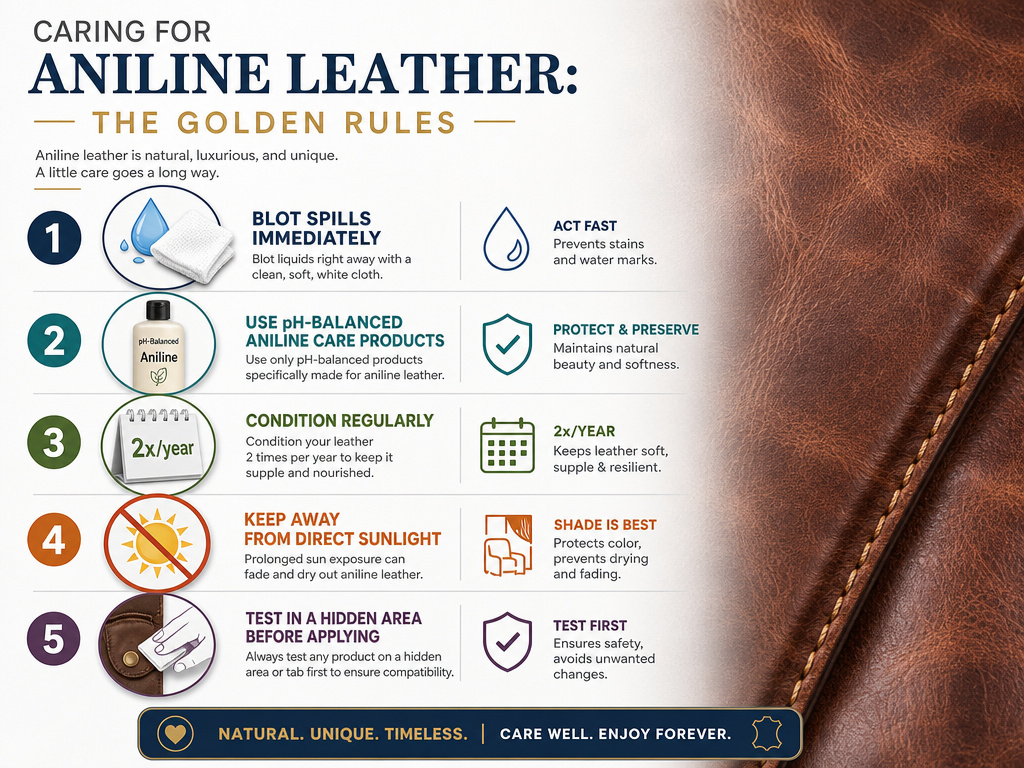
Here’s the practical takeaway. Aniline leather isn’t fragile like tissue paper; it’s demanding like a cast-iron skillet. It requires a specific, consistent regimen to perform at its best for decades. Ignore it, and it will show neglect quickly. Care for it, and it rewards you with unmatched character.
The Golden Rules:
- Clean Spills Immediately. Blot, never rub. Use a clean, white cloth and distilled water for most accidents.
- Use Aniline-Specific Products. Look for cleaners and conditioners formulated for “naked,” “aniline,” or “semi-aniline” leathers. They are pH-balanced and free of heavy oils or silicones that can clog pores.
- Condition Regularly (But Not Too Often). Think of it like moisturizing skin. Clean furniture twice a year; for a jacket or bag seeing daily use, maybe once a season. Over-conditioning is as bad as under-conditioning, it can lead to a greasy, darkened surface.
- Keep It Out of Direct Sunlight. UV light will fade any dye, especially aniline dyes. Position furniture away from direct sun, or use shades.
- Test First. Always test any new cleaner or conditioner on a hidden area (like a back flap or underside) and wait 24 hours to check for darkening or discoloration.
In my early days, I learned about surface preparation the hard way. I once tried to apply a protector to a piece without first ensuring it was perfectly clean and dry. The product formed hazy, uneven patches that took a professional to fix. The leather will tell you what it needs, but you have to listen. Proper care for aniline leather is less about brute-force cleaning and more about gentle, consistent stewardship.
Related Leather Finishes You Should Know
Aniline leather doesn’t exist in a vacuum. Understanding its cousins helps frame its place in the leather world.
Pull-up leather is a close relative, often aniline or semi-aniline in base. It’s treated with extra oils or waxes. When you stretch or bend it, the oils move, causing the leather to lighten temporarily. This gives it a fantastic ability to hide scuffs and adds dramatic character. It’s underrated for casual furniture and bags.
Corrected grain leather is almost the opposite philosophy. Here, the hide’s surface is sanded or buffed to remove imperfections before any finish is applied. It’s then embossed with an artificial grain and heavily finished, often as pigmented leather. It’s durable and affordable, but it lacks the natural tactile feedback of aniline.
Nubuck is another premium finish, created by lightly sanding the top grain of the leather to produce a velvety surface. Like aniline, it shows marks easily but develops a beautiful patina. The care regimen is similar, gentle, specific brushes and cleaners.
When you’re comparing, remember you’re often choosing between a natural finish (aniline, nubuck) and an applied finish (pigmented, corrected grain). One showcases the hide; the other conceals and protects it. Your choice depends entirely on whether you want a partner that ages with you or a tool that performs consistently.
Frequently Asked Questions
Is aniline leather more delicate than other types?
Yes, it is inherently more delicate. The lack of a protective pigment layer means spills and oils can penetrate quickly, and it is more prone to fading from direct sunlight. This vulnerability is the trade-off for its unmatched natural texture and aesthetic.
Can aniline leather be repaired if it gets stained or scratched?
Professional repair is possible but can be challenging. Because the color is within the fibers and not on a surface coat, blending repairs to match the natural grain and patina requires significant skill. Prevention through regular conditioning and immediate cleaning of spills is always the best approach.
Why is aniline leather often more expensive?
The high cost is driven by the extreme selectivity of raw materials. Only the most flawless hides, typically under 5% of supply, qualify. The specialized dyeing process and the lower yield from these perfect hides contribute to its premium, luxury status.
How can I tell if I’m buying genuine aniline leather?
A seller should be able to reference the DIN EN 15987 standard. Be wary of products described as “aniline” that look perfectly uniform, as they may be a semi-aniline or pigmented finish.
Before You Go
Aniline leather is for the buyer who sees value in authenticity and history. It’s not the most practical choice, but it is the most expressive. The 0.01mm finish limit isn’t a suggestion; it’s the line that defines the category. If you want a leather that tells a story, first the animal’s, then yours, this is it.
For everyone else, semi-aniline leather is the intelligent compromise. It offers a clear view of the grain leather underneath with a sensible layer of protection, making it the default for a reason. Before you invest, run your hand over the samples. Feel the difference. Your touch will tell you more about the finish than any marketing copy ever could. Understand leather better, and you’ll make a confident choice that lasts.
