
What Is Ostrich Leather? Guide to Its Unique Quill Pattern
This post contains affiliate links. As an Amazon Associate, we earn from qualifying purchases.
Ostrich leather is the tanned hide of farmed ostriches, instantly recognizable by its pattern of raised bumps, quill follicles where feathers once grew, set across a smooth field. It’s one of the strongest and most durable luxury leathers, but its unique texture and complex, specialized tanning process make it a premium, costly material.
That texture is the whole story. The bumps aren’t a flaw or an added effect; they’re the animal’s anatomy preserved through meticulous craftsmanship. This means the quality and authenticity of ostrich leather live in its feel and look, not just a label.
What follows is a breakdown of what defines this leather: the specific part of the hide the quills come from, why it’s so strong, the two distinct types produced, and the intricate tanning steps that turn a raw, fatty skin into a stable, luxurious material. By the end, you’ll be able to look at any product and understand exactly what you’re seeing, and why it commands the price it does.
Key Takeaways
- The prized “full quill” or “crown” pattern comes only from the back of the ostrich, where neck meets body, making it a small portion of the total hide.
- Ostrich leather’s exceptional tear strength comes from its dense, rope-like fiber structure where collagen bundles run parallel, a unique trait among leathers.
- Two distinct leathers come from one bird: the quill-patterned body skin and the reptilian-scale-patterned leg skin, which is smaller and often gloss-finished.
- The tanning process is unusually complex because ostrich fat is stored within the skin layers, not in the meat, requiring specialized chemistry to avoid a greasy, unstable result.
- For all its durability, ostrich leather remains surprisingly soft and pliable, a combination that explains its use in high-end accessories, footwear, and automotive interiors.
The Defining Texture: Quills and Grain
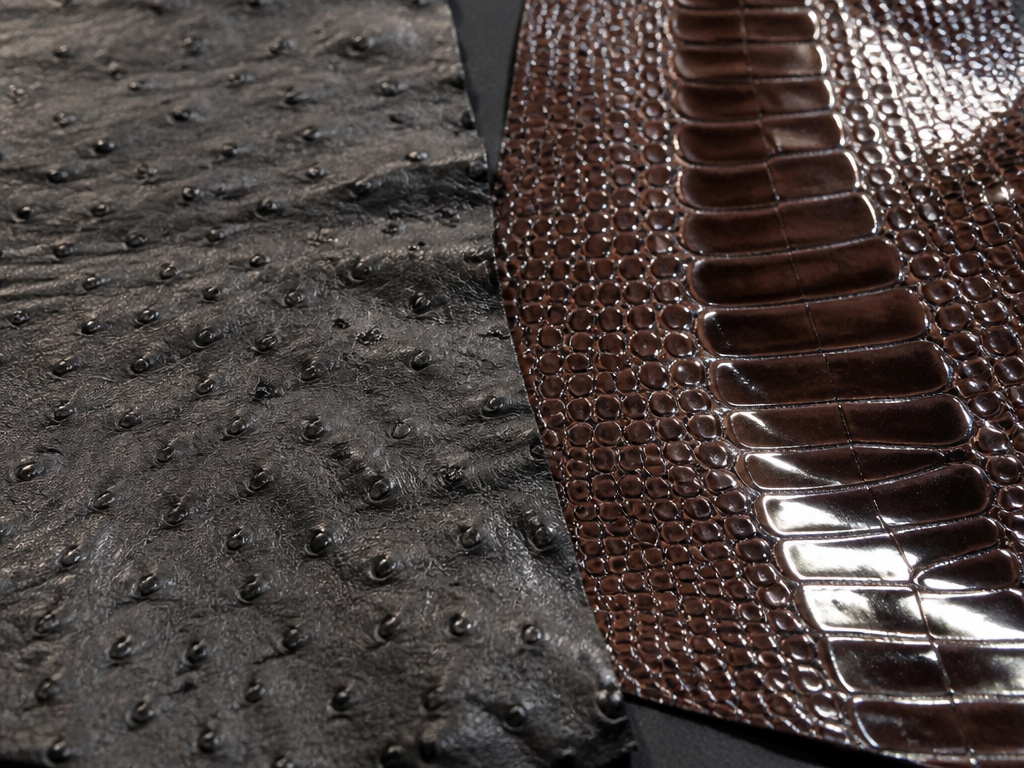
Look at an ostrich leather wallet or boot. Your eye goes straight to the bumps. Those are empty quill follicles, the spots where the bird’s large feathers were anchored. This is the leather’s fingerprint, impossible to replicate synthetically with any real fidelity.
The area with the highest density of these follicles is called the “crown” or “full quill” section. It’s a diamond-shaped patch on the bird’s back, right where the neck meets the body. This is the most sought-after part. The skin to the left and right of this crown is smooth, often called the “valley” grain. A truly “full quill” product uses only this crown section, which is why it’s exponentially more expensive, you’re using a smaller, more distinctive part of the hide. This is a far more specific designation than generic leather grades, which speak to layer, not pattern.
The “crown” pattern of quill follicles is not a surface embossment. It is the actual, raised architecture of the dermis preserved through tanning, making each hide genuinely unique.
The smooth areas between quills have a fine grain, with striations that resemble a human palm. This contrast, the three-dimensional quill against the flat, grained valley, gives the leather its dynamic, living texture. Modern designers often use both areas in a single piece for visual interest, whereas traditional craftsmanship might isolate only the full-quill section.
Why It’s So Strong: The Rope-Like Structure
Most leather strength comes from the interwoven nature of its collagen fibers. Think of cowhide like a woven basket, strong, but if you pull it apart, the fibers separate. Ostrich leather is different.
Its fiber structure is often compared to a rope. The dense collagen bundles run largely parallel to each other along the length of the hide. This aligned, dense packing is what gives ostrich leather its very high tear strength. You can pull on it with immense force, and it resists ripping far better than most other leathers of similar thickness. This inherent toughness is why it stands up to years of use in items like boots and bags that see daily abrasion.
This structural fact is highlighted in industry literature, noting its “flat fibre structure… Comparable to a rope where fibres all run in the same direction.” It’s a physical trait, not a result of a special finish. That’s why when you’re testing leather quality, a pinch and pull test on ostrich will reveal a remarkable resistance to stretching and tearing compared to bovine leather of a similar weight.
Two Hides in One: Body Skin vs. Leg Skin
We’ve been talking about the body skin. But an ostrich yields a second, completely different leather: leg skin.
Ostrich leg skin is smaller and features a distinct pattern. It has a central band of broad, reptilian-looking scales running down its length. The texture is flatter and more geometric than the organic quill pattern of the body. Leg skin is often finished with a high-gloss glaze, though matte options exist, and it’s particularly popular for smaller accessories like watch bands, card holders, and accent pieces.
It’s a common point of confusion. You might see “ostrich” and assume it’s all the same. Leg skin offers a more exotic, scale-like aesthetic, while body skin provides the classic, soft-quill look. Both are genuine and durable, but they cater to different design tastes. This variety within a single animal source is part of what makes working with exotic leathers so interesting for craftsmen.
How Ostrich Leather is Made: A Specialized Tanning Process
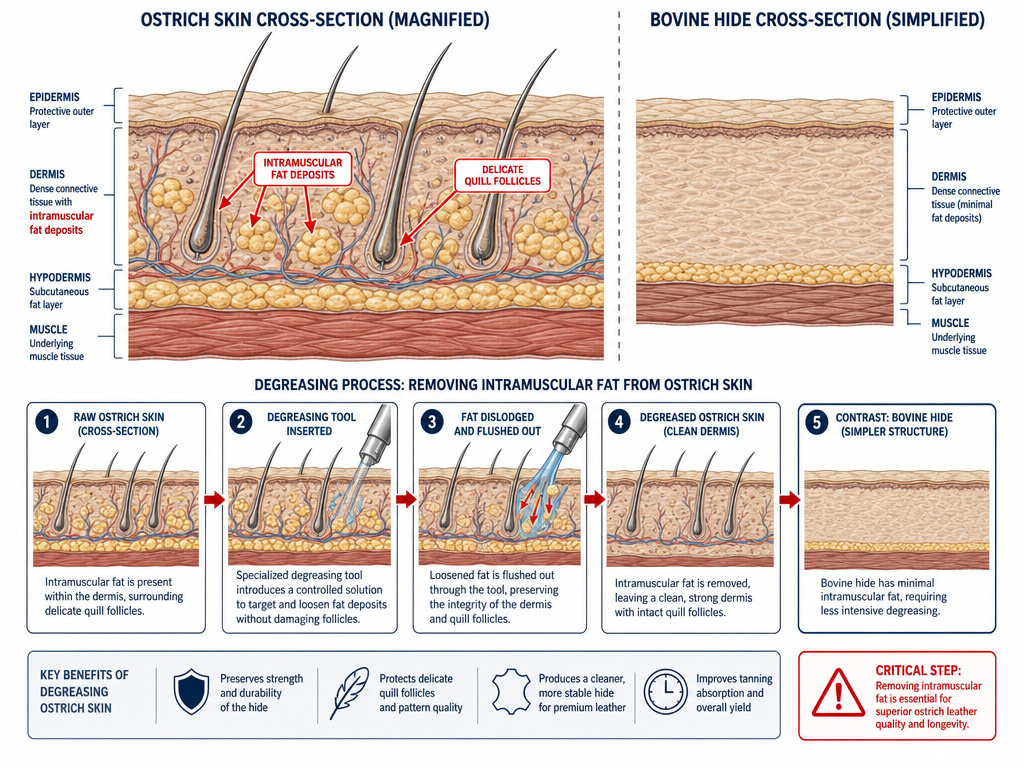
Tanning any leather is a craft, but ostrich presents a unique challenge. In most animals, fat is stored in the meat. In ostriches, a significant amount of fat is deposited within the skin itself. This isn’t just a surface issue; the fat is intramuscular.
If this fat isn’t completely and carefully removed during the early processing stages, it will leach out later, leaving the leather greasy, unstable, and prone to discoloration. This necessitates a complex, specialized tanning sequence that is both longer and more precise than for bovine hides.
| Processing Stage | Key Steps | Why It’s Critical for Ostrich |
|---|---|---|
| Raw Stage (~15 steps) | Curing, soaking, liming, fleshing, degreasing. | The degreasing step is paramount. Must remove intramuscular fat without damaging the delicate quill follicle structures. |
| Tanning (Crust Stage) | Pickling, tanning (chrome or vegetable), sammying, splitting. | The choice between chrome or vegetable tanning affects flexibility and water resistance. The dense fiber structure absorbs tannins differently. |
| Finishing (~11 steps) | Conditioning, dyeing, drying, staking, buffing, glazing, grading. | Staking (mechanically softening) is crucial due to the leather’s density. Grading is done by the centimeter for size and follicle pattern quality. |
The process is exhaustive, often involving over 30 discrete steps from raw skin to finished leather. This intensive labor, combined with the relatively small yield per bird (an average prepared skin is about 16 square feet), is a primary driver of the material’s high cost. As the Wikipedia entry on ostrich leather notes, this intricate production makes its aesthetic value costly.
Common mistake: Assuming the tanning process is similar to cowhide. The intramuscular fat changes everything, requiring a dedicated degreasing protocol that adds time, cost, and skill.
The industry itself, particularly in South Africa where it is a major export, has developed stringent grading systems to account for natural variation. Skins are graded on size, the perfection of the quill pattern (no scars or bug bites), and the evenness of dye uptake.
Ostrich Leather in Use: Where and Why It Shines
Given its cost and properties, ostrich leather isn’t a general-purpose material. It’s deployed where its specific advantages are worth the investment.
First, its durability and softness combo is rare. It can be tanned to be buttery soft yet still resist scuffing and tearing. This makes it ideal for high-wear luxury items that need to remain supple: * Footwear: Especially cowboy boots and high-end dress shoes, where the shaft and vamp get constant flexing. * Accessories: Wallets, belts, and handbags that develop a rich patina over time with daily handling. * Automotive Interiors: Steering wheel covers, gearshift boots, and seat accents. For automotive use, it requires special finishes with very high light-fastness to resist sun fading.
Second, its texture is a design statement. The quill pattern communicates exclusivity and a connection to a natural, exotic source. It’s a material chosen for visual and tactile impact, not anonymity.
Does this make it “better” than bovine leather? Not universally. A thick, vegetable-tanned steerhide is more cost-effective for a heavy work belt. But for a soft, lightweight jacket that needs to be tough, or a billfold that will mold perfectly to your pocket, ostrich’s strength-to-weight ratio is exceptional. It occupies a specific niche alongside other reptile leathers like alligator, prized for texture and status.
Caring for Ostrich Leather
Caring for it is straightforward, but the principles matter. That unique, porous quill structure needs the right nourishment.
- Clean gently. Use a soft, dry brush to dust out the quill follicles. For stains, a barely damp cloth with a drop of saddle soap specifically formulated for exotic leathers will do. Don’t flood the leather.
- Condition sparingly. Use a light, non-greasy leather conditioner. Apply a tiny amount to a cloth and work it in, focusing on the smooth “valley” areas. Let it dry completely for 24 hours before use. Over-conditioning will clog the pores and dull the texture.
- Store properly. Keep it in a breathable cotton bag away from heat and direct sunlight. Don’t cram it into a tight space where the quills can be permanently crushed.
The goal is to preserve both the look and the feel. A well-maintained ostrich leather piece won’t just last; its color will deepen and mellow, and the surface will become glossier with handling, telling the story of its use.
Frequently Asked Questions
Is ostrich leather ethical?
Ostrich leather comes from birds farmed primarily for meat and feathers in countries like South Africa. The leather is a byproduct of an existing agricultural industry. As with any animal product, ethical sourcing depends on the specific farm’s practices. Look for transparency from manufacturers.
Can ostrich leather get wet?
It is more water-resistant than many leathers due to its dense structure, but it is not waterproof. Light rain won’t ruin it, but prolonged soaking will damage the finish and cause the leather to stiffen. Always let it dry at room temperature, never with direct heat.
Why is ostrich leather so expensive?
Three reasons: low yield per bird (small hide size), the labor-intensive, specialized tanning process required to handle the intramuscular fat, and the high demand for the distinctive “full quill” section, which is a small part of an already small skin.
How can I tell if ostrich leather is real?
The quill pattern should be completely random and natural-looking, with slight variations in follicle size and spacing. Press the quills; they should have a slight give and spring back. Fake versions often have a perfectly uniform, stamped-on pattern that feels plastic-like and hard. For more on this, our guide on how to tell real leather from fake delves deeper.
Before You Go
Ostrich leather isn’t a commodity. You don’t buy it by the square foot for an unknown project. You commission a specific item, a pair of boots, a bag, because you want that exact combination of texture, durability, and history.
The one rule that reframes everything: the value is in the uncorrected surface. Any attempt to sand down or heavily emboss over the natural quill pattern defeats the purpose. You’re paying for nature’s architecture, preserved. So when you evaluate a piece, your first question shouldn’t be about the brand name stitched inside, but about the story told by the leather itself. Is the quill pattern vibrant and varied? Does the leather feel dense yet supple? That’s your proof.
And remember, for all its exotic appeal, it’s still leather. It will dry out, fade, and wear. The difference is that with minimal, informed care, an ostrich leather item will wear in, not out, for decades. That’s the real return on the investment.
