
How to Choose a Leather Couch: Your Essential Buying Guide
This post contains affiliate links. As an Amazon Associate, we earn from qualifying purchases.
This post contains affiliate links. As an Amazon Associate, we earn from qualifying purchases.
Choosing a leather couch that lasts starts with three decisions: the right finish for your home’s mess level, a frame built to handle daily use, and a size that leaves breathing room in your floor plan. Get these three wrong, and you’re living with a mistake for a decade.
That last point about floor space is where most people trip up first. A beautiful, oversized sectional can feel perfect in a showroom and then dominate your living room like a beached whale. The rest of this guide walks through the specifics, leather grades, construction details, and a simple test you can do today, that turn a stressful purchase into a confident one.
To choose a leather couch, match three things: your household’s lifestyle to the leather finish, your room’s dimensions to the sofa’s footprint, and your long-term comfort to the frame and cushion construction. For most families, a top-grain leather with a semi-aniline or pigmented finish offers the best balance of durability, stain resistance, and manageable care.
Let’s be clear about this. A couch isn’t just something you buy; it’s something you live with. The goal is to find the piece that supports your actual life, not the idealized version in a catalog.
Key Takeaways
- Finish over grade: For a family room, a protected semi-aniline or pigmented finish on top-grain leather will outlast and outperform a delicate full-aniline hide.
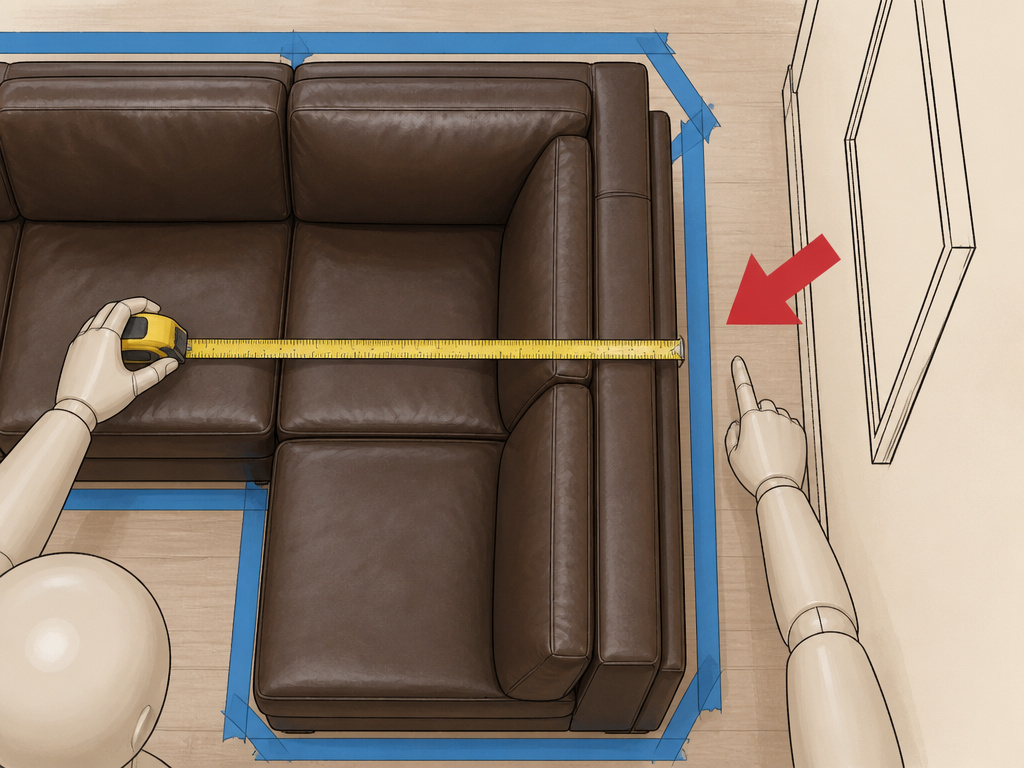
- Measure twice, buy once: Use painter’s tape to map the couch’s footprint on your floor before you shop. If it obstructs walkways, scale down.
- The frame is the foundation: Kiln-dried hardwood frames with reinforced joinery (dowels, corner blocks) last decades; frames held by staples or glue alone start creaking within a few years.
- Condition only when dry: Over-conditioning leather furniture softens the supportive substrate and can leave a greasy residue. Clean it regularly, but only add conditioner when the surface feels stiff or looks dull.
- Test everything in person: Operate recliners, feel the cushion density, and examine the stitching. If buying online, always order a leather swatch first.
The 3-Step Pre-Purchase Framework
Before you get lost in leather types or spring systems, answer these three questions. They filter out 80% of the options that would be wrong for you.
First, map your room with painter’s tape. Mark the exact length and depth of any couch you’re considering directly on the floor. Live with that taped outline for a day. Walk around it. Can you still get to the bookshelf or the patio door without doing a sidestep? A couch that cramps a room creates friction every single day. This one act saves you from the most common and expensive sizing mistake.
Second, take an honest audit of your household. Do you have kids, pets, or a habit of eating on the couch? If the answer is yes to any, you need a leather finish that can take a hit. That means leaning towards a pigmented or protected semi-aniline finish. The purist obsession with untouched full-aniline leather is beautiful but misguided for a family sofa. It shows every water ring and oil stain.
The part nobody mentions: Peer-reviewed chamber studies have measured VOC emissions from new upholstery leather. These emissions vary based on the leather, its finish, the furniture build, and even room temperature. Unpack a new sofa promptly and give the room good airflow for the first few days.
Third, define the couch’s primary job. Is it for napping, formal seating, or marathon movie nights? That tells you what cushion firmness and seat depth you need. A seat depth of 23-26 inches is great for lounging but terrible for upright conversation if you’re under 5’6″, your feet won’t reach the floor, straining your lower back over time. Purpose dictates form.
Leather 101: Finish is Everything
The label “genuine leather” is virtually meaningless. It’s a classification that includes the good, the bad, and the truly awful bonded leather. What matters is the finish applied to the hide. This determines how it looks, feels, and survives your life.
Think of leather finishes on a spectrum from natural to protected. On one end, you have aniline finishes. These dyes soak into the hide with little to no protective topcoat. The result is incredibly soft, breathable leather with a rich, natural grain that develops a unique patina. The trade-off? It’s unforgiving. Spills, oils, and even prolonged contact with dark jeans can leave permanent marks.
On the other end, you have pigmented finishes. A layer of pigment and protective coating sits on top of the leather. This creates a uniform color, excellent stain resistance, and easy clean-up. It feels less soft and natural, but it stands up to kids and pets. The middle ground is the semi-aniline finish, which adds a light protective layer over an aniline dye. It retains much of the natural look while offering practical stain resistance.
Here’s how the main finishes compare for real-world use:
| Finish Type | Best For | Feel & Look | Biggest Risk |
|---|---|---|---|
| Aniline | Low-traffic, adult-only spaces; collectors | Supremely soft, natural grain variation, develops patina | Stains and scratches show immediately; requires diligent care |
| Semi-Aniline | Most households; balances beauty and practicality | Soft, shows grain, slight protective sheen | Can be damaged by harsh cleaners; moderate maintenance |
| Pigmented | High-traffic homes, kids, pets, dining areas | Uniform color, slightly firmer feel, durable surface | Can develop cracks if the coating fails; least natural feel |
Then there are the materials to avoid. Bonded leather is made from shredded leather fibers bonded with latex and coated with a polyurethane layer. It looks okay new but peels and flakes at armrests and seat edges within a few years. PU (polyurethane) leather is a plastic laminate that might last a bit longer but never feels right and won’t age, it just degrades. If a price seems too good to be true, check the material description for these terms.
The leather you choose dictates the care routine. A pigmented finish might just need a damp cloth. An aniline finish demands specific, pH-balanced cleaners. This is why understanding upholstery leather finishes is the first step in choosing leather furniture that won’t become a burden.
Construction: What’s Under the Leather
Great leather can’t save a poorly built couch. The frame, suspension, and cushions are the engine. Ignore them, and you’ll have a sagging, squeaking mess in five years.
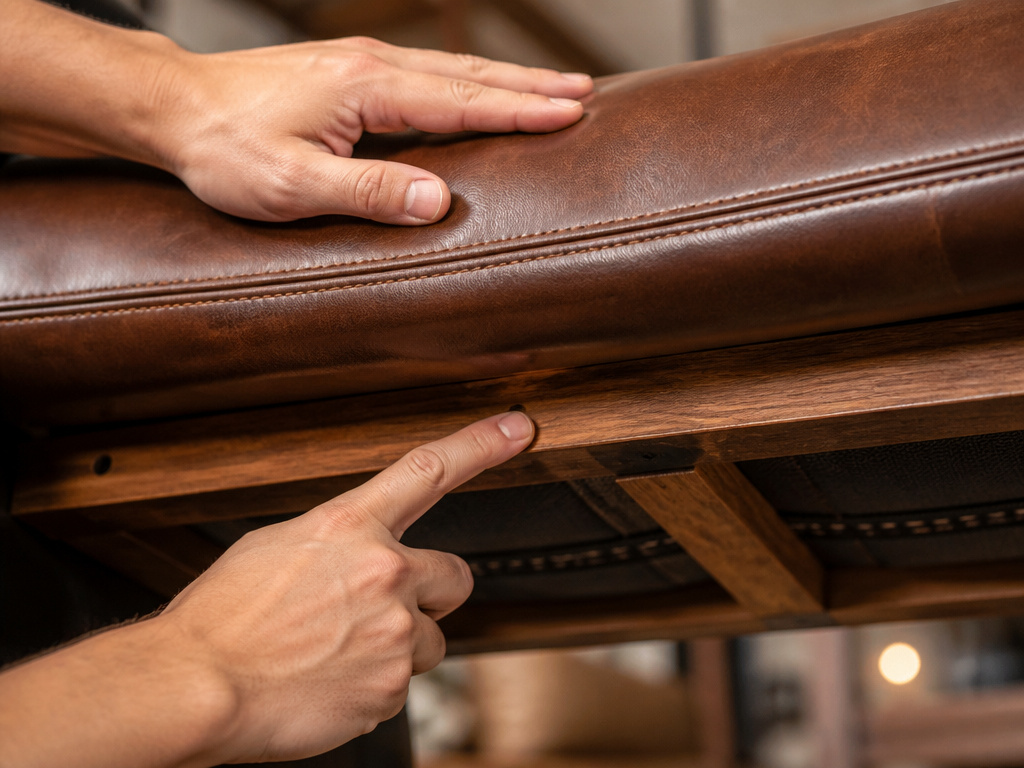
The frame is the skeleton. You want kiln-dried hardwood, oak, maple, or ash, not softwoods like pine, which warp. Look for joints secured with dowels, screws, or corner blocks. Glue and staples alone won’t hold. A quick test in the store: lift one front corner of the sofa about six inches. If the frame twists or groans a lot, it’s not rigid. That twist is what leads to joint failure over time.
Suspension supports the cushions. Sinuous springs (continuous S-shaped wire) are common and good if they’re closely spaced and firmly anchored. Eight-way hand-tied springs are the gold standard, offering superior support and longevity, but the quality of the tying matters more than the label. Feel the seat from edge to edge; it should be uniformly firm, with no weak spots.
Cushions are where you live. High-resiliency (HR) foam is the durable standard. Density is key, look for foam rated at 1.8 pounds per cubic foot or higher. Lower density foam collapses quickly. Down-wrapped foam cores are luxuriously soft but require constant fluffing. A foam core with a wrap of wool or a down blend provides a good middle ground. Whatever the fill, cushions should be reversible to even out wear.
I used to think the leather was the whole story. Then I saw a gorgeous, expensive sofa start to sag in the middle after two years. The leather was perfect top-grain, but the frame was cheap pine and the cushion foam was low-density junk. The hide is the skin; the construction is the bones.
Stitching might seem minor, but it’s the seam holding everything together. Look for double stitching on stress points like corners and where cushions meet the frame. Thread should be heavy-duty polyester or nylon. Run your finger along a seam; it should be smooth and tight, with no loose loops or puckering.
Sizing and Configuration: Avoiding the “Too Big” Trap
 A couch that doesn’t fit your room is a daily annoyance. A couch that doesn’t fit through your door is a crisis.
Start with the obvious: measure your doorways, hallways, and staircases. Note any tight turns. Many modern sofas come with modular designs or detached backs for easier delivery, ask. Then, measure your room. The standard advice is to leave at least 18 inches of walkway between the sofa and other furniture or walls. In a smaller room, you might get away with 15 inches, but anything less starts to feel cramped.
Seat depth and height are personal. The standard seat height of 17-19 inches works for most. If you or a family member has knee or hip issues, aim for the higher end (18-19 inches) to make standing up easier. Seat depth is critical. For upright sitting (conversation, reading), 20-22 inches is ideal. For lounging or napping, 23-26 inches is better. Here’s the catch: if you’re under 5’6″, a deep seat can force you to sit with your back unsupported or your legs dangling. Always test-sit.
Where this goes sideways: Choosing a deep, lounging-style sectional for a small room. It consumes floor space, blocks natural pathways, and makes the room feel closed in. The tape-on-floor test reveals this instantly.
Configuration is the next choice. A standard sofa is straightforward. A leather sectional maximizes seating in a corner but commits you to a specific layout, make sure the chaise is on the correct side. A leather recliner built into the sofa adds comfort but requires clearance behind it and access to a power outlet if it’s motorized. Operate every mechanism in the store. Listen for smooth, quiet movement, not grinding or loud motors.
Understanding the different leather sofa types and configurations helps you visualize what will work. For large, open-plan spaces, a leather sectional can define the area. For a dedicated reading nook, a dedicated leather recliner might be the smarter buy.
The In-Store Test Drive
 You can’t evaluate a couch from a photo. If buying online is your only option, order a leather swatch first. The color and texture on screen are almost always wrong. If you can get to a showroom, use this checklist.
First, sit down. Don’t just perch, sit the way you would at home. Lean back. Put your feet up. Does the seat feel supportive, or do you bottom out? Do the armrests hit at a comfortable height? Stay for at least five minutes. A couch that’s comfortable for 30 seconds can become unbearable as the cushion foam compresses.
Second, inspect the details. Look underneath the sofa at the frame construction. Feel the weight, a solid hardwood frame is noticeably heavy. Examine the stitching on visible seams and in hidden places like the back or underside of cushions. It should be straight and even.
Third, ask specific questions. Don’t accept “it’s genuine leather.” Ask: “Is this top-grain or full-grain? Is the finish aniline, semi-aniline, or pigmented? What is the foam density in the cushions? What is the frame wood?” Reputable retailers have this information. As noted in the Wirecutter leather sofa buying guide, focusing on durable construction criteria is what separates a long-term investment from a short-term disappointment.
Finally, think about the future. Ask about the warranty. A warranty that covers the frame for a lifetime, springs for 5-10 years, and leather for 1-5 years is standard. Read the terms, some warranties are voided by using the wrong cleaning products. This ties directly to knowing how to care for your purchase, which starts with knowing how to clean a leather couch properly.
Long-Term Care & Damage Control
Leather is durable, but it’s not invincible. A simple, consistent care routine prevents most problems.
Dust is the enemy. It’s abrasive. Vacuum your couch weekly with a soft brush attachment. For spills, blot, don’t rub, immediately with a clean, absorbent cloth. For general cleaning, use a damp microfiber cloth. Only use a dedicated leather cleaner when needed, and always test it on a hidden spot first. This is a rule I learned the hard way: a cleaner that’s fine for one finish can discolor another.
Conditioning is the most misunderstood step. You do not need to condition leather every few months. Over-conditioning can soften the leather’s supporting structure and leave a greasy film. Condition only when the leather feels dry or stiff to the touch, or looks dull. For most households in climate-controlled homes, that might be once a year, if that.
Protect your couch from its environment. Keep it at least 18 inches away from heat sources like radiators or fireplaces, and out of direct, sustained sunlight, which dries and fades leather. This is where proactive measures like using leather couch covers or specific dog couch covers can shield the surface from pets, sun, and spills, extending its life dramatically.
For households with pets, keeping claws trimmed is the single best thing you can do. For added peace of mind, our guide on how to protect a leather couch from pets has specific, product-free strategies. Most scratches on protected finishes can be lessened with a gentle rub of your finger; the oils from your skin can help blend minor scuffs.
Frequently Asked Questions
Is a leather couch a good choice for a family with kids and pets?
Avoid aniline and full-grain leathers. Opt for a top-grain leather with a pigmented or durable semi-aniline finish. This provides the best stain and scratch resistance. Using washable throws or protective couch covers on high-use spots is also a smart move.
What’s the difference between “top-grain” and “full-grain” leather for a sofa?
Full-grain is the entire, un-sanded hide, showing natural markings and developing a rich patina. It’s less common in sofas. Top-grain is sanded to remove imperfections, making it more uniform and generally more receptive to protective finishes. For a family sofa, a finished top-grain leather is almost always the more practical and durable choice.
A leather couch should last 15 to 20 years with proper care. With proper care and quality construction, a good leather couch should last 15-25 years. The leather upholstery itself often outlasts the cushion foam, which may need replacing after 7-12 years depending on use. The hardwood frame should last a lifetime.
Can you fix scratches or stains on a leather couch?
Minor scratches on pigmented or semi-aniline leather can often be minimized with a leather conditioner. Deeper scratches or stains on aniline leather usually require professional repair. The key is prevention: clean spills immediately and keep pets’ nails trimmed. For color loss, a professional leather dye service is the solution.
Are leather couches cold in the winter and sticky in the summer?
Leather adjusts to ambient temperature faster than fabric, so it may feel cool initially when you sit in a cold room. It does not get “sticky” like vinyl; its natural breathability means it won’t cling to your skin in humidity. It generally feels more temperature-neutral than many fabrics over time.
The Bottom Line
Choosing a leather couch isn’t about finding the prettiest one. It’s a series of practical matches. Match a protective finish to your household’s chaos level. Match a rigid, hardwood frame to your expectation of a decade of service. Match the physical dimensions to the space you actually have, not the space you wish you had.
If you remember one thing, let it be this: the leather is the surface, but the construction is the substance. A $500 discount on a sofa with a vague “genuine leather” tag and a pine frame is no discount at all. You’re just prepaying for the frustration you’ll feel when it sags.
For the large majority of homes, the sweet spot is a top-grain leather with a semi-aniline finish, on a kiln-dried hardwood frame, with high-density foam cushions. That combination delivers beauty without fragility, comfort without planned obsolescence, and a presence in your home that feels right for the long run. Start with the tape on the floor, and you’re already ahead of 90% of buyers.
