
What is Leather Buffing | Beyond the Buzzword
This post contains affiliate links. As an Amazon Associate, we earn from qualifying purchases.
This post contains affiliate links. As an Amazon Associate, we earn from qualifying purchases.
Leather buffing is a mechanical finishing step where an abrasive wheel or paper lightly scours the surface of a hide to raise a fine nap, smooth imperfections, and prepare the leather for final coloring and sealing. The depth of buffing determines the result: light buffing preserves the natural grain for a “corrected grain” finish, while deeper buffing creates the soft surface of nubuck or the heavy nap of suede.
This process addresses a practical problem tanneries face daily: no hide is perfect. Buffing allows a manufacturer to salvage and standardize hides that might otherwise be wasted.The moment you understand that, the entire leather classification system, from the revered full-grain to the utilitarian corrected grain, starts to make practical sense.
What follows is a straight look at the machines, the measurements, and the reasons behind buffing. You’ll see how a little controlled abrasion can turn a flawed hide into a durable shoe or a soft bag, and you’ll learn to spot the telltale signs of a buffed surface.
Key Takeaways
- Buffing uses abrasives like carborundum paper or emery wheels to microscopically cut surface fibers and raise a uniform nap.
- The depth of buffing dictates the final leather type: light buffing creates corrected grain, moderate buffing on the grain side creates nubuck, and heavy buffing on the flesh side creates suede.
- A 2018 study found buffing nubuck leather significantly increases its water absorption, making it a poor choice for external footwear uppers despite its soft feel.
- Corrected grain leather is not inherently low quality; it’s a practical solution for using hides with surface scars or insect bites without wasting the entire skin.
- The process requires precise control, too deep, and you destroy the grain’s inherent strength; too shallow, and you fail to conceal the flaws.
What Exactly Is Leather Buffing?
Let me share what I’ve learned by looking past the marketing. In the conservation glossary compiled by Etherington & Roberts, buffing is defined as “the process of producing a fine nap on the grain surface of leather by means of carborundum paper or on the flesh sides of small skins by the action of an emery wheel.” That’s the core of it: abrasive action creating a nap.
Think of the very top layer of a hide, the grain layer, as a dense forest of microscopic collagen fibers. A sharp abrasive, like carborundum, doesn’t just sand these fibers down flat. It cuts across them, leaving tiny, uniform ends standing upright. This creates the velvety surface we recognize as a nap. It’s a physical transformation, not just a cleaning.
This process can remove microscopic fibrils and surface defects. Many of the grain defects in a leather do not penetrate into the leather nearly to the depth of the grain layer, and can be entirely removed by buffing. , Etherington & Roberts, Dictionary of Bookbinding Terms
Why does this matter for you? Because this step is the fork in the road for leather types. That uniform nap is the blank canvas for creating corrected grain leathers. It’s also the starting point for nubuck and suede. Understanding this mechanical action explains why a buffed leather behaves differently than an untouched full-grain leather. The surface has been fundamentally altered.
The Three Destinations: Corrected Grain, Nubuck, and Suede
The same machine can produce three different outcomes. The destination depends on two variables: which side of the hide you buff and how deep you go.
| Leather Type | Side Buffed | Buffing Depth | Key Characteristic | Best For |
|---|---|---|---|---|
| Corrected Grain | Grain Side | Light (“Snuffed”) | Original grain pattern is lightly abraded, then a new, uniform grain is often embossed on top. | Furniture, shoes, bags where uniform appearance and price are priorities. |
| Nubuck | Grain Side | Moderate | A fine, velvety nap is raised on the top-grain side. No heavy finish is applied. | Luxury bags, jackets, interiors where a soft, dry hand-feel is desired. |
| Suede | Flesh Side (Split) | Heavy | A deep, plush nap is raised from the fibrous underside of the hide. | Apparel, linings, decorative items where a rich texture is the main feature. |
The industry has specific, if subtle, terms for the depth. When a hide is “buffed to a measurable depth,” it’s called buffed. When it’s “buffed to a lesser depth,” it’s snuffed. That snuffed level is what creates the base for a corrected grain finish. The leather grain itself is still intact underneath, but it’s been lightly scuffed to accept new coatings.
Nubuck is the trickier sibling. It feels luxurious, but that fine nap comes with a trade-off. A peer-reviewed study led by El-Sayed in 2018 tested the properties of buffed leathers. They found that buffing nubuck significantly increases water absorption. The raised nap creates more surface area for water to cling to. The study’s conclusion was blunt: nubuck is “not recommended for footwear uppers manufacturing due to its high water absorption.” So that beautiful nubuck boot? It’ll soak through faster in the rain than a standard corrected grain boot. You can read the full analysis in this leather finishing processes study.
Suede takes the buffing concept to the other side of the hide. By aggressively buffing the flesh side, tanneries create that signature deep, soft pile. Because there’s no tight grain layer to protect, suede is inherently more vulnerable to staining and wear. It’s a sacrifice made for texture.
The Buffing Process: Abrasives & Wheels
The machinery functions as a controlled abrasion system. Tanneries use large, rotating wheels covered in abrasive paper (like carborundum) or built from abrasive materials (like emery).The hide is fed grain-side-up against this wheel under tension.
The operator controls the pressure, speed, and dwell time. A few seconds too long in one spot, and you burn through the grain layer entirely, ruining the hide. The goal is uniformity, creating the same nap density across the entire surface.
This stage is a critical part of the broader leather manufacturing sequence. It happens after the hide has been tanned, dyed, and dried, but before the final finishes, the pigments, waxes, and resins, are applied. In fact, for corrected grain leathers, buffing is the essential step that allows those heavy finishes to adhere evenly. You can’t roll a perfect, glossy coating onto a naturally variable grain. You need that sanded, uniform base first.
Common mistake: Equating “buffing” with the hand-buffing you do with a cloth to shine shoes. Industrial buffing is a subtractive, aggressive mechanical process. Hand buffing is a final, additive polishing step.
The abrasives themselves are graded. A coarser grit (like 80) removes material quickly to level out major imperfections. Finer grits (220 and up) then refine the surface to create the desired nap smoothness. This step-by-step refinement is why the final surface can feel so consistent.
Why Buff? The Practical Reasons Behind the Process
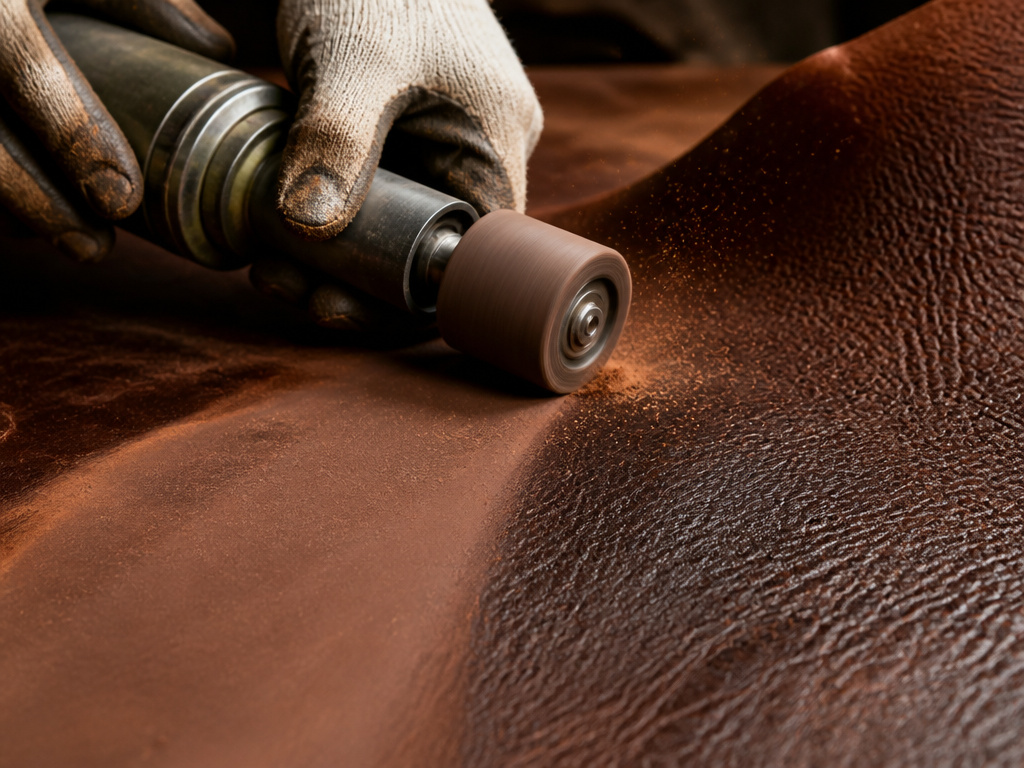
Ignoring the marketing copy for a minute, why would a tannery choose to buff a hide? Three reasons drive the decision: salvage, specification, and feel.
First, salvage. Only a tiny percentage of hides arrive at the tannery without scars, insect bites, or brand marks. Buffing lets a manufacturer remove these superficial flaws. Instead of discarding a otherwise strong, thick hide because of a surface scar, they can sand it out. This reduces waste and makes leather goods more affordable. The resulting corrected grain leather is a pragmatic product.
Second, specification. Mass-produced goods need consistency. A car seat manufacturer needs every square foot of leather to have the exact same thickness, texture, and absorptivity. Natural full-grain leather varies. Buffing creates a standardized starting point. It allows for the heavy, uniform finishes used in automotive and airline interiors. This pursuit of consistency is a major theme in modern leather production.
Third, feel. Sometimes the goal is simply to create a specific tactile experience. The dry, velvety hand of nubuck or the plush softness of suede are direct products of buffing. You can’t get those textures any other way. It’s a deliberate aesthetic choice.
How Buffing Affects Leather Performance
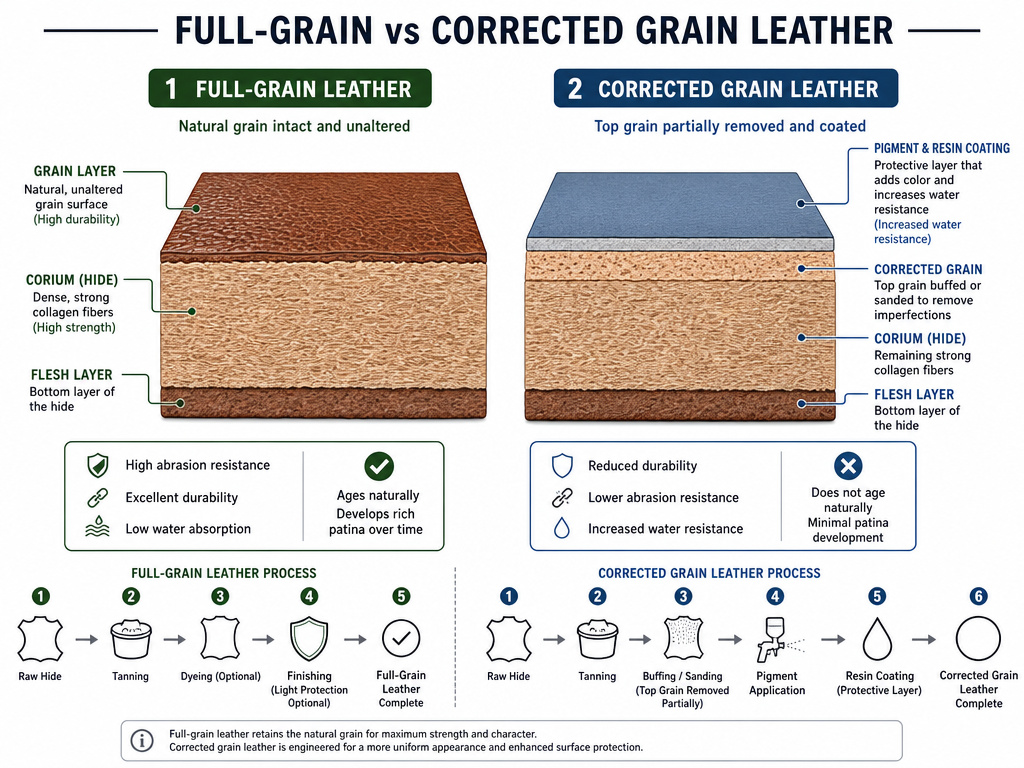
Buffing doesn’t just change looks; it changes how the leather functions. That 2018 study quantified some of these changes. By testing flex resistance, water absorption, and water vapor permeability, they showed buffing has measurable, sometimes counterintuitive, effects.
For nubuck, the increased surface area from the nap raised water absorption, a clear downside for wet-weather gear. However, that same textured surface can also increase breathability in some contexts. For corrected grain leathers, the subsequent layers of pigment and polyurethane resin decrease water absorption, making them more water-resistant but often less breathable.
The process also affects longevity. The grain layer is the strongest, most tightly woven part of the hide. Buffing away some of it inherently reduces abrasion resistance. That’s why a full-grain leather belt can last decades, while a heavily corrected grain belt might show wear faster. This is a key factor in assessing leather for a long-term project.
The short version: Buffing trades a degree of the hide’s natural durability and water-repellency for uniformity, flaw concealment, or a specific soft texture. It’s a series of engineering compromises.
Spotting Buffed Leather: A Quick Guide
You don’t need a lab. You can often identify buffed leather by sight and touch. Here’s what to look for:
- Too-Perfect Grain: If the grain pattern (the pebbling, the pores) looks completely uniform and repeats perfectly across a large area, it’s almost certainly an embossed pattern applied to a buffed surface. Nature doesn’t do perfect repeats.
- A Velvety Feel (Nubuck): Run your finger across the grain side. If it has a dry, velvety, almost chalky sensation, it’s likely nubuck. Try the same spot against the nap and with the nap, you’ll feel a slight difference in resistance.
- A Uniform, Coated Look (Corrected Grain): The surface will feel smooth but often plastic-like. Bend it. If the finish cracks or creases in a fine line (rather than developing a soft roll), it’s a heavy coating on a buffed base. This is different from the deep, rich creases that develop in a natural leather patina.
- The Flesh Side (Suede): This one’s obvious. If both sides are napped, it’s a split suede. If one side is smooth grain and the other is napped, it’s a full-grain suede, a premium product where the top grain was used for smooth leather, and the split was buffed for suede.
These clues help you make informed choices. You’re not just buying “leather”; you’re buying the outcome of specific processes like buffing, which directly impacts care, durability, and cost.
Frequently Asked Questions
Does buffing mean the leather is low quality?
Not at all. Buffing is a standard industrial process used across quality tiers. A high-quality corrected grain leather uses a thick, durable hide and applies a durable finish after buffing. A low-quality one uses a thin split and a cheap coating. The buffing step itself is neutral; the quality lies in the materials used before and after it.
Is “buffed leather” the same as “polished leather”?
No. In industrial terms, buffing is abrasive and subtractive. Polishing, like the final shoe buffing process, is a gentler, additive process that uses a soft wheel and wax compounds to shine an already-finished surface. One removes material, the other adds a layer.
Can you buff leather at home to repair scratches?
On already-finished leathers, like a desk top or bag, very light sanding with extremely fine grit (400+) can sometimes lessen a surface scratch, followed by conditioning. But you risk going through the finish into the raw leather, which creates a bigger problem. It’s a last-resort fix, not a standard repair technique.
Why doesn’t full-grain leather need buffing?
Full-grain leather is left in its natural state, with the grain layer intact and unfinished. The beauty is in its natural imperfections and ability to develop character. Since the goal is to showcase the hide’s natural surface, buffing, which alters that surface, defeats the purpose. It’s the difference between a polished stone and a rough gemstone.
Is suede just the “backside” of leather?
Essentially, yes. Suede comes from the flesh side (or a split) of the hide, which is the fibrous underside of the grain. It’s naturally rougher, so buffing raises that fiber into a uniform nap. The term ‘full-grain suede’ is a misnomer, as suede is defined by the absence of the grain side.
Before You Go
Buffing is the tanner’s eraser. It’s the tool that lets the industry deliver the consistency and flaw-free surfaces the mass market demands, while also creating the textures we love in suede and nubuck. The trade-offs are physical: some natural durability and water resistance are exchanged for uniformity and softness.
The next time you shop, feel the leather. That perfectly smooth, pebbled chair? Thank buffing and embossing. That incredibly soft, dry jacket? Thank a precise, moderate buff on the grain side. Now you know what created those surfaces, and you can decide if the trade-off suits your needs. The leather, after all, has already been through the machine. Your job is just to understand what came out the other side.
