
Defining Shell Cordovan Leather and Its Unique Production
This post contains affiliate links. As an Amazon Associate, we earn from qualifying purchases.
Shell cordovan is a unique, high-density leather made from a membrane found in the hindquarters of a horse, specifically tanned using a slow vegetable-tanning process that takes six to nine months to complete. Its tight fiber structure results in a non-creasing surface that develops a deep, glossy patina over time, making it a premium choice for durable shoes and accessories.
That timeline is the core mechanic, not marketing. Most leathers are chrome-tanned in a day.Shell cordovan spends sixty days submerged in vats of tree bark extract, then another ninety days resting after being stuffed with oils. The leather isn’t just being processed; it’s maturing, like a whisky. That duration is what builds the density that sets it apart from any cowhide.
What follows is a breakdown of what this leather actually is, how it’s made, and why its six-month creation window is essential. This section details its specific properties, its real-world strengths and weaknesses, and the brands that use it best.
Key Takeaways
- Shell cordovan is not a surface part of the skin; it’s a dense, internal membrane found only in the horse’s hindquarters, making it extremely rare.
- Its legendary non-creasing property is a result of its tight, cross-fibered structure, it rolls and forms rolls, not sharp creases, which prevents cracking.
- The entire vegetable tanning and finishing process at Horween Leather Company takes six to nine months, with mandatory multi-month resting periods that cannot be rushed.
- While incredibly water-resistant and durable, shell cordovan is sensitive to extreme heat and pressure during shoemaking, requiring skilled craftsmen and older, gentler machines.
- Its care is counterintuitive: less is more. Vigorous brushing with a horsehair brush does more to restore its shine than most conditioners.
What Makes Shell Cordovan Different? It’s Not a Skin.
Let’s be clear about one thing. When you hear “horsehide leather,” you’re probably picturing the outer skin of a horse. Shell cordovan isn’t that. It comes from underneath.
Specifically, tanneries harvest it from a football-shaped area on the horse’s rump. The useful section starts about 24 inches from the tail and extends about two feet on either side. Inside that area, between the outer grain and the flesh, is a thick, fibrous membrane, the “shell.” It’s about the size of an A3 sheet of paper. One horse yields two of them.
That membrane’s fiber structure is a chaotic, dense weave. Think of the difference between a loose burlap sack and a tight canvas sail. This density is the source of its magic. It’s why shell cordovan doesn’t crease like calfskin. It lacks the loose, pebbled grain that allows other leathers to fold sharply. Instead, it forms gentle rolls. No sharp creases means no cracking along stress lines, which is a primary reason well-made shell shoes can outlive their owners.
This fine-pored surface and the leather’s high fat content make Shell Cordovan particularly water-repellent. Unlike many other leathers, it is made by using the flesh side, rather than the grain side, as the outer surface.
The practical takeaway? A shell cordovan shoe has a smoothness you can’t get from cowhide. It’s also why you’ll see it used “unlined” in high-end shoes, both sides are so smooth there’s no need for a fabric backing. That tight weave, once properly tanned and stuffed with oils, also becomes naturally water-resistant. Water beads on its surface instead of soaking in immediately.
How Is Shell Cordovan Leather Made? The 6-Month Process.
The story of modern shell cordovan is almost exclusively the story of one tannery: Horween Leather Company in Chicago. Founded in 1905, they’ve refined a process that treats time as an essential ingredient, not an obstacle.
It starts with the raw “shells” or “butts” from the horsehide. The hair is removed, and the hides are pickled, given an acid bath, to prepare the fibers to accept tannins. Then comes the first long wait.
The Vegetable Tanning Vats
While most leather today is chrome-tanned in hours, Horween uses a traditional vegetable tanning method. The shells are submerged in massive vats containing a brewed solution of tree bark extracts, things like quebracho, acacia, and maple. They stay there for about sixty days. The tannins slowly bind to the collagen in the membrane, making it stable and rot-resistant.
Shaving, Stuffing, and the Second Long Wait
After tanning, the leather is “shell shaved” by craftsmen who thin it to a remarkably uniform 1.2 to 1.4 millimeters using foot-powered machines. Then it’s “hot stuffed.This process is a forceful impregnation with a proprietary blend of tallows and waxes, followed by a hand-smearing of oils.
Then it rests. For at least ninety days. This resting period is non-negotiable. The oils and waxes need to migrate fully through that dense fiber structure. Skipping this step would leave the core of the leather dry and brittle, defeating the entire purpose.
Finishing: Color and Glass
Only after this months-long conditioning does the shell get its color. Horween’s most famous shade is “Color 8,” a deep burgundy-red often called oxblood. The dye is applied by hand and machine. The final step is glazing: the leather is passed under tremendous pressure over glass or steel rollers. This friction and heat burnish the surface, creating that signature, almost liquid shine.
The entire process, from raw hide to finished leather, takes six to nine months. Every step that involves waiting, the sixty-day tan, the ninety-day rest, is what builds the leather’s legendary density and performance. It’s the opposite of modern, fast-turnaround manufacturing.
| Stage | Process | Duration | Why It Matters |
|---|---|---|---|
| Tanning | Submersion in vegetable tannin vats | ~60 days | Slow infusion creates a dense, stable base; chrome tanning (1 day) would not achieve the same result. |
| Resting (Post-Stuffing) | Oils and waxes permeate the leather | At least 90 days | Ensures the leather is nourished throughout, preventing a brittle core. Skipping this causes long-term dryness. |
| Total Production Time | From raw hide to finished leather | 6–9 months | The extended timeline is not inefficiency; it’s the essential catalyst for developing the leather’s unique properties. |
The Properties: Dense, Supple, and Surprisingly High-Maintenance for Makers.
So you have this piece of leather that spent half a year coming to life. What can you actually do with it?
On paper, its specs are a shoemaker’s dream: * Non-Creasing: Forms rolls, not cracks. * Dense Fiber Structure: Incredibly durable and resistant to abrasion. * Natural Water Resistance: High fat content causes water to bead. * Develops a Patina: Sunlight and wear bring out rich, unique color depth over years. * Two Smooth Sides: Can be used unlined, reducing bulk.
But here’s the twist: for all its toughness in use, shell cordovan is notoriously difficult to work with. James Fox of Crockett & Jones put it bluntly: “Materials with vegetable tannage do not like heat, pressure or water.” The very process that makes it durable, the hot stuffing with waxes, makes it sensitive to the heat and pressure used in standard shoemaking.
Shoemakers like Crockett & Jones have to assign shell work to their most skilled staff using older, gentler machines that require constant maintenance. The alternative, using modern high-heat presses, can damage the leather’s temper and finish. This extra labor and machine upkeep is a significant part of why a pair of shell cordovan shoes costs what it does.
Where this goes sideways: Assuming shell’s durability means it’s easy for artisans to work with. Its sensitivity to heat and pressure forces factories to use older, finicky equipment and their most experienced workers, adding weeks to production time.
For you, the wearer, this density translates to a break-in period. New shell shoes can feel stiff, almost hard. They don’t immediately mold like soft calfskin. But once they do, they form to your foot like nothing else, and that fit becomes permanent. It’s the difference between a soft pillow and a custom orthopedic insert, one is immediately comfortable, the other builds a perfect, lasting support.
Shell Cordovan Care: Less Is Almost Always More.
 A student who initially couldn’t tell cowhide from goatskin once surprised me by correctly identifying a rare deer hide just by its grain and pore structure. Their rapid progress came from learning one rule: let the material tell you what it needs. Shell cordovan shouts this rule.
Forget most of what you know about leather care. Shell’s tight pores and high oil content mean it needs less intervention, not more.
The Daily Routine: Brush, Don’t Bathe
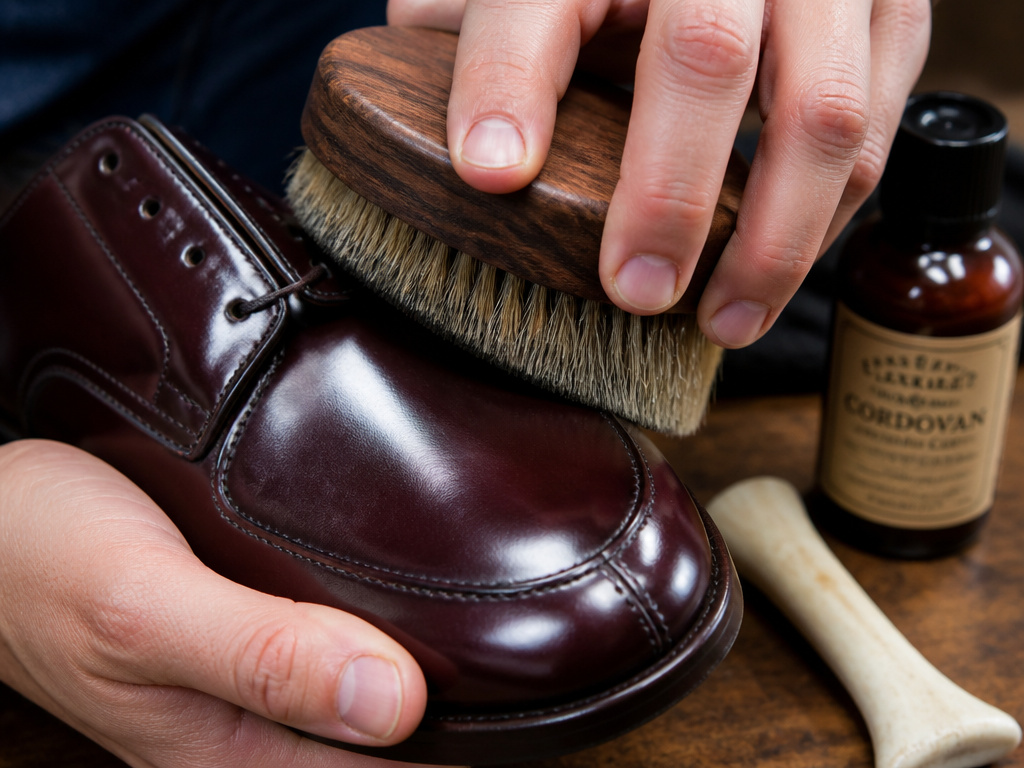
Your primary tool is a stiff horsehair brush. Vigorous brushing does three things: it removes surface dust, it redistributes the natural oils already in the leather, and it polishes the surface through friction alone. For daily cleaning and shine restoration, brushing is 90% of the job.
Conditioning: Rarely and Sparingly
Because the leather is already “stuffed” with fats, it rarely needs additional conditioning. Over-conditioning is a real risk, it can clog the pores and create a greasy, dull film. If the leather starts to look dry or scuffed after years of wear, a tiny amount of a product like Saphir Rénovateur can be used. Apply it sparingly, let it absorb overnight, and brush vigorously the next day.
Dealing with Scratches and Rolls
Shell cordovan is prone to light surface scratches and its characteristic rolls. Here, the deer bone, a traditional tool, is still championed by experts like Steven Taffel of Leffot. The bone contains oils that, when rubbed firmly over a scratch or roll, can help smooth and blend the surface. It’s a hands-on, gentle approach that respects the material’s nature.
I won’t recommend a bottomless bottle of conditioner for shell. The leather already has what it needs; your job is to maintain the surface, not rebuild it from the inside out.
Shell Cordovan in the Wild: Brands and Patina.
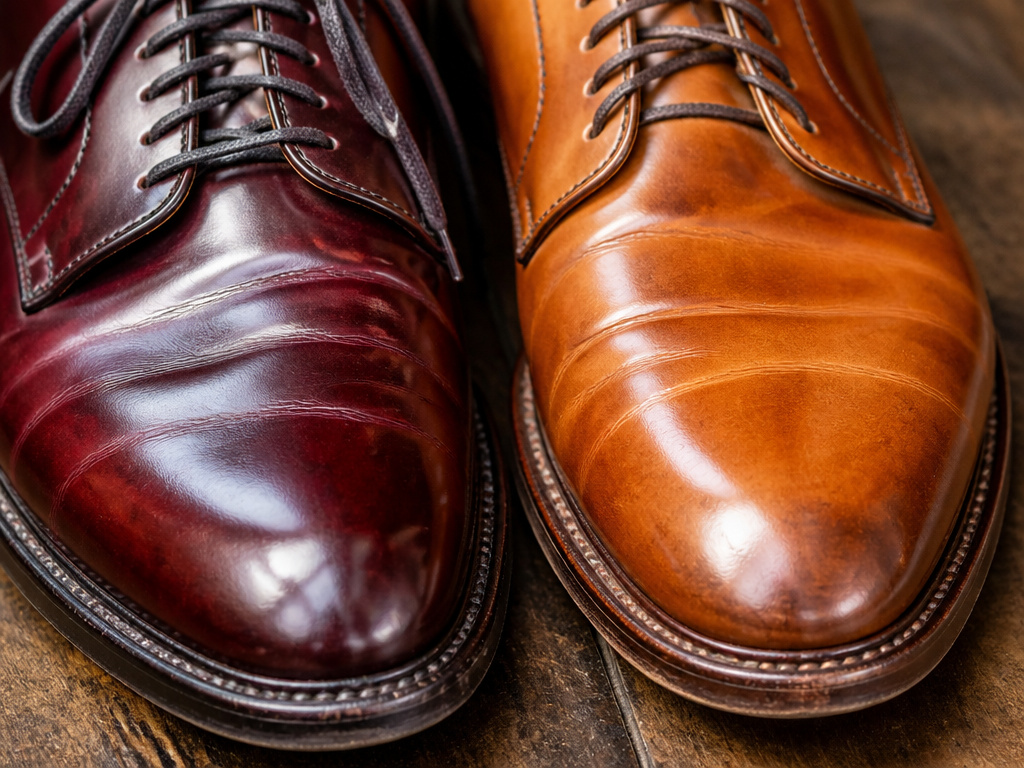 Horween’s shell is supplied to a short list of premium footwear makers. Alden in the United States is perhaps the most famous, especially for their Color 8 styles which often have an extra layer of dye applied at the factory, resulting in a deeper, more uniform aubergine color. Carmina in Spain and Viberg in Canada are other notable clients.
The real magic happens after purchase. This is where the patina develops. Unlike the patina on vegetable-tanned leather, which darkens, shell cordovan’s patina is a revelation of color. Sunlight acts as a bleaching agent on the dyes.
- Color 8 (Burgundy): Fades to a rich, reddish oxblood.
- Natural (Undyed): Ages from a pale caramel to a deep orange-amber.
- Black: Can develop a “teacore” effect, where scuffs reveal a brown underlayer.
This evolution is personal. The rolls that form at the toe, the slight color shift from left shoe to right based on sun exposure, the gentle darkening from trouser dye transfer, it all tells the story of your wear. Two pairs made from the same batch of Horween shell will look completely different after five years. That’s the point.
Frequently Asked Questions
Is shell cordovan ethical?
The shells are a byproduct of the horse meat industry. Tanneries like Horween do not raise horses for their hides; they source hides that would otherwise be discarded. For many, this makes it a more ethical choice than leathers from animals farmed primarily for their skins.
Why is shell cordovan so expensive?
Three reasons: scarcity (only two small shells per horse), time (the 6-9 month production process), and labor (both at the tannery and at the shoemaker, where it requires specialized skill to work with). The leather making journey is long and hands-on at every stage.
Can shell cordovan get wet?
Yes, its natural water resistance is excellent. Water will bead up and roll off. However, you should still wipe it dry if it gets soaked, and never force-dry it with direct heat like a hairdryer, as this can damage the oils and cause stiffness.
How does shell cordovan compare to full-grain calfskin?
It’s a different material with different goals. Calfskin is more supple from day one, breathes better, and shows a natural leather grain. Shell is harder initially, less breathable, but far more resistant to creasing and water. It’s not about one being better, but about which properties you value most. A quality full-grain leather is an excellent choice; shell cordovan is a specific, premium alternative.
Before You Go
Shell cordovan belongs to a different category altogether, defined by a production calendar measured in seasons, not days. Its value isn’t just in its legendary durability or its shine, but in its story, a story of slow alchemy that turns a membrane into a heirloom.
If you’re considering it, look past the initial gloss. Understand that you’re buying into a timeline: a stiff break-in for a perfect fit, a high upfront cost for decades of service, and a surface that will change uniquely for you. For the right person, that’s not a cost. It’s the whole point. Your first step is to go feel a pair. Let your fingers trace the tight pores and the hard, glassy finish.The leather will tell you what it needs.
