
What is PU Leather | A Real-World Look Beyond the Marketing
This post contains affiliate links. As an Amazon Associate, we earn from qualifying purchases.
This post contains affiliate links. As an Amazon Associate, we earn from qualifying purchases.
PU leather is a synthetic leather substitute made by coating a fabric or split leather base with a layer of polyurethane plastic. It’s chosen for uniform appearance, design flexibility, and lower cost compared to real leather, but it trades durability and breathability for those benefits. The “PU” refers to the polyurethane coating, not the base material, which is why performance varies wildly between a soft bag lining and a stiff car seat cover.
That base material is the whole game. Calling something “PU leather” tells you about the surface chemistry, but it says nothing about what’s underneath holding it together. A PU coating over a cheap, loose-weave fabric will crack and peel within a year on a frequently used sofa. The same coating over a dense, stable microfiber backing might last five years in a handbag. The failure isn’t in the plastic; it’s in the foundation it’s glued to.
What follows is a breakdown of what PU leather actually means for buyers, makers, and users. We’ll look at the national standards that define it, the material specs that predict its lifespan, and the practical trade-offs you make when you choose it over real leather or other synthetics. By the end, you’ll be able to read a supplier’s spec sheet and know exactly what you’re getting, and how long it’s likely to last.
Key Takeaways
- PU leather is a category, not a single material. Its performance is dictated by the base fabric (woven, non-woven, microfiber, or split leather) and the polyurethane coating’s quality.
- Key sourcing specs that predict longevity are hydrolysis resistance (for humid climates), cold crack resistance (for flexible items in the cold), and abrasion level (for high-wear surfaces).
- With frequent use, low-grade PU leather typically cracks and peels within 1-2 years. Higher-grade versions with better backing can last longer, but they remain less durable than full-grain leather.
- It is not a sustainable “vegan leather” by default. Most PU leather is a petroleum-based plastic laminate destined for landfill and cannot be recycled or biodegraded like natural materials.
- For a truly vegan and durable alternative, look beyond PU to emerging plant-based materials like cork, Mirum, or cactus leather, which offer different environmental profiles.
The Core Definition: A Buyer’s Perspective
Let me share what I’ve learned from talking to manufacturers and seeing samples fail. When an importer asks “what is PU leather?”, they’re not looking for a dictionary definition. They need to know if the roll of material they’re about to buy for 500 hotel lobby chairs will still look presentable in three years. The answer is in the specs the sales rep isn’t leading with.
PU leather is a synthetic leather material made by applying a polyurethane layer or polyurethane resin system onto a base material such as fabric, split leather, microfiber, or another engineered backing. In commercial use, the phrase can refer to several different constructions.
That’s the technical snippet, pulled straight from industry sourcing guides. It’s useful, but it’s sterile. The practical meaning is about control and cost. Brands turn to PU leather when they need 10,000 identical handbags, all in a specific shade of burgundy, with a consistent pebbled grain. Real leather varies with the animal’s life; PU leather varies with the factory’s QC. That uniformity comes at the expense of character, breathability, and often, longevity.
Here’s a straightforward guide to the common structures you’ll see:
- Fabric-backed PU: This is the most common “vegan” version. A woven or non-woven fabric (like polyester) is coated with polyurethane. It’s lightweight, cheap, and comes in any color or embossed pattern. It’s also the most prone to delamination, the coating peeling away from the base.
- Split leather-backed PU: Here, the base is a layer of real leather (the fibrous “split” layer left after the top-grain is removed). It’s coated with PU to create a uniform surface. This isn’t vegan, but it’s often sold as “real leather.” The feel is often plastic-y, and the lifespan is limited by the plastic coating’s failure, not the leather underneath.
- Microfiber-backed PU: A higher-end synthetic option. The base is a dense, uniform microfiber that mimics the feel of real leather more closely and provides better dimensional stability. This is what you’ll find in better-quality automotive interiors or premium accessories.
Two products both called “PU leather” can differ greatly in softness, durability, cost, thickness, hydrolysis behavior, cold crack resistance, and appearance. A soft bag grade may not work for hospitality seating, and a decorative grade may fail under transport interior demands.
The Material Specs Sourcing Teams Actually Check
If you’re evaluating material for a project, the sales brochure is noise. The specification sheet is the signal. These are the terms that tell you whether a PU leather is right for a car seat in Arizona or a handbag in London.
Total Thickness: This ranges from about 0.5mm for lightweight garments to 2.0mm or more for heavy-duty upholstery. Thickness influences drape, firmness, and perceived quality. A thin material will feel flimsy and wrap poorly around furniture curves.
Hydrolysis Resistance: This is the big one for humid environments. Hydrolysis is the chemical breakdown of the PU polymer chain by moisture and heat. When it happens, the coating turns sticky, then cracks into a web of fine lines. A product with “standard” hydrolysis resistance will fail quickly in a tropical climate or on gym equipment. Look for “enhanced” or a specific humidity-test rating.
Cold Crack / Flex Resistance: This measures how low a temperature the material can withstand before the coating becomes brittle and cracks when flexed. It’s critical for car interiors, shoes, or any item that will be used in cold weather. “Standard export grade” might not cut it for a product shipped to Scandinavia.
Abrasion Level: Is it for decorative throw pillows or for the arms of a daily-use office chair? The abrasion rating, often tested with a Martindale or Taber machine, gives you a quantifiable guess. Don’t trust a “heavy-duty” claim without a number behind it.
| Specification | What It Means | Why It Matters For… |
|---|---|---|
| Total Thickness | Overall material depth (e.g., 1.2 mm). | Upholstery: Needs heft to wrap seams. Bags: Thinner is lighter. |
| Hydrolysis Resistance | Ability to resist breakdown from moisture & heat. | Humid Climates, Automotive Interiors, Gym Equipment: Prevents sticky, cracked surfaces. |
| Cold Crack Resistance | Lowest temp material can flex without coating cracking. | Shoes, Car Interiors, Outdoor Gear: Ensures flexibility in cold weather. |
| Abrasion Level | Measured resistance to surface wear (e.g., Martindale cycles). | High-Use Seating, Backpacks: Predicts how long the finish will last. |
| Surface Finish | Visual & tactile grain (matte, gloss, napa, embossed). | Brand Aesthetics, Product Feel: Drives consumer perception. |
These specs are often defined by national standards. For example, the Chinese standard QB/T 5141-2017 for “Polyurethane synthetic leather for casual shoes” lays out test methods for many of these properties, referencing other standards for abrasion resistance (QB/T 2726-2005) and flex resistance (QB/T 2714-2005). Another standard, QB/T 2958-2021, does the same for clothing. A supplier referencing these standards is at least playing by a documented rulebook.
PU Leather vs. The Rest of the Fake Leather Family
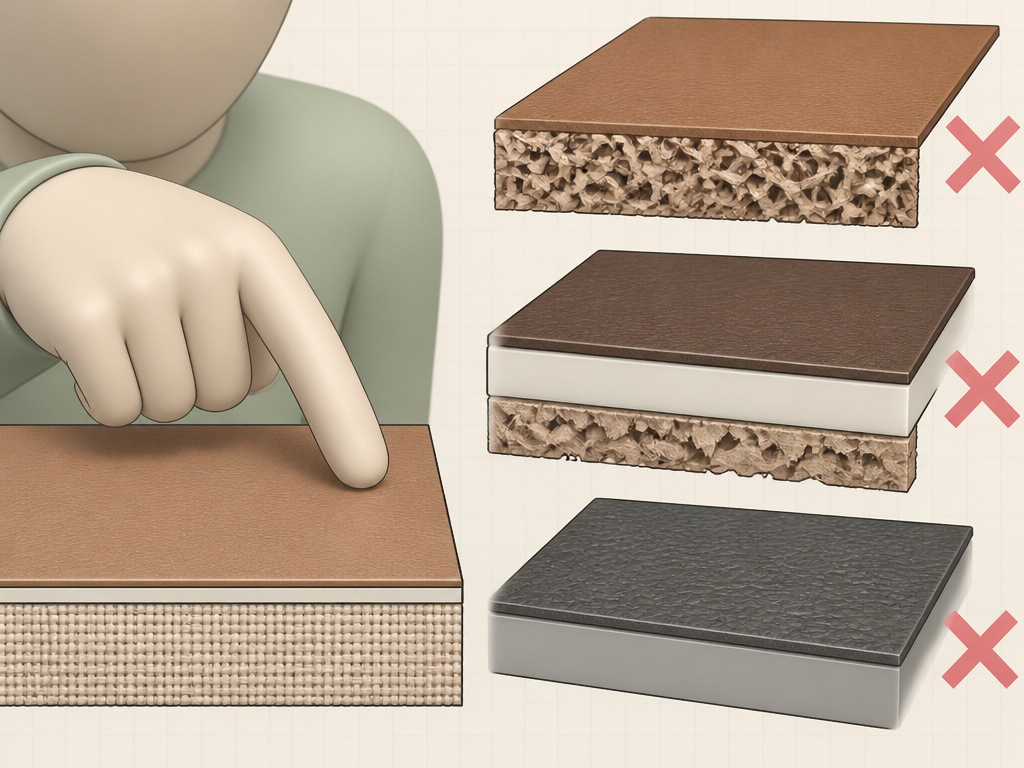
It’s not that PU is bad. It’s that other materials are better suited for specific jobs, and confusing them leads to disappointment. The label “faux leather” is a bucket holding several different materials. Let’s be clear about one thing: knowing the difference saves you money.
PU Leather vs. Bonded Leather: Bonded leather is the bottom of the barrel. It’s made from shredded leather fibers mixed with latex or PU binder and pressed into sheets, then often given a PU topcoat. It feels dusty, has almost no strength, and disintegrates with time and sunlight. PU leather, even on a fabric base, is more dimensionally stable and durable. If you must choose a synthetic, a fabric-backed PU with a high rub count is a more honest product than bonded leather.
PU Leather vs. Bicast Leather: This is where it gets tricky. Bicast leather starts with a split leather base (real leather), but then it’s coated with a heavy layer of polyurethane and embossed with a grain. It’s often marketed as “real leather.” The problem is the thick plastic coating. It can’t develop a patina, it’s not breathable, and when it eventually cracks, you’re left with an ugly, plastic shell over a thin layer of leather fiber. A fabric-backed PU leather is at least upfront about being synthetic.
PU Leather vs. PVC Leather (Vinyl): PVC leather is the older, cheaper synthetic. It’s stiffer, less breathable, and can feel clammy. It also tends to crack with age rather than peel. Environmental and health concerns over chlorine and plasticizers have pushed many brands toward PU as a “less bad” plastic option. For a budget-conscious project where flexibility isn’t key, vinyl might still be evaluated, but PU generally offers a softer hand and better color clarity.
Common mistake: Treating a PU-coated item with traditional leather conditioner. The oils and waxes can’t penetrate the plastic layer. At best, they sit on top and attract dirt. At worst, they can degrade the adhesives binding the coating to the base, speeding up delamination.
The Performance Reality: Lifespan and Failure Modes
I once over-complicated advice on conditioning a simple belt, loading the reader down with too many options and caveats. The belt just needed a light oil twice a year. With PU leather, the failure modes are simpler, more predictable, and far less fixable.
The leather will tell you what it needs. PU leather announces its failures loudly.
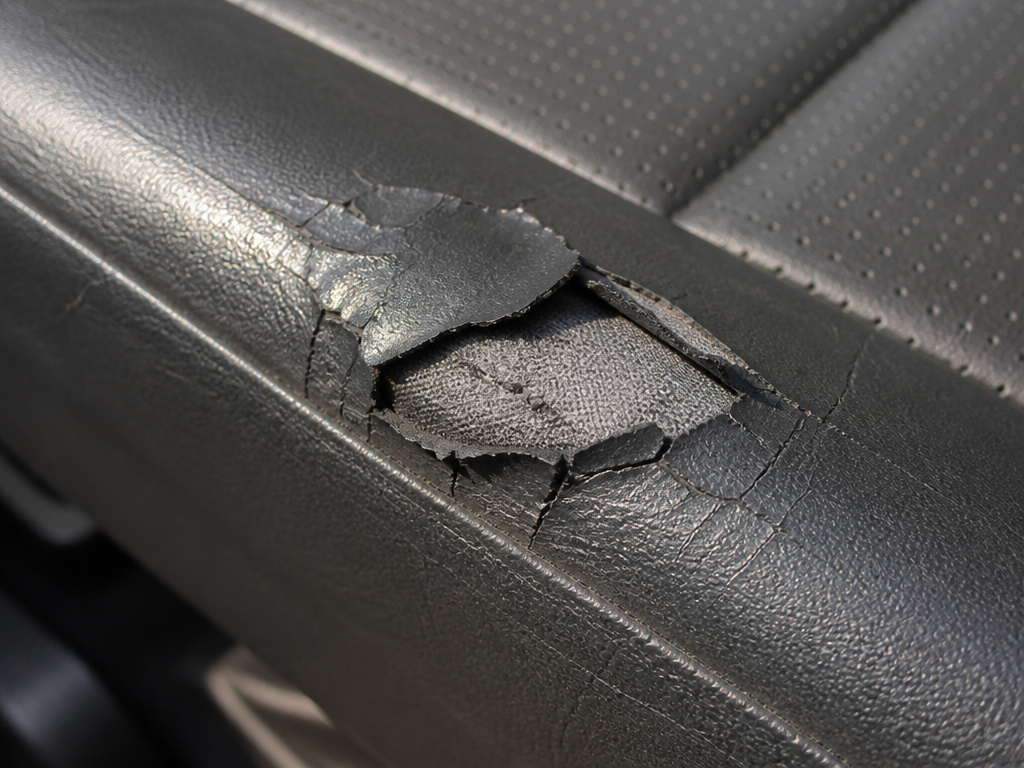
The 1-2 Year Window: With frequent, daily use, think an office chair, a daily-wear wallet, or a car seat, lower-grade PU leather typically starts to crack within 1-2 years. The stress points go first: creases, corners, areas of constant flex. The coating, which is a plastic film, loses its plasticity and develops a network of fine fractures.
Delamination (Peeling): This is when the PU coating separates from the base fabric. You’ll see it as bubbles or flaps. It’s caused by poor adhesive, mechanical stress, or exposure to oils and solvents (like from your skin or cleaning products). Once it starts, it spreads.
Discoloration from Sun and Heat: Direct sunlight bleaches and dries out the plasticizers in PU. The material fades, turns chalky, and becomes brittle. A car interior left in a sunny lot will show this damage within a single summer. UV protectant sprays can slow it, but they’re a temporary barrier, not a cure.
The Sticky Feeling of Hydrolysis: In a humid environment, you might notice the surface of a PU item, like shoes or a gym bag, feeling tacky. That’s the early stage of hydrolysis. Left unchecked, it progresses to cracking. This is why hydrolysis resistance is an essential spec for certain applications.
The practical takeaway? Buy PU leather for what it is: a cost-effective, design-flexible material for medium-term use. Don’t buy it expecting a lifetime companion. For that, you need to look at full-grain vegetable-tanned leather or truly durable alternatives like waxed canvas.
Is PU Leather a Sustainable or Vegan Choice?
This is where marketing and material science collide head-on. Most polyurethane-based ‘vegan leathers’ are an environmental disaster masquerading as an ethical choice, destined for landfill long before a well-maintained leather item would even be considered worn.
The Vegan Claim: Yes, fabric-backed PU contains no animal products. It is technically vegan. However, the environmental cost is often ignored. PU is a petroleum-derived plastic. Its production involves isocyanates (potentially hazardous chemicals), and it is not biodegradable. At end-of-life, it sits in a landfill for centuries.
The Circularity Problem: Unlike a natural leather jacket that can be repaired, re-dyed, and reworn for decades, a PU jacket that cracks is trash. You can’t sand it down and refinish it. You can’t effectively patch it. The complex laminate of fabric, adhesive, and plastic makes it unrecyclable through standard municipal streams.
Better Alternatives Exist: If your goal is an ethical, durable purchase, evaluate materials on their entire lifecycle. My stance is to champion emerging plant-based alternatives that are building circularity in from the start. Natural Fiber Welding’s Mirum is a plastic-free, biocomposite material. Desserto cactus leather uses cactus nopal as a base. Vegea makes material from grape marc leftover from winemaking. These are nascent and often more expensive, but they represent the direction of meaningful innovation, not just greenwashing a plastic laminate.
Overrated in this space is the hype around pineapple leather (Piñatex) for durable goods; it’s a fascinating material but lacks the tensile strength and abrasion resistance for items like bags or shoes without heavy backing and coating, which often brings us right back to a PU layer.
How PU Leather Is Actually Made (The Wet Process)
Understanding how leather is made traditionally involves tanning, fatliquoring, and drying. Making PU leather is a different kind of alchemy, one of coatings and coagulations. The most common method for creating the porous, leather-like surface is the wet-phase inversion process.
Here’s the short version: 1. A base fabric (woven or nonwoven) is pre-wetted. 2. It is coated with a layer of soluble polyurethane (SPU) dissolved in a solvent like dimethylformamide (DMF). 3. The coated fabric is immersed in a water bath. 4. The water is a “non-solvent” for the PU. This causes the PU to coagulate out of the solution, forming a porous, spongy layer on the fabric. 5. The material is washed, dried, and may receive a final topcoat or embossing to create the desired grain, like a pebbled leather texture or the distinct cross-hatch pattern of Saffiano leather.
This porous layer is what allows some breathability and gives the material a softer hand than a simple plastic film. The thickness and porosity of this layer are controlled by the recipe and the process timing. After this, the material might be dyed or have a surface grain applied through embossing.
Frequently Asked Questions
Is PU leather good quality?
It depends entirely on the specification and the application. A high-grade PU leather on a microfiber base, with high hydrolysis and abrasion ratings, can be excellent quality for a mid-market car interior where uniformity and cleanability are paramount. A low-grade PU on a loose fabric backing is poor quality for any demanding use. The term “PU leather” alone tells you nothing about quality, you must ask for the technical data sheet.
Does PU leather peel?
Yes, peeling (delamination) is a common failure mode, especially in lower-quality products or when the material is exposed to oils, solvents, or repeated stress. The polyurethane coating separates from the base fabric. Higher-quality manufacturing with better adhesives and a more compatible fabric backing can delay this, but the risk is inherent to the laminated structure.
How can you tell real leather from PU leather?
Identifying real leather involves using your senses. Look for natural grain imperfections and pore patterns (uniform embossing is a giveaway). Feel it, real leather warms to your touch, while PU often feels cool and plasticky. Smell it, real leather has a distinctive, organic smell, while PU can have a chemical or plastic odor. The “pinch test” also helps: real leather wrinkles and shows smaller creases when pinched; PU tends to show fewer, larger creases and may feel stiffer.
Is PU leather the same as patent leather?
No. Patent leather is a finish, not a base material. It’s a high-gloss, lacquer-like coating that can be applied to real leather or to PU leather. You can have “PU patent leather,” which is a plastic-coated material with a shiny topcoat. Traditional patent leather uses a different chemistry and is often based on real leather.
Before You Buy
One rule most guides skip: if your primary concern is longevity and repairability, PU leather is the wrong choice. Its lifespan is capped by the inevitable degradation of a plastic film. If you need design consistency and a lower upfront cost for a medium-term product, it can be the right technical choice, but only if you source the correct grade.
Here’s the practical threshold. Before you commit to a PU leather item, ask yourself: “Am I okay with this likely needing replacement in 2-5 years?” If the answer is yes, and the price reflects that, proceed. If you want an item to age with you, developing character and lasting decades, your money is better spent on full-grain leather, waxed canvas, or one of the newer, more durable plant-based alternatives.
The leather world, both real and synthetic, is filled with compromise. PU leather’s compromise is time for money and control. Understand that trade-off, read the specs, and you’ll make a confident choice.
