
What Thread to Use for Leather Stitching: A Complete Guide
This post contains affiliate links. As an Amazon Associate, we earn from qualifying purchases.
Use a 0.55mm diameter waxed polyester or linen thread for general leather goods like handbags and satchels. For small items like wallets, drop to 0.45mm. The thread material determines longevity and repairability: synthetic threads like Ritza Tiger Thread are strong and consistent, while traditional waxed linen thread wears predictably and is easier to replace when the seam eventually fails.
That diameter recommendation isn’t a guess. It’s the published spec from sources like Decocuir for hand-saddling, and it exists because a thread that’s too thin cuts through the leather under stress, while one that’s too thick won’t pull through pre-punched holes without tearing. The choice between polyester and linen, however, decides what happens to your project a decade from now.
What follows is a breakdown of the three variables that actually matter, diameter, material, and finish, plus the needle pairing that makes or breaks the stitch. We’ll also look at when to break the standard rules for belts, watch straps, and machine work.
Key Takeaways
- The default thread diameter for hand-sewn leather goods is 0.55mm (size 632 / M50). For fine work on wallets, use 0.45mm.
- Waxed linen thread fails by tearing, making future repairs straightforward. Synthetic polyester thread fails by cutting the leather, which complicates restoration.
- Never pair a thick thread with a small needle. If you can’t achieve smooth tension and the knot keeps surfacing, your needle is too small for the thread.
- For stitch densities over 10 stitches per inch, you must use a round-point needle. A chisel point will shear the leather between holes.
- The ASTM D6193 standard defines proper seam engineering as balancing strength, elasticity, durability, security, and appearance, thread choice is the first variable in that equation.
The Core Variables: Diameter, Material, and Finish
Open any thread catalog and you’re hit with a dozen numbers and names. Ignore the marketing. Your decision narrows to three specs: how thick it is, what it’s made from, and whether it’s coated.
The most common diameter for hand-saddling leather goods, think handbags, satchels, totes, is 0.55mm. That corresponds to Fil Au Chinois size 632 or Meisi M50. It’s a sweet spot: thick enough to fill a 1mm pricking iron hole without slop, thin enough to pass through multiple layers of 3-4 oz leather without needing a hammer. For small leather goods like card holders and key fobs, the standard drops to 0.45mm (size 832 / M40). The smaller stitch spacing on these items looks clunky with a thick thread.
ASTM D6193 standard practice defines seam engineering as “the determination of the best stitch type, seam configuration, and thread type which should be used for a particular assembly.” The standard notes that improper selection of any one component can result in failure of the sewn junction.
Material is where you choose your project’s future. You have two main paths: synthetic or natural.
Polyester thread (like Ritza Tiger Thread) is consistent, strong, and rot-proof. It’s a braided filament wrapped in a polyester sheath, which gives it a round, smooth profile that pulls evenly. It’s my default for anything that will see weather or heavy use. Nylon is similar but has more stretch and can degrade with prolonged UV exposure.
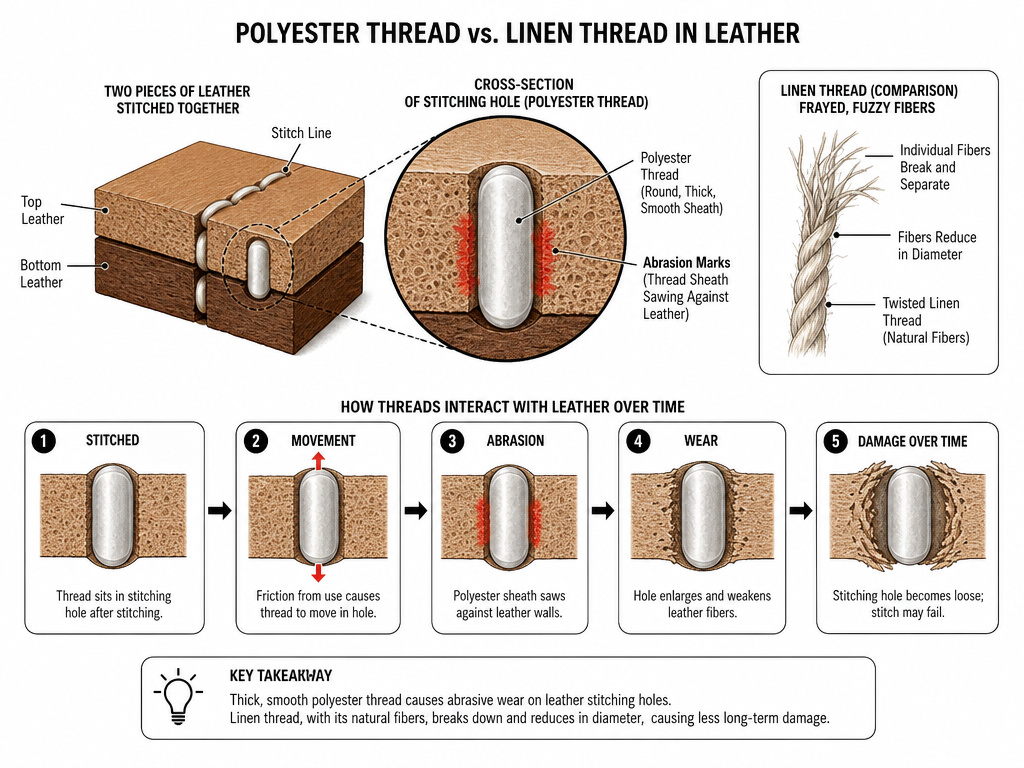
Linen thread is the traditional choice. It’s a twisted natural fiber, usually waxed. Its advantage isn’t raw strength, it’s how it fails. When a linen seam wears out from years of friction, the thread fibers tear. You can unpick the remnants and re-sew the same holes. A synthetic thread, under the same conditions, will slowly saw through the leather like a wire. Repairing that means patching or abandoning the piece.
The finish, wax or pitch, isn’t decorative. Waxing does three things: it binds the fibers, reduces friction as the thread passes through the leather, and slightly waterproofs the seam. You should wax even pre-waxed thread before a long stitch; the heat from pulling it through your fingers melts a fresh layer into the fibers. Pitch is a heavier, stickier coating derived from pine resin used in saddlery for maximum water resistance.
Matching Needle to Thread (And Why Getting It Wrong Puckers Seams)
This is the most common mechanical mistake I see. The needle’s job is to carry the thread through the hole without damaging either. If the relationship is off, the thread won’t follow freely.
Think of the needle’s eye as a tunnel. The thread should fill about two-thirds of that tunnel’s space. Less than half, and the thread whips around, causing uneven tension and weak loops. More than 90%, and the thread drags against the sides of the eye and the leather hole with every pull. That drag creates heat, weakens the thread, and, here’s the visible sign, forces you to pull harder to seat the stitch, which puckers the leather.
Where this goes sideways: Pairing a thick thread with a small needle. The constant friction heats the thread, melts any wax coating prematurely, and the increased pull force deforms the stitch holes. The seam will look gathered, not flat.
Sailrite’s leather guide states it plainly: if you cannot get the desired thread tension and the knot constantly shows on the bottom, the thread and needle are too large. The reverse is also true. A tiny thread in a giant eye has no control.
| Thread Diameter | Recommended Needle Size (John James) | Best For |
|---|---|---|
| 0.45mm (M40 / 832) | Size 004 (0.8mm shaft) | Wallets, cardholders, fine stitch lines |
| 0.55mm (M50 / 632) | Size 002 (1.0mm shaft) | General handbags, belts, satchels |
| 0.65mm (M60 / 432) | Size 001 (1.2mm shaft) | Heavy bags, saddle skirts, structural seams |
Needle point matters as much as size. For hand-sewing with pre-punched holes, you use a round point needle. Its blunt tip won’t catch or split the leather fibers as you navigate the existing hole. For machine sewing or very thin leathers where the needle must pierce the material, a sharp point (like a wedge or diamond point) is necessary. The Tippmann Industrial guide warns against using a chisel point needle for high stitch densities, at over 10 stitches per inch, the cutting action can tear the leather from hole to hole.
Hand-Sewing vs. Machine-Sewing: A Different Game
The best thread for your project changes completely depending on whether you’re pushing a needle by hand or using a machine. The mechanics are not the same.
For hand stitching, especially the saddle stitch, you want a thread with some body and friction. A braided or twisted thread that’s been well-waxed is ideal. The wax helps it grip itself within the hole, forming the lock that makes the saddle stitch so secure. This is where the classic 0.55mm diameter shines. The process is slow, but the result is a seam that can be repaired stitch-by-stitch decades later. If you’re new to this, our guide on the fundamental hand-stitching process walks through the setup.
Machine sewing leather demands a different thread. Domestic machines generally use a lighter, spun polyester thread (size 69 or 92) because the machine’s tension discs and bobbin case can’t handle thick, waxed cords. Industrial leather machines use heavier topstitching thread, often a bonded nylon or polyester filament. The key here is consistency, the thread must be perfectly uniform to avoid snags at high speed. Unlike hand-sewing, a machine lockstitch concentrates wear on a single loop of thread within the seam. If that thread fails, the entire seam can unravel.
The part nobody mentions: A hand-saddled seam with two independent threads is inherently more secure than a machine lockstitch. If one thread wears through in a saddle stitch, the other still holds the seam together. In a machine stitch, that single thread breaking can open a chain reaction.
This durability difference is why I advocate for hand stitching on any piece meant to last. The saddle stitch method is worth the extra hour.
Special Cases: Belts, Watch Straps, and High-Density Stitching
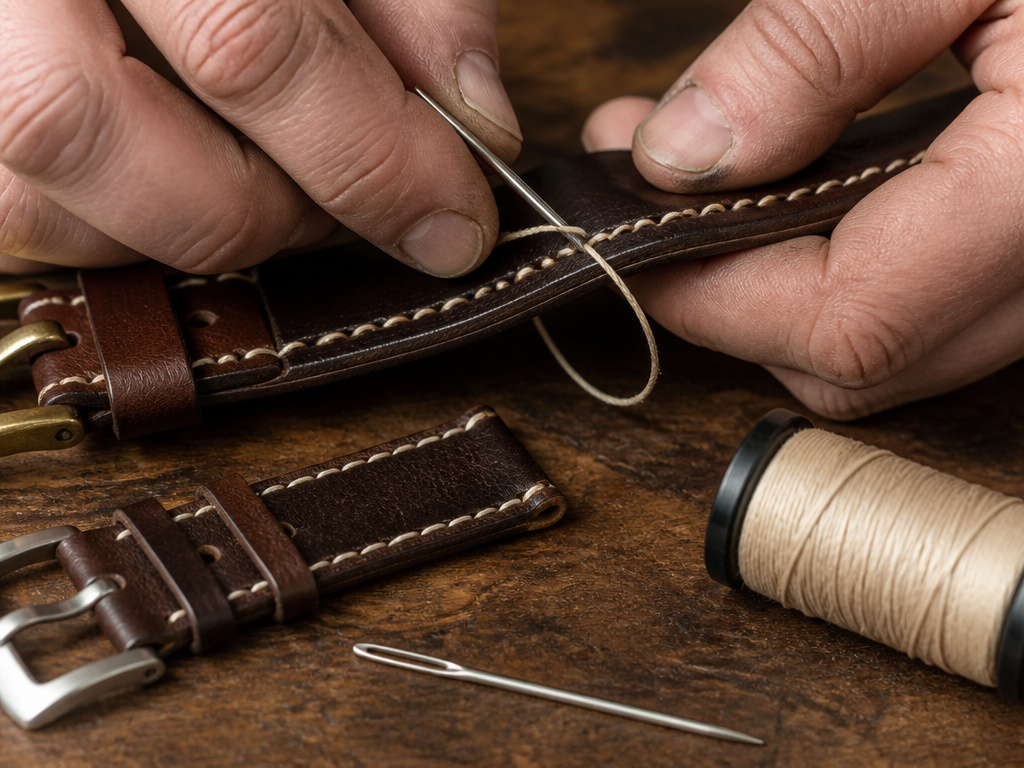
Not all leather projects are a standard bag. The thread spec shifts for specialized items.
- Belts: You need a thread that looks good on the surface and withstands constant flex. Schmetz recommends a core-spun polyester thread (sizes #40 to #8) for the top stitch for appearance, with a thinner thread in the bobbin. The top thread is thicker and more visible, so it’s chosen for its look.
- Watch Straps: These involve very fine, dense stitching. Here, bonded polyamide (nylon) filament threads are common because the ends can be melted and welded cleanly, leaving no bulky knot to irritate the wrist.
- Saddlery & Harness Work: This is the domain of heavily waxed linen thread or pitched synthetic thread. The priority is absolute water resistance and rot-proofing. The thread is often a beefy 0.8mm or larger.
- High Stitch Density: When you’re punching more than 10 stitches per inch (like on fine folios or portfolio edges), you must use a round-point needle. The Tippmann guide is explicit: a chisel point at this density will cut the leather between holes, leading to a tear-out along the stitch line.
For these applications, the general thread selection factors of diameter and material still apply, but the priority order changes. For a belt, appearance might trump absolute tensile strength. For a watch strap, clean finishing is everything.
Why-Layer: The Mechanics Behind the Recommendations
A rule without a reason is just folklore. Here’s what’s happening inside the seam.
Why does diameter matter? Thread strength increases with its cross-sectional area. A 0.65mm thread is roughly 40% stronger in pure tension than a 0.55mm thread. However, strength isn’t the only limit. The hole in the leather is a fixed size. A thread that’s too thick for the hole abrades against the edge with every movement, acting like a tiny saw. This is the “cutting” failure of synthetic threads. The 0.55mm standard for handwork balances strength against this abrasive wear.
Why does linen tear but polyester cut? It’s about fiber structure. Linen is a bundle of short, natural fibers twisted together. Under abrasive wear, these fibers break individually and fuzz out, reducing the thread’s diameter until it tears. Polyester is a continuous filament with a smooth, bonded sheath. It doesn’t fuzz; it maintains its diameter like a cable, concentrating wear on a single point of the leather hole until it wears through.
A 2024 study in the International Design Journal examined variables in cow leather seams. The peer-reviewed leather seam study found that stitching along the grain direction significantly increased seam strength, as the thread makes use of the aligned leather fibers. This is a perfect example of seam engineering, matching your technique to the material’s properties.
Why wax? It’s not just for tradition. Wax lubricates the thread’s passage, reducing heat and friction that weakens fibers. It also fills the microscopic gaps between fibers, making the thread more round and consistent, which leads to even tension and a flatter seam.
A Real-World Choice: Ritza Tiger Thread vs. Waxed Linen
Let me share what I’ve learned. In my shop, two spools live within arm’s reach: Ritza Tiger Thread in 0.55mm and a spool of waxed linen from a local supplier.
The Tiger Thread is my go-to for 90% of work. It’s consistent, comes in endless colors, and its braided construction lays flat perfectly every time. It’s the right choice for a customer’s commission where predictability is key. The linen comes out for my personal projects, or for pieces where I envision myself, or someone else, repairing them in thirty years. There’s a honesty to its failure mode.
I learned the importance of finish the hard way. I once used a poorly waxed linen on a briefcase handle. After six months of daily use, the friction had frayed the thread inside the stitch channels, leaving a weak, fuzzy seam. Rewaxing the thread properly before stitching would have bound those fibers from the start. Now, I pull every length of thread, synthetic or natural, across a block of beeswax before I thread the needle. The difference in hand-feel is immediate, the thread glides.
Your top thread choices ultimately depend on the life you expect the object to have. This is based on years of practical experience.
Frequently Asked Questions
Can I use regular sewing thread on leather?
No. Regular cotton or all-purpose polyester thread is too thin and weak. The abrasive nature of leather edge holes will quickly fray and break it. Leather requires a heavier-duty thread specifically designed for the material’s weight and stiffness.
What is the best thread for stitching leather by hand?
For most hand-sewn projects like bags and belts, a 0.55mm diameter waxed polyester thread (like Ritza Tiger Thread) is the best all-around choice. It offers an excellent balance of strength, consistency, and ease of use. For traditionalists or items where future repairability is paramount, a 0.55mm waxed linen thread is the best alternative.
How do I choose between polyester and nylon thread for leather?
Choose polyester for general use. It has less stretch, better UV resistance, and is more rot-proof than nylon. Choose nylon if you need a seam with significant elasticity, such as on sheaths or cases for items that flex constantly. Be aware that nylon can degrade and become brittle with long-term sun exposure.
What size needle do I need for leather stitching?
Match the needle shaft diameter to your thread. For 0.55mm thread, use a needle with a shaft around 1.0mm (like a John James size 002). The thread should fill about two-thirds of the eye. Using a stitching awl? The same rule applies, the thread must pass smoothly through the awl’s eye without binding.
Is saddle stitching stronger than machine stitching?
Yes, for leather, a hand-sewn saddle stitch is stronger and more durable than a machine lockstitch. The saddle stitch creates two independent interlocking threads within the same hole. If one thread breaks, the other secures the seam. A machine stitch is a single chain of loops; if the thread breaks, the seam can unravel. For a deep dive, read our comparison of saddle stitch vs machine stitch durability.
How do I keep my thread from tangling while hand-stitching?
Wax your thread thoroughly. The wax binds the fibers and reduces static. Use a stitching pony to hold your work, keeping both hands free to manage the needles. Finally, maintain consistent, moderate tension, don’t yank each stitch tight, which twists the thread and leads to knots.
Before You Go
The practical takeaway is this: start with a 0.55mm waxed polyester thread and a matching needle. That combination will succeed on 80% of your projects. Once you’re comfortable, experiment with linen to understand its character.
The leather will tell you what it needs. If the thread is dragging and the seam is puckering, your needle is too small. If the thread looks lost in the hole, go up a diameter. This isn’t about memorizing charts; it’s about observing the mechanics of the materials in your hands.
Understand leather better to make confident choices. Ignore the marketing copy on thread spools that promises “ultimate strength.” Look instead for the diameter and material. Those two numbers, paired with the right needle and a block of beeswax, are what build a seam that lasts.
