
What Is a Moccasin | The Footwear That Shaped North America
This post contains affiliate links. As an Amazon Associate, we earn from qualifying purchases.
This post contains affiliate links. As an Amazon Associate, we earn from qualifying purchases.
A moccasin is a type of footwear, traditionally made from a single piece of animal hide, that is drawn up around the foot and sewn with a seam over the instep. Characterized by its flat, flexible sole and lack of a separate heel, its core purpose is protective yet tactile, allowing the wearer to feel the ground. The design is fundamentally Native American, with specific constructions, hard soles for rocky plains, soft soles for forest floors, evolving directly from environmental needs.
That “single piece of hide” definition is the starting point, not the full story. The real history is a map of adaptation, where geography dictated the entire structure of the shoe, not only its decoration. From the Subarctic to the Sonoran Desert, the moccasin was re-engineered for snowshoes, cactus thorns, and everything in between.This subject concerns a profoundly practical invention that solved specific problems with elegant, localized craftsmanship, rather than a static, ancient design.
What follows is a breakdown of the moccasin’s defining anatomy, the environmental logic behind its two main forms, and how this Indigenous innovation morphed into the casual shoes we recognize today. You’ll learn why a true moccasin isn’t just a slipper, but a lesson in material intelligence.
Key Takeaways
- The word “moccasin” comes from Algonquian languages and traditionally described a shoe with a distinctive puckered U-shaped piece (a vamp) over the instep.
- Construction splits into two adaptive types: hard-soled moccasins for the rocky plains and deserts, and soft-soled moccasins for the soft ground of eastern woodlands.
- Traditional moccasins were most often made from 3-4 ounce deerskin or elk hide, thick enough for durability but soft enough to hand-sew.
- The modern “driving moccasin,” with its rubber nubs, is a direct descendant, but its soles are not repairable and the shoes are not water-resistant.
- True moccasin construction, where the upper and sole are a single wrapped piece or stitched together, remains a benchmark for flexible, comfortable footwear.
The Core Definition: More Than a Simple Shoe
Let’s be clear about this. A moccasin isn’t just any flat leather shoe. The term, adapted from Powhatan and other Algonquian words like makasin, originally pinpointed a specific build: a shoe where a U-shaped piece of leather, called a vamp, is gathered over the instep. That puckered seam is a hallmark. The Fashion History Timeline on moccasins defines it succinctly as “essentially a shoe made up of one piece of hide drawn up around the foot and sewn with no seams on the lower part.”
This construction method is the whole game. Instead of attaching a pre-made sole to an upper, the leather itself forms both the sole and the sides in one continuous wrap. The result is a shoe with unparalleled flexibility and a close-to-the-ground feel. It molds to the foot rather than forcing the foot into a rigid shape. When you’re assessing leather quality in a modern context, this wrap construction is a sign of a shoe built for comfort, not just style.
The moccasin, an Algonquian Native American word for footwear, is essentially a shoe made up of one piece of hide drawn up around the foot and sewn with no seams on the lower part. This single-piece, wrap-around construction is the defining technical feature that separates true moccasins from other slip-on shoes.
I used to think of moccasins only as beaded souvenirs or plush slippers. Then you handle a traditionally made one. The absence of a stiff midsole is immediately apparent. You can roll it in your hand. This flexibility was a survival feature, allowing for silent, sensitive movement across varied terrain. Today, that same principle translates to a broken-in feel from the first wear.
Anatomy of a Moccasin: Parts and Purpose
Understanding the parts explains why it works. The Wikipedia entry on the moccasin notes the variety, but three elements are consistent.
First, the vamp. This is the piece of leather that covers the top of your foot. In the classic “pucker-toe” style, it’s a U-shaped insert that is deliberately gathered, creating a distinctive wrinkled toe box. This wasn’t just decorative; the gathers provided extra material for a better fit. Other styles use a wider vamp or even a central seam running from toe to ankle.
Second, the sole. In a true soft-sole moccasin, the sole is the central part of that single hide that wraps upward, not a separate component. For hard-sole versions, a piece of stiff rawhide is cut and stitched to a separate upper.This is a two-piece construction, a direct adaptation to harsh ground.
Third, the perimeter. This is the edge of the leather that gets stitched. In one-piece moccasins, the perimeter is sewn to itself along the top. In two-piece builds, the perimeter of the upper is stitched to the perimeter of the sole. The thread traditionally was sinew (animal tendon), prized for its strength. The stitching was often done inside-out, so the finished seam sat protected on the interior, with knots on the outside for comfort.
| Part | Function | Traditional Material | Modern Equivalent |
|---|---|---|---|
| Vamp | Covers instep, provides shape & fit | U-shaped deer/elk hide | Often a single piece of leather or suede |
| Sole | Provides protection & ground feel | Same hide as upper (soft) or rawhide (hard) | Thin leather, rubber nubs, or crepe |
| Stitching | Holds the structure together | Sinew (animal tendon) | Waxed polyester or nylon thread |
| Cuff/Legging | Extended ankle or calf protection | Additional hide, often fur-lined | Uncommon in casual styles; seen in boots |
The choice of leather was critical. As noted in the research, very thin 1-2 ounce leathers were impractical, and heavy 5-6 ounce hides were nearly impossible to sew by hand. The sweet spot was, and still is for handcraft, a 3-4 ounce deerskin or elk hide. It’s sturdy enough to withstand walking but pliable enough to needle. This thickness is a great real-world benchmark when you’re learning about the characteristics of leather grain and how it behaves.
Hard Sole vs. Soft Sole: An Environmental Blueprint
This is where the moccasin proves it’s a tool, not just a garment. The sole type wasn’t a stylistic choice from a catalog. It was a geographical imperative. The NativeTech moccasin overview lays this out perfectly: the design was for “their specific environment.”
Soft-sole moccasins were the domain of the Eastern Woodlands and forests. Tribes like the Huron or Iroquois walked on carpets of pine needles, moss, and leaf litter. A thick, rigid sole would have been a clumsy hindrance. Their moccasins were typically made from that single piece of soft leather, puckered at the toe. The sole was simply the underside of the same hide. It provided just enough barrier from moisture and cold while granting the wearer supreme sensitivity to the forest floor, crucial for tracking and silent movement.
Hard-sole moccasins were born on the Plains and in the desert Southwest. Here, the ground was unforgiving: sharp rocks, cactus spines, and abrasive prairie grass. A soft sole would be punctured or worn through in days. The solution was a two-piece construction: a sturdy upper stitched to a separate sole made of thick, hardened rawhide. Some designs, like those of the Apache, featured a distinctively turned-up toe. This wasn’t a stylistic quirk. That upturn prevented sharp objects from running directly into the front seam and injuring the foot.
Where this goes sideways: Assuming all moccasins are soft-soled. Walking a rocky path in a woodland-style moccasin would destroy it in an afternoon, just as wearing stiff rawhide soles in a dense forest would be needlessly loud and cumbersome.
The difference was so pronounced that, as some sources note, a skilled tracker could identify a person’s tribe by their moccasin prints alone. The hard, flat impression of a rawhide sole versus the soft, conforming imprint of a hide sole told a clear story. This environmental logic is the ultimate “why-layer.” The construction is the direct, physical answer to the question underfoot.
From Traditional Craft to Modern Style
The moccasin never really went away. It was adopted. European fur traders and voyageurs quickly swapped their stiff, heeled boots for Indigenous-made moccasins because they were warmer, quieter, and more practical for wilderness travel. This adoption was the first step in a long evolution.
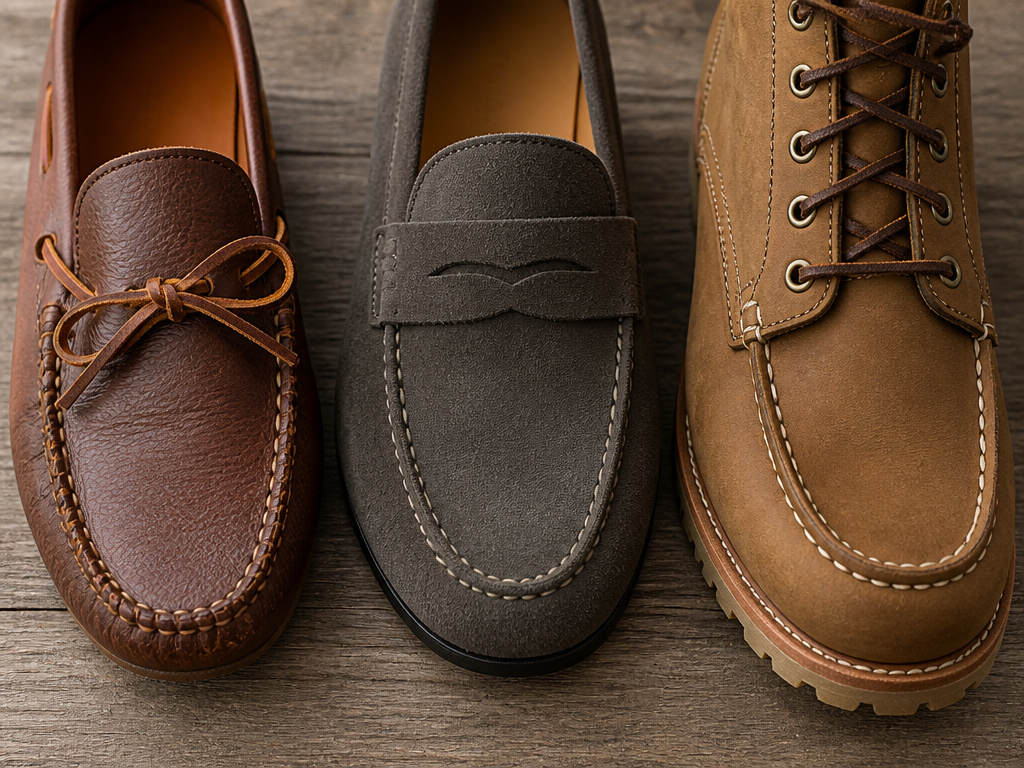
Post-World War II, the moccasin shape morphed into several familiar fashion categories. The handsewn, wrap construction became the blueprint for the classic loafer. The pursuit of casual, slip-on comfort led directly to the driving moccasin, a car-centric design with rubber nubs glued to a leather sole for grip on pedals. Let me share what I’ve learned about these modern versions. Those rubber nubs can’t be repaired once they wear down; the shoe is simply done. Also, the gaps between the nubs allow water to seep in instantly, making them useless in wet weather.
Then there are moc-toe boots, where the distinctive puckered seam over the toe box is replicated in a heavy boot format, often with a hard rubber lug sole for workwear. Each of these is a translation of the original moccasin principle into a new context. The through-line is always comfort and a certain relaxed sensibility rooted in that flexible, foot-hugging build.
When you look at a modern suede loafer, you’re seeing the moccasin’s legacy. The use of suede leather or nubuck for the upper is a direct nod to the soft, napped finish of traditionally smoked hides. The debate over nubuck vs suede in these shoes is a modern concern about durability and scuffing, but the underlying form is centuries old.
How to Identify a True Moccasin Construction
So, how can you tell if a shoe is genuinely built like a moccasin? Look for two things.
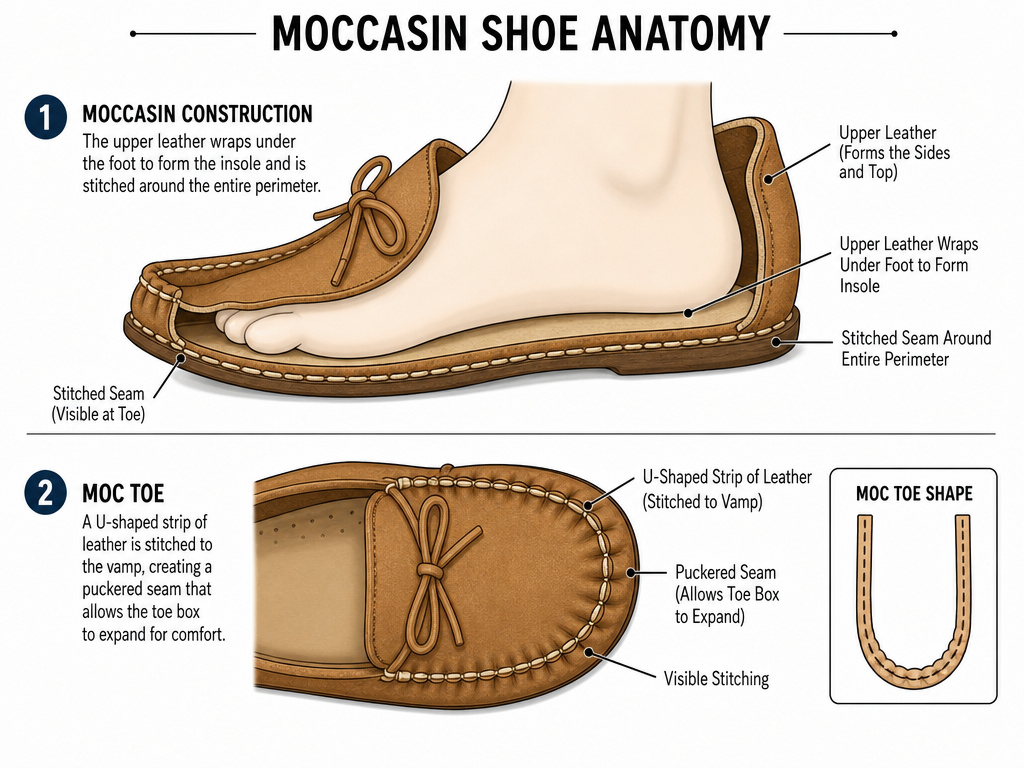
First, examine the relationship between the upper and the sole. On a true moccasin, the upper leather will wrap under your foot to form the insole, or it will be visibly stitched to a separate sole with a seam that runs around the entire perimeter of the shoe. This is called a “moccasin construction” or “California construction” in shoe-making terms. If the sole is just glued on (cemented), it’s borrowing the style, not the structure.
Second, check for the “moc toe.” This is that recognizable strip of leather stitched over the top of the toe box, often creating a U-shaped or puckered appearance. It’s a stylistic remnant of the functional vamp from traditional designs. Not all moccasin-style shoes have it, but its presence is a strong clue.
Here’s a straightforward way to think about it. A shoe can have a moccasin style (slip-on, casual, maybe a moc-toe) without having moccasin construction. The latter is about the hidden architecture, the way the pieces come together to create that signature flexibility. When you’re learning about how leather is made, you start to see why this construction matters: it uses the natural pliability of the hide as a feature, not a bug.
Common mistake: Confusing “genuine leather” with quality moccasin construction. The term “genuine leather” is a generic classification that tells you nothing about the hide’s thickness, finish, or durability. A poorly made shoe can be “genuine leather” and still fall apart. Focus on the construction details first.
This matters because construction dictates longevity and feel. A cemented sole will eventually separate. A stitched sole can be resoled. That handsewn moccasin build, when done well, conforms to your foot like few other shoes can. It’s the difference between buying a look and buying a function.
Frequently Asked Questions
Are moccasins good for your feet?
They can be, due to their flexibility which allows your foot to move naturally. However, they offer minimal arch support or cushioning. For some, this promotes foot strength; for others with specific biomechanical needs, it can lead to discomfort. They are best for casual, limited walking on forgiving surfaces.
What’s the difference between a moccasin and a loafer?
All loafers are descended from the moccasin shape, but not all are true moccasin construction. A loafer is a specific style of slip-on shoe, often with a heel and a more structured shape. A true moccasin refers to the specific wrap-and-stitch construction method that results in an extremely flexible sole. Many loafers use cemented or Blake-stitched construction instead.
Can you wear moccasins outside?
Traditional soft-sole moccasins are not designed for modern pavements and will wear out quickly. Modern “outside” moccasins or driving mocs have added rubber soles for durability. Always check the sole material. Leather soles are for indoor or very gentle outdoor use; rubber soles are necessary for regular outdoor wear.
How should moccasins fit?
They should fit snugly but not tightly, hugging your heel and instep with a little room for your toes to move. Because they are made of soft leather, they will stretch and mold to your foot shape over time. A brand-new pair should not have any painful pressure points.
What is a “water moccasin”?
This is a case of shared name, nothing more. A water moccasin is a venomous snake (also called a cottonmouth) found in the southeastern United States. It has no relation to the footwear, other than the borrowing of the word “moccasin,” likely due to the snake’s muted, leathery coloration.
The Bottom Line
A moccasin is a lesson in adaptive design. It started as a brilliant, region-specific solution for traversing a continent, built from locally available hides with breathtaking efficiency. That core idea, a flexible, protective wrap for the foot, proved so effective that it never died out. It was adopted, adapted, and eventually evolved into whole categories of modern casual shoes.
When you see a loafer or a driving shoe, you’re seeing the moccasin’s long shadow. The takeaway is practical as well as historical. If you value comfort that comes from structure, not padding, seek out shoes that use true moccasin construction.Look for that perimeter stitching and flexible sole. And remember, the best leather for the job has always been that middle ground: not too thin, not too thick. It’s a timeless principle for a timeless piece of footwear.
