
Suede vs Leather Guide: Comparing Durability, Care & Best Uses
This post contains affiliate links. As an Amazon Associate, we earn from qualifying purchases.
This post contains affiliate links. As an Amazon Associate, we earn from qualifying purchases.
Choosing between suede vs leather means matching structure to function. Grain leather uses the dense, outer grain layer of a hide for strength and weather resistance. Suede uses the softer, inner corium layer for a luxurious nap that requires sheltered, dry conditions and meticulous care.
The difference is structural, not material, both come from the same animal skin. That single fact changes everything about how they perform, age, and what they cost you over a decade. Grain leather’s tight collagen fibers resist abrasion; suede’s looser fibers flatten and compress.
This guide breaks down the numbers: tensile strength, flex cycles, lifespan projections, and the real-world care routines each demands. You’ll see why a grain leather jacket is a 20-year investment and a suede jacket is a 10-year luxury, and you’ll know exactly which one fits your life before you spend a dime.
Key Takeaways
- The core difference is structural: Grain leather uses the hide’s tough outer layer; suede uses the softer inner layer. This dictates all performance.
- Grain leather wins on longevity: Expect 10-50 years with minimal care. Suede lasts 5-15 years and demands weekly brushing and immediate stain treatment.
- Water is suede’s enemy: A single heavy rain can leave permanent dark spots and a stiffened nap. Grain leather sheds light rain naturally.
- Maintenance is essential: Suede needs a specialized brush and protector spray. Applying standard leather conditioner will ruin its texture.
- The lifetime math favors grain leather: Its higher initial cost spreads over decades, leading to a fraction of suede’s cost-per-wear.
The #1 Difference: It’s Not What You Think
Let’s be clear about one thing. Suede and grain leather start as the same piece of animal hide. Calling them different materials is like calling the crust and the crumb of a loaf two separate breads. They’re not. The real fork in the road is which layer of that hide becomes the finished surface.
Every hide has a layered anatomy. The outermost surface, where the animal’s hair grew, is the grain layer. Its collagen fibers are packed tight, like the dense grain in a piece of wood. This layer is naturally water-resistant and tough. Directly beneath it lies the corium, or flesh layer. Its fibers are looser, more porous, and far softer.
Grain leather uses the grain layer as its wearing surface. Suede splits the hide, buffs the inner corium layer to raise a nap, and uses that as its surface. This single structural decision, which side faces the world, creates the entire performance gap.
The tactile difference is immediate. Run your hand over grain leather. It’s smooth, with a slight sheen. The surface feels solid, dense. Now touch suede. It’s a soft, fuzzy velvet. That nap isn’t a coating; it’s the ends of those looser corium fibers standing up.
The visual tells are there, too. A well-worn grain leather jacket develops a rich, dark patina at the elbows and creases. A worn suede jacket shows a compressed, flattened nap in those same spots, often looking matted and tired. One ages with character; the other ages with wear.
This is about matching the material’s inherent structure to the job you’re asking it to do. You wouldn’t use a butter knife to split firewood.Understanding the corium versus grain distinction is your first step to choosing the right tool.
Sensory Reality: How They Feel & Fail
The proof is in the hand, the eye, and the nose. You don’t need a spec sheet to tell suede from leather after a year of use. You just need to know what to look for.
Pick up a broken-in grain leather jacket. The surface has a slight warmth from your skin, and it glides smoothly over a sweater. When it gets wet in a light drizzle, you’ll hear a faint, hollow pat-pat as the beads roll off the waxed surface. Dry it at room temperature, and it returns to the same supple drape with no marks.
Now, a suede blazer after a season. The cuffs and collar feel slightly stiff, the nap pressed flat from friction. The color is a shade darker at the elbows where oils from your skin have absorbed. Spill a drop of rain on it, and you won’t hear a sound, the liquid vanishes instantly into the thirsty fibers, leaving a dark bloom that takes hours to dry and often stays visible.
Common mistake: Letting a suede garment air-dry flat after a spill. The water spreads, the nap dries matted, and the stain sets. The right move is to blot, never rub, with a clean cloth, then use a suede brush to gently lift the nap as it dries.
The smells tell a story, too. A neglected suede shoe stored in a damp closet develops a faint, sweet-musty odor long before mold appears. It’s the smell of trapped moisture and dust in those porous fibers. Grain leather, especially vegetable-tanned, might smell faintly of beeswax or the conditioner you used. It doesn’t absorb ambient smells the same way.
These sensory details are the material’s honest report card. Grain leather tells you it’s working.Suede tells you it needs attention. Ignoring those signals is how a $400 jacket becomes unwearable in three years.
Suede vs Leather: A Side-by-Side Breakdown
Numbers cut through the marketing. Here’s what the structural difference means in measurable performance, care demands, and real-world cost.
| Property | Grain Leather | Natural Suede | Synthetic Suede (e.g., Microsuede) |
|---|---|---|---|
| Source Layer | Outer grain layer (tight fibers) | Inner corium split (loose fibers) | Woven polyester microfibers |
| Key Strength | Tensile strength, abrasion resistance | Softness, tactile richness | Stain resistance, uniformity |
| Water Response | Beads light rain; dries without marking | Absorbs instantly; stains and stiffens | Often treated to bead liquids |
| Lifespan (Garment) | 10–50 years with care | 5–15 years with meticulous care | Varies widely (5–20 years) |
| Primary Care | Condition every 3-6 months; occasional wipe | Brush after every wear; protector spray every 2-4 weeks | Damp cloth; mild soap for stains |
| Aging Character | Develops a patina; improves with age | Nap flattens; shows wear at contact points | Minimal change; may pill or fade |
| Best Use Case | Daily-wear jackets, boots, bags, furniture | Dry-weather casual jackets, luxury accessories, delicate linings | High-traffic upholstery, kids’ items, athletic apparel |
Grain leather is your daily driver. Its job is to take a beating and look better for it. The high tensile strength, over 39.5 N/mm² in some studies, means it resists tearing under stress. Its flex resistance exceeds 80,000 cycles, which is why a leather sofa can be sat on for decades and a boot flexes with every step without cracking. For a detailed look at its production, see our article on how suede is made, which starts with the same raw hide.
Natural suede is your weekend luxury. Its beauty is fragile. That soft nap comes from the weaker corium split, which is why it abrades faster. Spills are a crisis, not an inconvenience. Its entire care regimen is defensive: constant brushing with a suede brush to lift the nap, preemptive protector sprays, and immediate stain intervention. It’s a material that demands a relationship.
Synthetic suede (like Ultrasuede®) is a different category, a high-performance textile. It’s engineered for specific jobs, like withstanding 500,000+ double rubs on furniture or offering consistent color for mass production. Don’t judge it as a leather substitute; judge it on its own specs for the job you need done.
The Lifetime Math: Cost-Per-Wear & Longevity
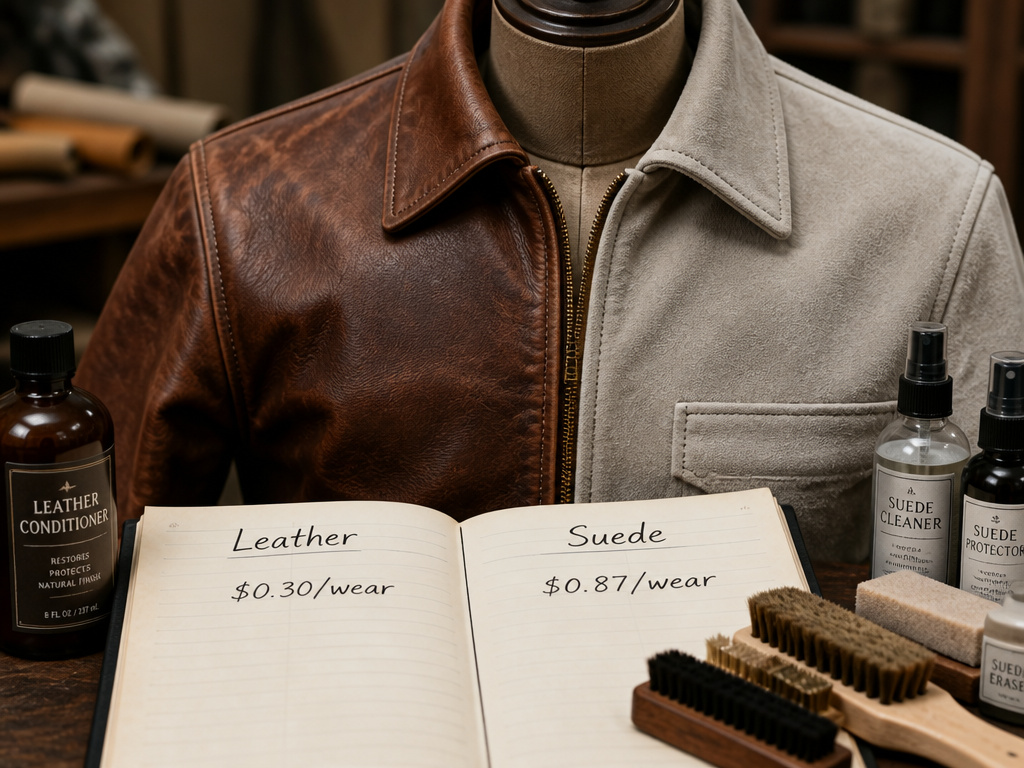
Forget the price tag for a second. Let’s talk about what each material actually costs you over the years. This is where grain leather’s reputation for value is born, and where suede’s luxury tax becomes clear.
Take two jackets. A full-grain leather jacket costs, say, $600. A nice suede jacket might be $450. If you wear the leather jacket twice a week for 20 years, that’s roughly 2,000 wears. Your cost is about $0.30 per wear. The suede jacket, worn once a week for 10 years (its realistic upper lifespan with perfect care), gives you about 520 wears. Your cost is about $0.87 per wear.
The suede jacket costs you nearly three times more for each time you wear it. And that’s before factoring in the added cost of specialized cleaners, protector sprays, and potential professional cleaning bills that suede demands. Grain leather might need a $20 bottle of conditioner every other year.
Where this goes sideways: Buying suede for a “daily driver” jacket. The math assumes perfect, diligent care. Miss a few brushings, get caught in one downpour, and that 10-year lifespan can easily shrink to 3 or 4. The cost-per-wear then doubles or triples.
Resale value widens the gap. A well-maintained, patina-rich grain leather jacket retains 30-60% of its original value on the secondhand market. It has a story, and that story has worth. A used suede jacket, no matter how carefully kept, has a compressed nap and likely a few shadowy stains. Its value plummets because its best days are visibly behind it.
This means you must understand the purchase of suede. You’re buying a finite experience of softness and texture, not a durable asset.A grain leather jacket is a purchase. A suede jacket is an ongoing subscription.
Choosing Your Fighter: A Decision Framework
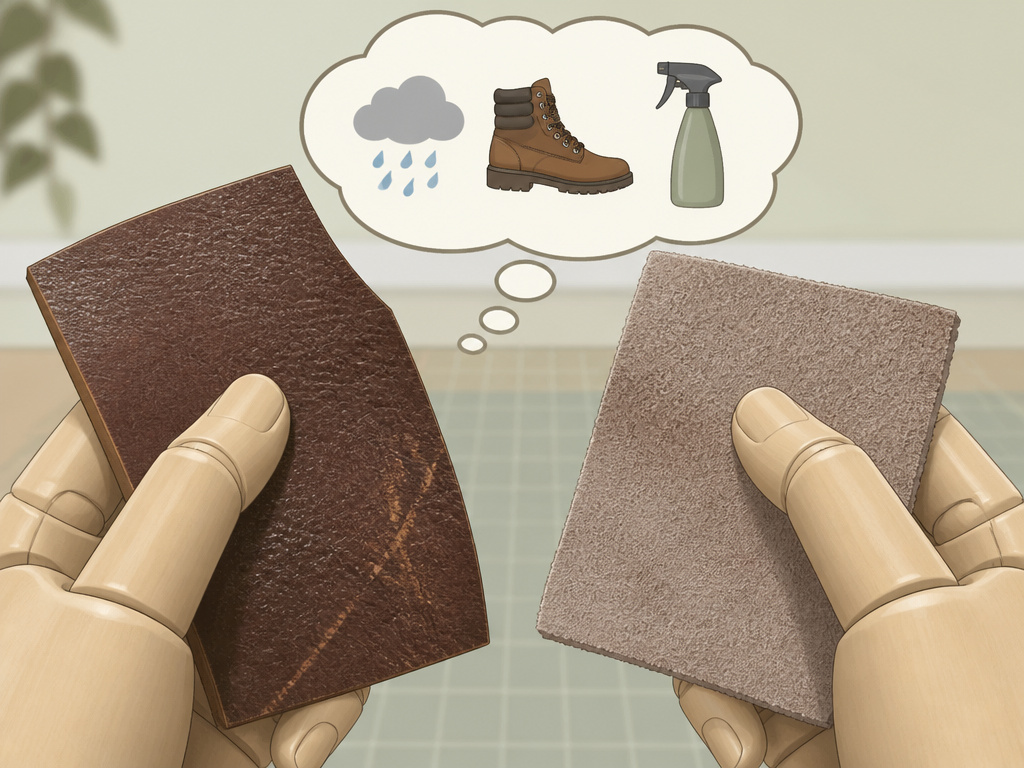
So, which one is for you? It comes down to three questions: Where will you use it? How do you want it to age? What’s your maintenance tolerance?
Pick Grain Leather If:
Your life is active and your style is daily. You want a jacket for all seasons, boots for walking, a bag that goes everywhere, or a sofa that survives a family. You prefer a “wear it and forget it” care routine, condition it a few times a year, wipe off the occasional spill. You like the idea of an item that looks better in a decade than it did new, developing a patina that’s uniquely yours. For items that see hard use, the toughness of roughout leather, full-grain hide worn flesh-side out, is another durable, low-maintenance option.
Pick Natural Suede If:
You’re a dry-weather stylist. You want a soft blazer for autumn evenings, elegant gloves, or a tactile bag lining. You commit to the ritual: storing it on a wide hanger, brushing it before it goes back in the closet, treating it with a protector spray like Tarrago Nano Protector every month. You accept that its beauty is transient and that part of the luxury is the attentive care it requires. For more on its delicate nature, our guide on caring for suede covers the essentials.
Pick Synthetic Suede (Microsuede) If:
Practicality rules. You need upholstery that stands up to pets, kids, and spills, or athletic apparel that wicks moisture. You value uniformity of color and ease of cleaning, most stains come out with a damp cloth and mild soap. You’re not chasing the authenticity of animal hide; you want a high-performance fabric that solves a specific problem, like the stain-resistant suede material used in performance interiors.
Still stuck? Hold both materials in your mind’s eye in five years. The grain leather item has a few scuffs and a deeper color. The suede item has flattened areas and a more “lived-in” softness. Which future do you prefer? Your gut knows the answer.
The Essential Care & Product Guide
You’ve chosen. Now you have to keep it alive. Here’s the straightforward, product-specific guide to maintaining your investment. Using the wrong product is the fastest way to ruin good material.
Caring for Grain Leather
The mantra is less is more. Over-cleaning and over-conditioning are the real dangers. 1. Clean: For dust, a soft, dry cloth. For dirt, a barely damp cloth. Never soak it. 2. Condition: Use a light, nourishing oil like pure neatsfoot or a high-quality cream (I reach for Saphir Médaille d’Or) every 3-6 months. Apply sparingly, let it absorb overnight, buff off excess. 3. Protect: A light wax-based waterproofing (like Nikwax) can be applied for boots, but it will slightly darken the leather and change the hand. For jackets, often skipping this is fine.
Easy to miss: Conditioning a dry leather. If the leather feels stiff and doesn’t warm quickly in your hands, it’s thirsty. If it’s already supple and dark, you’re just adding greasy buildup.
Caring for Natural Suede
Your toolkit is a brush, an eraser, and a spray. Liquids are the enemy. 1. Brush: Use a proper suede brush (brass, gum rubber, or horsehair) after every wear. Brush in one direction to lift the nap and remove surface dust. 2. For dry dirt, use a suede eraser (the Kiwi Suede & Nubuck Kit includes one). For grease, immediately sprinkle cornstarch or talc to absorb, leave overnight, brush away. For liquid stains, blot with a clean cloth and let dry, then brush. 3. Protect: Before first wear, apply a dedicated suede/nubuck protector spray (Tarrago Nano Protector is excellent). Reapply every 2-4 weeks for items worn often. This doesn’t make it waterproof, but it buys you a few seconds to blot a spill. 4. Revive the Nap: For crushed areas or light creases, hold a garment steamer 6-8 inches away, pass steam over the area, then brush vigorously as it dries. The heat and moisture will plump the fibers.
The one product ban: Standard leather conditioner. Applying it to suede will mat the nap into dark, greasy spots that are nearly impossible to fix. If you want to understand a similar but distinct material, read about nubuck leather, which shares some care needs but comes from the grain layer.
Navigating Labels & Marketing (“Genuine” & Beyond)
Walk into any store and you’ll be bombarded by terms: “Genuine Leather,” “Full-Grain,” “Top-Grain,” “Bonded Leather.” Most are meaningless or actively misleading. The FTC leather labeling guides provide the legal framework, but marketers have become adept at navigating the gray areas.
“Genuine Leather” is the biggest trap. Legally, it can mean anything that was once part of an animal hide. It often refers to the bottom split of the hide, the leftover layer after the top-grain is taken for better products. It’s thin, weak, and usually coated in a heavy plastic polymer to look uniform. It’s not a grade of quality; it’s a legal category of material. A “Genuine Leather” wallet will crack and peel within a year.
“Full-Grain Leather” means the outermost grain layer is intact, with all its natural marks and pores. It’s the strongest, most breathable, and will develop the best patina. “Top-Grain Leather” is full-grain that’s been lightly sanded to remove imperfections, then often embossed with a fake grain pattern. It’s more uniform but slightly less durable.
When you see “Real Suede,” it should mean the napped surface comes from the corium split of an animal hide. But always check the tag. If it says “100% Polyester” or “Microsuede,” it’s a synthetic. There’s nothing wrong with that, synthetics like those studied in this microfiber synthetic leather research offer fantastic performance, but you shouldn’t pay a natural material price for it.
Your best defense is to touch and inspect. Real grain leather will feel substantial, have slight variations, and smell organic. Real suede will have a deep, consistent nap you can brush. If it feels plasticky, looks perfectly uniform, or smells like chemicals, it’s likely a coated split or a synthetic. Knowing the difference between nubuck vs suede can also help you identify a grain-based napped leather versus a split-based one.
Frequently Asked Questions
Is suede real leather?
Yes, suede is real leather. It comes from the inner layer (corium) of the same animal hide that produces smooth grain leather. The difference is which side of the hide is used as the finished surface, not the source material.
Which lasts longer, suede or leather?
Grain leather lasts significantly longer. With proper care, a grain leather jacket can last 10-50 years, developing a patina. A suede jacket typically lasts 5-15 years, as its soft nap gradually flattens and shows wear more readily, even with meticulous maintenance.
Can you wear suede in the rain?
You should not wear suede in heavy rain. Water absorbs instantly into the porous fibers, causing dark stains and a stiffened nap that is difficult to restore. For light, accidental moisture, immediate blotting and proper drying with a suede brush can mitigate damage. Using a protector spray is essential.
Is suede harder to care for than leather?
Yes, considerably. Suede requires brushing after every few wears, application of protector spray every 2-4 weeks, and immediate treatment of any stains. Grain leather needs only occasional conditioning and wiping. Crucially, you cannot use standard leather conditioners on suede, they will ruin the nap.
What’s the difference between suede and nubuck?
Both have a napped surface, but they come from different layers of the hide. Suede is made from the inner corium split. Nubuck is made from the outer grain layer that has been lightly sanded to raise a fine, velvety nap. Nubuck is more durable and water-resistant than suede but still requires similar careful maintenance.
The Bottom Line
Understand leather better to make confident choices. This is about aligning a material’s innate properties with your actual life.
If you reach for the same jacket daily, face the elements, and want an heirloom, the path is clear: grain leather. Its durability and low-maintenance payoff over decades. If you cherish texture, enjoy the ritual of care, and can reserve a piece for dry, elegant occasions, suede offers a unique softness nothing else replicates.
Before you buy anything, run this final check. Run your thumb over the surface. Grain leather should feel solid, like dense fabric. Suede should feel like a deep, soft velvet. Sniff it. It should smell of hide, wax, and tannin, not plastic or glue. Check the edges. Rough, fibrous edges often indicate a split or bonded material; smooth, painted edges can be a sign of a top-grain or full-grain leather.
Then, ask the one question that matters: “Can I see myself caring for this, exactly as it needs, for the next ten years?” If the answer is a confident yes, you’ve found your match. If it’s a hesitation, save your money for the material that fits your reality. The right choice is the one you’ll actually use and love for years.
