
What is Pigskin Leather | Beyond the Football Field
This post contains affiliate links. As an Amazon Associate, we earn from qualifying purchases.
Pigskin leather is a durable, full-grain leather from domestic pigs (Sus scrofa), instantly recognizable by its unique surface pattern of small, often triangular clusters of pores where the bristles were removed. Its natural toughness and flexibility make it ideal for gloves, garments, and durable accessories.
That “full-grain” qualifier matters more than you might think. Unlike splits or suedes, pigskin leather keeps the original, dense outer layer of the hide intact, which is where most of its strength lives. This isn’t just a leather for rugged work gloves; its specific porous structure and how it’s tanned define whether you’re getting a hard-wearing tool or a soft, supple lining.
This guide walks you through what makes pigskin distinct, from the biology of its grain to the chemistry of its tanning. You’ll learn how to spot it, what it’s genuinely good for, and where it fits, or doesn’t, in a world of cowhide, sheepskin, and goatskin.
Key Takeaways
- Pigskin’s signature look comes from hair follicles arranged in roughly triangular groups of three, a pattern visible even from the flesh side.
- It’s defined as leather from the grain layer of the domestic pig; the term “pigskin” does not legally apply to the inferior flesh split.
- About 200 million pigskins are processed into leather globally each year, accounting for roughly 15% of all leather production.
- Its biggest strength is durability-to-weight, offering more toughness per ounce than most leathers, but achieving uniform softness requires specific, intensive processing.
- For centuries, German bookbinders prized pigskin for its ruggedness, using it on large, wooden-board books from 1550 to 1640.
The Raw Material: Defining Pigskin
Let’s be clear about one thing. When we talk about “pigskin leather,” we are referring specifically to the tanned hide from the domestic pig, Sus scrofa. This is the legal and industry standard in most of the world. In Germany, Italy, and Spain, the definition expands to include leather from wild pigs, but for our purposes, the domestic animal is the benchmark.
The confusion starts with the raw skin itself. Not every slaughtered pig becomes a piece of leather. In many cases, the skin stays attached to the meat for consumption or gets diverted to produce gelatin or collagen. This scarcity is part of the reason pigskin leather feels more specialized than ubiquitous cowhide. When it is processed for leather, the raw hide is typically cured with salt, though in China you’ll also find dried or limed pelts. They usually arrive as whole skins, including the sides, rather than just the premium “back” section.
What most people get wrong: The term “pigskin” legally applies only to leather made from the full-thickness grain layer of the hide. It does not cover leather made from the weaker, split layer beneath. Calling a split product “pigskin” is a misrepresentation.
The potential volume is staggering. With around one billion pigs slaughtered annually worldwide, only about 20%, or 200 million skins, are actually transformed into leather. That still yields a massive 200 million square meters of grain leather plus another 50 million square meters of splits. China dominates this production, with its roughly 500 million live pigs translating to nearly 100 million raw pigskins processed each year. That’s about 1.5 billion square feet of finished leather looking for a purpose.
How Can You Identify Pigskin Leather?
You don’t need a laboratory. The most reliable test is a visual one. Hold the leather up to a good light and look at the surface grain.
You’re looking for a distinctive pattern of small holes or pores. They aren’t random. The hair follicles on a pig are arranged in roughly triangular groups of three. After tanning, where the bristles are removed, these clusters of pores remain as a permanent fingerprint in the leather. It’s a dead giveaway. In fact, according to the Etherington & Roberts conservation dictionary, this pattern is so pronounced you can often see the holes from the flesh side as well.
This is different from the looser, more erratic pore pattern you’d see on a cowhide or the much finer, almost pebbled texture of goatskin. If you’re trying to assess leather quality visually, this unique grain is your first major clue. It tells you not just the species, but that you’re looking at the genuine, full-thickness grain layer, the strong part.
The feel is another clue. High-quality pigskin, especially when processed for garments, can be remarkably soft. But there’s often a underlying firmness, a density to it that thinner sheepskin lacks. Cheaper or poorly processed pigskin can feel stiff and boardy because of its inherent structure. The hair roots penetrate the entire cross-section of the skin, which makes achieving consistent, all-over softness a technical challenge for tanners.
Pigskin Leather vs. Other Common Leathers
So how does it stack up? It’s not about one being universally better, but about which is better for what. A head-to-head comparison cuts through the marketing.
| Leather Type | Key Strength | Typical Feel | Best Use Case for Pigskin |
|---|---|---|---|
| Cowhide | Overall durability, widespread availability | Firm, thick, can be heavy | Pigskin wins for lightweight durability (gloves, lightweight jackets). |
| Sheepskin/Lambskin | Unmatched softness, luxurious drape | Buttery soft, lightweight | Pigskin wins for abrasion resistance (work gloves, high-wear areas on garments). |
| Goatskin | Excellent strength-to-weight, flexible | Smooth, firm yet pliable | A close call. Goatskin is often more uniformly supple; pigskin can be more rugged but less consistent. |
| Pigskin | High durability-to-weight, unique porous grain | Dense, can range from stiff to surprisingly soft | The default when you need toughness without bulk. |
The “durability-to-weight” point is the practical takeaway. If you need a leather that can take a scraping without adding heft, pigskin is a strong contender. It’s why you’ll find it in areas where cowhide would be overkill and sheepskin too fragile. However, if uniform, all-over softness is your primary goal, think a drapey suede shirt, a top-tier lambskin or a specially processed goatskin might still be the safer bet. It’s a trade-off, not a sweeping victory.
What is Pigskin Leather Used For?
Its applications are a direct reflection of its properties. You won’t find pigskin on a delicate handbag flap, but you will find it where wear is expected.
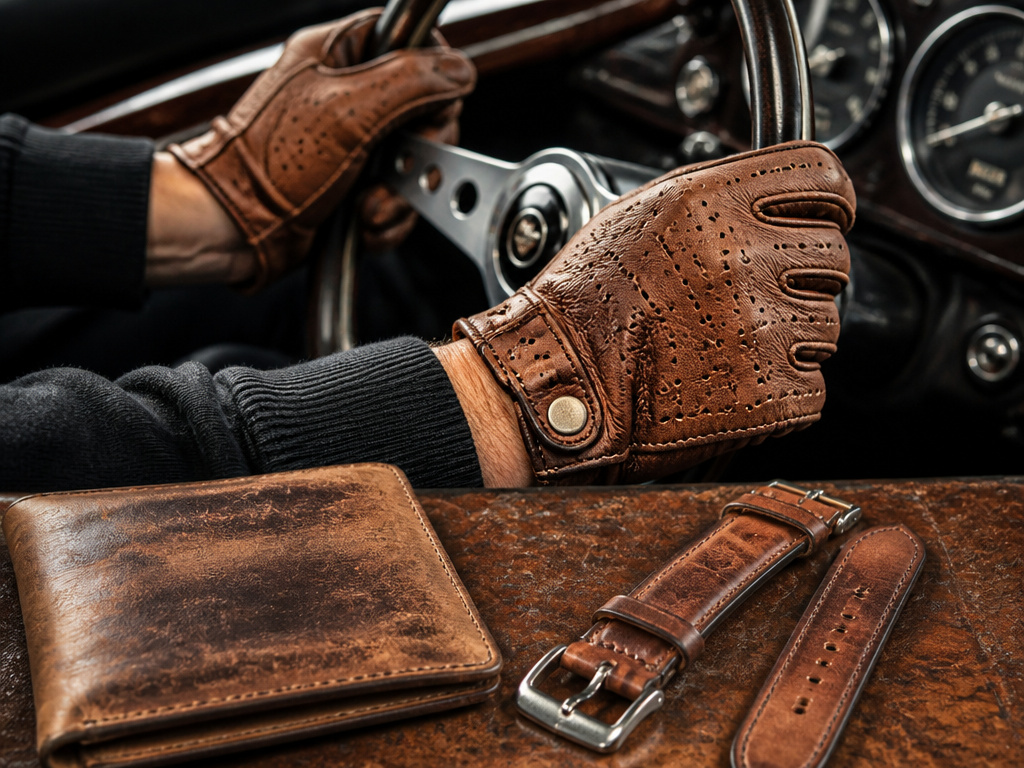
The most classic use is gloves. From durable driving gloves to dexterous work gloves, pigskin offers abrasion resistance without sacrificing too much fingertip feel. It’s also a staple in the garment industry, particularly for suede and nappa finishes. When tanned and finished well, it can compete with sheep and goatskin on softness while offering better durability at a competitive price. Jacket collars, cuff overlays, and even full suede jackets benefit from its resilience.
Beyond wearables, pigskin has a niche in leather goods. Wallets, watch straps, and key fobs made from pigskin break in beautifully and develop a robust character. Its toughness also makes it suitable for certain upholstery applications, especially in commercial or automotive settings where long-term wear is a factor. Don’t forget the splits, the lower layer of the hide. Pigskin splits are famously hard-wearing and easy-care, often used for more utilitarian items or as a backing material.
And then there’s history. From about 1550 to 1640, German bookbinders used pigskin extensively, typically on large, impressive volumes with wooden boards. The leather’s rugged, intractable nature suited these substantial tombs. It didn’t tool (emboss) easily except in blind impressions, but its sheer toughness made it a guardian for knowledge. This historical use underscores its core identity: a protector.
The Tanning Process: What Makes Pigskin Behave

Here’s where the magic, and the challenge, happens. Turning a raw pigskin into usable leather isn’t just a matter of running it through a standard cowhide process. That unique, pore-penetrating structure demands specific steps.
The dialdehyde method of tanning with subsequent anionic polymer filling provides the formation of a homogeneous porous structure of leather in various topographical areas with the necessary set of structural and performance characteristics.
That’s a technical finding from a Society of Leather Technologists study on pigskin. In plain terms, to get a consistent, soft leather from a material that naturally wants to be stiff, tanners need sophisticated chemical approaches. The study notes that such methods can produce leather that meets the DSTU 3115-95 standard for garment leather, suitable for everything from spring-summer chrome-tanned goods to autumn-winter dialdehyde-tanned pieces.
The process of making leather from pigskin highlights several critical, intensified stages:
- Degreasing: Pigskin has a lot of natural fat. If not removed thoroughly, these fats can later migrate to the surface, causing uneven shades and greasy spots called “spues.”
- Liming: This process, which loosens hair and opens up the fiber structure, needs to be longer and more intensive for pigskin to ensure ultimate softness.
- Bating: This enzymatic step is crucial for garment softness. Brands like BASF have developed specific products like Basozym CP10, a mixture of enzymes designed just for pigskin to cleanly remove hair roots and prepare the pelt for dyeing.
Tanners can choose between vegetable tanning and chrome tanning. Vegetable tanning, using natural agents like tree bark, yields a firmer, more age-resistant leather that darkens beautifully over time. Chrome tanning, using chromium salts, is faster and produces a softer, more pliable and water-resistant leather right out of the drum. The choice between these tanning methods dictates the leather’s final personality.
Advantages and Drawbacks of Pigskin Leather
Every leather has a balance sheet. Let’s look at pigskin’s.
Advantages:
- Outstanding Durability-to-Weight: It provides more scuff and tear resistance per ounce than almost any other common leather.
- Breathability: The natural porous structure allows air to pass through, making it comfortable for prolonged wear, especially in gloves and garments.
- Unique Aesthetic: The signature grain pattern is unmistakable and adds character that synthetic materials can’t replicate.
- Good Moldability: Once broken in, it can conform well to the shape of the hand or body.
- Cost-Effective for its Performance: Often less expensive than high-end calfskin or goatskin while offering superior ruggedness.
Drawbacks:
- Can be Stiff: Lower-quality or improperly tanned pigskin can be rigid and uncomfortable until extensively broken in.
- Inconsistent Softness: Achieving uniform softness across the entire skin is technically difficult due to the penetrating hair follicles, leading to potential variations in feel.
- Limited “Drape”: It rarely achieves the fluid, draping quality of premium lambskin or certain cowhides, making it less ideal for flowing garment designs.
- Porous Nature: While breathable, this also means it can absorb stains and moisture more readily than a tightly grained calfskin if left unfinished.
- Ethical & Religious Considerations: For some, the use of pig-derived products is a non-starter due to personal or religious beliefs.
Caring for Pigskin Leather Products
Care follows from character. Pigskin is durable, but its porous nature demands a specific approach. Forget the one-size-fits-all “condition every six months” rule. I learned that the hard way.
Early on, I conditioned a client’s pigskin bag on a rigid six-month schedule. The bag lived in a humid coastal climate. By the second year, the leather felt perpetually greasy and looked darkened in odd patches. The over-conditioning had saturated the porous structure. We had to strip it back and start over, switching to a simple cleaning and a much lighter, once-a-year conditioning touch-up. The environment dictated the care, not the calendar.
For general maintenance: 1. Dust & Clean: Regularly brush off dust with a soft horsehair brush. For deeper cleaning, use a damp (not wet) cloth with a pH-balanced leather cleaner. Test on an inconspicuous area first. 2. Condition Sparingly: Use a light, non-greasy leather conditioner. Apply a tiny amount, let it absorb fully, and buff off any excess. If the leather still feels supple and dry to the back-of-your-hand test, skip the conditioner. 3. Protect (Optional): For suede or nappa pigskin garments, a quality fabric protector spray can help repel water and stains. Be aware this may slightly alter the feel and breathability. 4. Store Properly: Keep in a cool, dry place away from direct sunlight. Stuff bags with acid-free paper to maintain shape. Never store in plastic, as it can trap moisture.
The leather will tell you what it needs. If it’s looking dry and feels stiff, it might be time for a touch of conditioner. If it’s still supple and rich, just keep it clean. This mindful, observant approach will help any pigskin item develop a beautiful, personal patina over time, rather than a greasy buildup.
Frequently Asked Questions
Is pigskin leather good quality?
It can be excellent quality, but it’s not automatic. Quality depends entirely on the tannery’s skill. A well-tanned pigskin from a reputable source like Horween is incredibly durable, soft, and a fantastic material for specific uses. A poorly processed one can be stiff and unpleasant. Focus on the maker’s reputation, not just the species.
Is pigskin leather real leather?
Yes, absolutely. It is genuine, full-grain leather from a pig. However, remember that the term “genuine leather” is a broad legal category that can include lower-quality splits and bonded leathers. A label saying “Genuine Pigskin Leather” should mean it’s made from the true grain layer of pigskin, but always inspect the natural grain pattern to be sure.
Why is pigskin leather so expensive?
It’s often not, relatively speaking. High-quality pigskin is usually more affordable than equivalent-grade calfskin or goatskin. Its price reflects the specialized tanning required to soften it consistently and the fact that only 20% of all pigskins are even available for leather production. You’re paying for a niche material with unique performance, not necessarily for luxury status.
Can pigskin leather get wet?
It can withstand moisture better than some untreated leathers due to its dense fiber structure, but it’s not waterproof. Water will darken it and, if saturated, can lead to stiffness as it dries. For items like gloves or outdoor garments, look for pigskin that has been oil tanned or treated with a water-repellent finish for greater protection.
Before You Go
Pigskin leather isn’t a substitute for cowhide or a cheaper version of lambskin. It’s its own category: the lightweight bruiser. Its value lies in that specific intersection of toughness, breathability, and distinctive character.
If you’re considering a piece made from it, let its history and properties guide you. It excels in roles that demand durability without bulk, think gloves, jackets, and accessories that see real use. Judge it by its grain: those tiny, triangular pore clusters are the mark of the real thing. And judge it by its hand: a good pigskin should feel substantial and dense, but never plank-like.
Finally, trust the tannery over the label. The difference between a stiff, cardboard-like pigskin and a supple, resilient one comes down to processing skill, not marketing. Seek out brands that are transparent about their leather tanning methods. That’s how you move beyond the football field nickname and find a material that truly lasts.
