What is Sheepskin Leather? An In-Depth Look & Buyer’s Guide
This post contains affiliate links. As an Amazon Associate, we earn from qualifying purchases.
Sheepskin leather is the soft, porous leather from the hide of a sheep tanned with the wool still attached, and, importantly, it is an unsplit hide. It is a distinct material, not a category of general leather, with specific requirements set by international standards like ISO 5432:2013(E). The term “sheepskin” indicates the full thickness of the skin is used; once split, it becomes another product entirely. This definition separates sheepskin from most other leathers you’ll encounter.
That definition changes how you assess the material. When you know a piece must be unsplit to be genuine sheepskin, you start looking for clues in its thickness and structure, a dense, spongy grain layer and a softer reticular layer that sometimes separates. This isn’t just a marketing label; it’s a manufacturing fact recognized by tanners and standards bodies for over five hundred years.
Here’s a straightforward guide to what sets sheepskin apart. This section describes its unique layered structure, how it’s made, the difference between sheepskin and lambskin, and what to look for when buying anything labeled as such.
Key Takeaways
- Sheepskin leather is exclusively an unsplit hide. If the leather has been split into layers, it’s not correctly called sheepskin.
- The skin has a unique, loose, spongy structure due to wool follicles and glands, which makes it inherently soft but less dense than bovine leathers.
- Lambskin is from younger animals, generally smoother and thinner, while sheepskin from mature sheep is more robust and has more distinct grain.
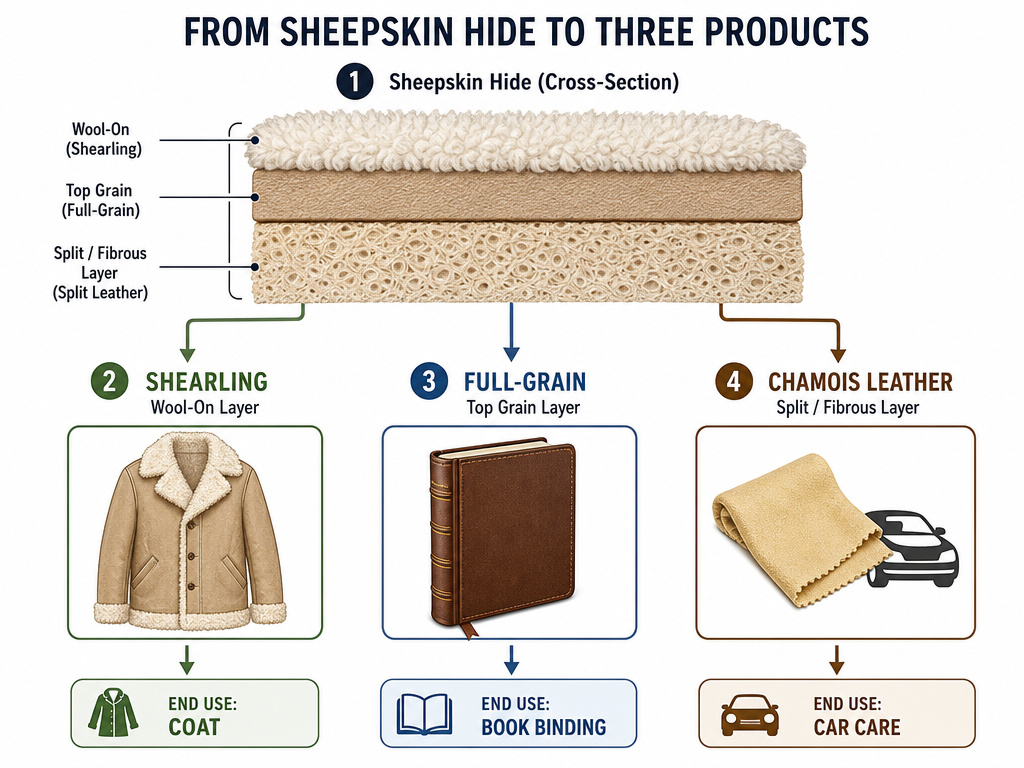
- True chamois is made from the split underside (reticular layer) of sheepskin, while the top grain layer is used for bookbinding and other fine leathers.
- Industry standards like Woolmark Product Specifications govern specific attributes like pile thickness and fiber diameter for finished goods.
What Sheepskin Leather Actually Is
Forget what you’ve heard in generic descriptions. According to the Etherington & Roberts conservation dictionary, sheepskin is a soft, porous leather from wooled or hair sheep, and the term always indicates an unsplit skin. That’s the line that matters. It’s not just leather from a sheep; it’s the whole skin, turned into leather with its structure intact.
The skin differs from cowhide because of the animal it came from. A sheep’s skin is interrupted by countless fine wool follicles and the associated sebaceous and sudoriferous glands. This creates an open, loose texture in the dermis. The grain layer, the top part, occupies over half the skin’s thickness and ends up rather spongy after tanning. Beneath it lies the reticular layer, which is less compact. A continuous layer of fat cells often separates these two layers, which is why you’ll sometimes see them come apart in lower-quality pieces or during specific splitting processes in a tannery.
Sheepskin is somewhat difficult to describe because the individual skins differ so greatly in size, fat content, and general quality of the dermal network. From the standpoint of leather, the closer a sheepskin approaches the hair sheep, the tighter and firmer the fiber network, and, therefore, the better the skin for producing leather.
This structure places it in a class by itself. It’s breathable, naturally insulating, and has a distinctive hand-feel that’s neither as tight as goat nor as heavy as steerhide.
Its Unique Composition
A 2023 proteomics study published in Collagen and Leather detailed the molecular makeup of sheepskin. It’s not just fibers and oils; it’s about 53% water, 27.5% protein (mostly collagen), 18.3% lipids, and trace minerals in its raw state. This high lipid (fat) content is why the skin feels supple and why it requires specific beamhouse operations to clear those fats during tanning. If you’ve ever handled a piece that feels greasy or overly soft, you’re feeling that native lipid profile.
How Sheepskin Leather Is Made (The Tanning Process)
The journey from a raw pelt to finished sheepskin leather follows the standard leather making stages but with critical tweaks for the wool. The fleece must be preserved, which limits some chemical options.
- Curing & Soaking: The skin is preserved with salt to prevent decay, then rehydrated.
- Fleshing & Liming: Machinery removes excess flesh and fat from the underside. The hide is soaked in a lime solution to loosen the wool and hair, which is then removed mechanically, unless the goal is a wool-on product.
- Deliming & Bating: The pH is adjusted, and enzymes are used to soften the hide and prepare it for tanning.
- Pickling: A mild acid bath prepares the collagen fibers for the tanning agents.
- The Main Tanning: Here, the path splits.
- Chrome Tanning: Most modern sheepskin is chrome-tanned for speed and water resistance. The process uses basic chromium sulfate, which must meet a minimum content (3.0% chromic oxide per ISO 5432) to achieve a shrinkage temperature of at least 95°C.
- Vegetable Tanning: Traditional and more time-consuming, using natural tannins from tree bark. This yields a firmer, more matte finish that ages beautifully. It’s less common for sheepskin but prized for certain bookbinding and heritage goods.
- Samming, Splitting, & Shaving: The hide is partially dried, and its thickness is standardized. Critically, at this stage, a true sheepskin is not split. If it is split, it is no longer called sheepskin in professional circles.
- Re-tanning, Dyeing, & Fatliquoring: Further treatments add color, softness, and durability. The Woolmark specifications, for instance, set limits on dichloromethane-extractable matter (fatliquors) at below 10% for most products.
- Drying, Conditioning, & Finishing: The leather is dried slowly, softened, and may receive a light surface finish.
| Process Stage | Key Consideration for Sheepskin | Why It Matters |
|---|---|---|
| Liming | Wool preservation | Dictates whether the final product is wool-on or wool-off. |
| Tanning Agent | Chrome vs. Vegetable | Chrome is faster and more rot-resistant; vegetable-tanned develops a patina. |
| Splitting | The hide is left unsplit | This is the definitional step. Splitting creates a split sheepskin (used for chamois) and a grain layer (for other leathers). |
| Fatliquoring | Oil and wax content regulated by standards | Too little, and it’s brittle; too much, and it feels greasy and stains. |
Sheepskin vs. Lambskin: A Practical Breakdown
A common point of confusion is the difference between sheepskin and lambskin. Both come from sheep, but the animal’s age changes everything about the leather.
- Lambskin: Comes from younger sheep. The fibers are finer, denser, and the skin is thinner overall. This results in a leather that is exceptionally soft, smooth, and has a more uniform grain with fewer markings. It’s the go-to for luxury gloves, fine apparel, and lightweight jackets where supreme softness is the goal. The downside is its lower resistance to abrasion and tearing compared to its mature counterpart.
- Sheepskin (Mature): From older animals, this hide is thicker, stronger, and has a more pronounced grain pattern. It’s more durable and better suited for items that take wear: rugs, heavier coats, boots, and equestrian gear. The texture is more robust, and the wool, if present, is typically coarser.
Where this goes sideways: Calling a thin, buttery-soft jacket leather “sheepskin” when it’s almost certainly lambskin. The age of the animal defines the leather’s hand and strength, a lambskin jacket will pill and scuff where a sheepskin jacket will simply wear in.
Here’s the practical takeaway. If you want cloud-like softness in a glove or a delicate jacket lining, you’re looking for lambskin. If you need a durable slipper, a hard-wearing seat cover, or a coat that stands up to the elements, mature sheepskin is the choice. The suede you often see on fashion items usually comes from the split layers of these skins, not the full-thickness hide.
The Standards and Specs That Define It

Sheepskin isn’t a free-for-all. Reputable manufacturers adhere to published standards that define quality and performance. Ignoring these is how the market gets flooded with inferior products that shed wool, stiffen after washing, or fall apart.
- ISO 5432:2013(E): This international standard specifies requirements for wet blue sheepskins (chrome-tanned, before dyeing). It mandates a shrinkage temperature of not less than 95°C, a minimum pH of 3.5 for the water extract, and details how to test for chrome content and fungicide efficacy. Fungicides, by the way, should be applied in quantities to ensure the skin survives up to four months in storage, a spec that speaks directly to the material’s perishability in its semi-processed state.
- Woolmark Product Specifications (2016): This document is for the finished consumer product. It’s exhaustive. For a sheepskin car seat cover or baby rug, it sets a minimum pile thickness (e.g., ≥15mm for a certain grade). It defines fibre diameter categories (like ≤30µm). It stipulates that infant products must withstand a 95°C shrinkage test, while other products need only 75°C. It even dictates how to wash nursing pads (60°C with bactericidal detergent) versus how to clean apparel (dry clean only, specialist methods).
Why should you care? Because a product meeting Woolmark specs has been verified for performance. It’s not marketing fluff; it’s a measurable benchmark for things like colorfastness, pile retention, and dimensional stability. When you’re assessing a high-ticket item like a sheepskin rug or aviation headset lining, looking for a Woolmark or similar certification is a solid step in testing leather quality.
Common Uses and Related Leathers
Sheepskin’s unique properties lend it to specific applications. Its natural insulation makes it perfect for cold-weather gear. Its softness, once the wool is removed and the surface is refined, makes it a candidate for luxurious nubuck or suede.
- Wool-On Products: Rug, slippers, aviation liners, seat covers, and classic winter coats (shearling). The wool provides unmatched natural insulation and wicks moisture.
- Wool-Off, Full-Grain Sheepskin: The unsplit grain layer, once dyed and finished, is used for high-quality book bindings, some types of bags, and finer apparel. It has a distinctive, spongy yet durable feel.
- Split Sheepskin Products: This is where the terminology shifts. When a true sheepskin is split, the top grain layer might be used as above. The fibrous underside, the reticular layer, is transformed into true chamois leather (not the synthetic “chamois” cloths). This is the origin of the connection between sheepskin and chamois leather. Another split product is roughout leather, where the flesh side is used as the outer face.
The connection to other leathers is direct. The same hide that provides a wool-on sheepskin for a pilot’s jacket can, through splitting and different finishing, become the chamois for drying a car or the nubuck on a designer shoe. It’s a versatile raw material.
Caring for Sheepskin Leather
Care depends entirely on whether the wool is present.
For Wool-On Sheepskin (Shearling coats, rugs, slippers):
- Spot Clean Only: Use a damp cloth with a mild, wool-safe detergent. Never soak.
- Brush the Wool: Use a soft bristle brush to fluff the pile and remove dust.
- Dry Away from Heat: Always air dry at room temperature. Direct heat will shrink and harden the leather.
- Professional Cleaning: For major soiling, use a cleaner experienced with shearling and wool.
For Wool-Off, Finished Sheepskin (Jackets, bags):
- Follow care instructions for a soft, vegetable-tanned leather or chrome-tanned leather, depending on its finish.
- Use a gentle leather cleaner and a conditioner designed for soft hides. Avoid heavy waxes or oils that will clog the porous structure.
- Store in a breathable cotton bag, never plastic.
A story from my bench: someone once tried to use vinegar to kill mildew on a wool-lined sheepskin boot. The acidity didn’t just bleach the wool; it disrupted the leather’s pH balance. The boot developed a persistent sour smell no conditioner could mask, and the leather around the affected area remained stiff and crackly. The shortcut cost them the boots. Sometimes, the gentlest-sounding home remedy does the most chemical damage.
Frequently Asked Questions
Is sheepskin leather good quality?
It can be exceptional quality, but it’s highly variable. Quality depends on the age of the sheep, the tannery’s skill, adherence to standards like ISO 5432, and the intended use. A Woolmark-certified sheepskin rug is high-quality. A cheap, unbranded sheepskin car seat cover from an unknown source is likely poor quality. Always ask about the origin and any applicable certifications.
Is sheepskin real leather?
Yes, absolutely. It is the tanned hide of a sheep. The “skin” in the name is the key. It undergoes the same leather tanning process as cowhide, but the starting material and the fact it’s often tanned wool-on make it distinct.
What is the difference between sheepskin and leather?
This is a trick of categories. “Leather” is the broad category. Sheepskin is a type of leather, just as cowhide is a type of leather. The difference is the source animal (sheep vs. Cow) and the fact that sheepskin, by definition, is an unsplit hide, whereas other leathers like cowhide are frequently split into layers.
How can you tell real sheepskin?
Look at the back. Real sheepskin leather (wool-off) will have a distinct, fibrous, slightly spongy suede-like back, the flesh side of the unsplit hide. It’s not a uniform, fabric-like backing. For wool-on products, pull gently on the wool; it should be firmly rooted and not pull out in clumps. The leather side should be supple and smell of tanned leather, not chemicals or plastic.
Is sheepskin durable?
It is durable in the ways its structure dictates. It is highly abrasion-resistant due to its loose fiber network and is very tear-resistant. However, it is more susceptible to cutting or puncturing than denser bovine leathers. Its durability against water and stains depends heavily on the tanning method (oil-tanned leather variants exist) and the surface finish applied.
Before You Go
Let’s be clear about one thing. The value of understanding sheepskin isn’t about memorizing specs. It’s about recalibrating your expectations. When you see a “sheepskin jacket,” you should now instinctively wonder: Is this from a mature sheep or a lamb? Was the hide split? Is it meant to be a durable outer layer or a soft lining?
That shift in questioning is how you avoid overpaying for mislabeled products. You start looking for the substance behind the label, the thickness, the feel of the backside, the quality of the wool if it’s present. You appreciate why a true, unsplit sheepskin has been used in bookbinding for centuries: it’s durable, workable, and ages with character. Don’t get lost in the broad term “leather.” Focus on the specific story of the material in front of you. The leather will always tell you what it is if you know what to look for.
