
What Is Fish Leather | From Scales to Sustainable Style
This post contains affiliate links. As an Amazon Associate, we earn from qualifying purchases.
This post contains affiliate links. As an Amazon Associate, we earn from qualifying purchases.
Fish leather is exactly what it sounds like: a genuine leather material made from the skins of fish, transformed through tanning. It’s not a synthetic imitation. It’s thinner and often more supple than cowhide, with a distinctive pebbled or scaled texture, and its unique criss-cross collagen structure makes it pound-for-pound stronger than traditional leathers of similar thickness.
The pebbled texture isn’t just for looks. That pattern is the literal fingerprint of the collagen scaffolding underneath, and it’s the source of the material’s surprising toughness. This structural secret is why the conversation has shifted from novelty to serious fashion and accessory material.
What follows: a breakdown of where this material comes from, the science behind its strength, the real challenges of turning slippery skin into stable leather, and how to spot quality in a finished piece. You’ll see why this isn’t just an eco-story, it’s a performance story backed by some hard numbers from the tannery floor and the lab.
Key Takeaways
- Fish leather is up to nine times stronger than cow or lamb leather of comparable thinness due to its multidirectional collagen fiber weave.
- It’s primarily a byproduct of the global fishing industry, turning waste into a valuable material and aligning with circular economy principles.
- The tanning process is delicate and heat-sensitive; temperatures inside the drum exceeding 30°C (86°F) risk degrading the raw skins.
- Quality varies dramatically by fish species and tannery skill. Salmon and Nile perch skins offer high collagen content and solid mechanical properties for leather goods. Fish leather should have no fishy odor, a consistent dye, and a firm, flexible hand-feel; any sliminess or strong smell signals a poorly processed skin.
The Unexpected Source of Modern Leather
Let me share what I’ve learned about sourcing. Fish leather begins at the dock, not the ranch. The vast majority of raw material comes as a byproduct of the food industry. For every salmon fillet or perch dinner, there’s a skin. Historically, those skins were discarded or ground into low-value commodities. The modern shift views that skin not as waste, but as a raw material waiting for a second life.
This isn’t just theory. Operations like Iceland’s Atlantic Leather have turned this into a commercial reality. Since 1994, they’ve been processing salmon, perch, cod, and wolffish skins from sustainable stocks, producing nearly a tonne of leather monthly. They run on geothermal energy and recycle water up to nine times in production. The model proves fish leather can be both environmentally strategic and economically viable.
The appeal here is a closed-loop system. Using a resource that already exists within another industry’s supply chain reduces the demand for new raw materials. It’s a practical answer to a waste problem. When you choose a fish leather good, you’re voting for a system that sees potential where others saw disposal. It’s a different kind of luxury, one built on efficiency and respect for the full yield of a resource.
The Science Behind the Strength: It’s All in the Weave
Most people assume thin leather is weak leather. With fish skin, that assumption is dead wrong. The strength comes from a structural fluke of biology. In mammalian hides, collagen fibers run mostly in a parallel, vertical grain. Think of it like the grain in a piece of wood, strong in one direction, easier to split in the other.
Fish collagen dances to a different tune. Research on species like Salmo salar (salmon) and Lates niloticus (Nile perch) shows their fibers arrange in a tight, criss-cross matrix. Under a microscope, it looks like a finely woven basket. This multidirectional weave distributes stress in multiple directions at once. It’s the difference between pulling on a single thread versus tugging on a knitted sweater.
This criss-cross fiber structure is the reason Atlantic Leather claims their fish leather is nine times stronger than lamb or cow leather of a similar thickness. It’s not marketing hyperbole, it’s basic material science.
The numbers from the lab back this up. A study in the East African Journal of Science, Technology and Innovation measured the tensile strength of finished salmon leather at 14.13 N/mm² and Nile perch leather at 21.63 N/mm². The single-edge tear strength was even more revealing: 21.68 N for salmon and a robust 132.20 N for Nile perch. For context, that perch leather’s tear resistance is in the range of many mid-weight bovine leathers, despite being less than half the thickness.
| Property | Salmo salar (Salmon) | Lates niloticus (Nile Perch) |
|---|---|---|
| Average Thickness | 0.62 mm | 1.38 mm |
| Tensile Strength | 14.13 N/mm² | 21.63 N/mm² |
| Tear Strength | 21.68 N | 132.20 N |
| Collagen Content (Raw Skin) | 61.2% | 72.0% |
This data shows why fish leather isn’t just for novelty items. That strength-to-thickness ratio makes it ideal for applications where bulk is a drawback: sleek wallets, lightweight bag linings, form-fitting gloves, and even durable shoe uppers where flexibility is key.
Making Fish Leather: Where the Real Challenge Lies
Understanding leather better means knowing its birth story. Transforming a raw, slippery fish skin into stable, odor-free leather is a nuanced art. The basic stages of the leather making process, curing, liming, fleshing, tanning, dyeing, are all there, but the devil is in the piscine details.
The first hurdle is the skin itself. Fish skins have a high natural grease content, upwards of 23% in salmon, per research. This grease must be meticulously reduced (down to around 6% for salmon) after the initial tanning stage, or it will bleed through and compromise finish adhesion and durability. Then there’s the shrinkage temperature, the point at which the leather’s proteins start to denature. Raw salmon skin collagen becomes unstable just above 43°C (109°F). A hot day in the tannery can ruin a batch.
Where this goes sideways: Using steel tanning drums in hot climates. During the July 2022 UK heatwave, drum temperatures hit 31°C, enough to begin breaking down sensitive fish skins. Wooden or polypropylene drums, which insulate better, are often mandatory for quality production.
The tanning process itself follows two main roads, just like traditional leather. Chrome tanning is faster and produces a more pliable, water-resistant leather, which is why it’s common for many fish leather goods. Vegetable tanning is a slower, more traditional method using plant tannins; it yields a firmer leather that ages and develops a leather patina uniquely. The choice between vegetable-tanned leather and chrome-tanned leather often comes down to the desired final hand-feel and the tanner’s expertise, a debate central to vegetable vs chrome comparisons.
Finally, coloring leather presents its own test. The dyeing process must penetrate a thinner, denser material evenly without masking the natural texture that defines its character. A dye job should highlight the natural leather grain.com/what-is-leather-grain/), it doesn’t paint over it.
How to Spot Quality Fish Leather
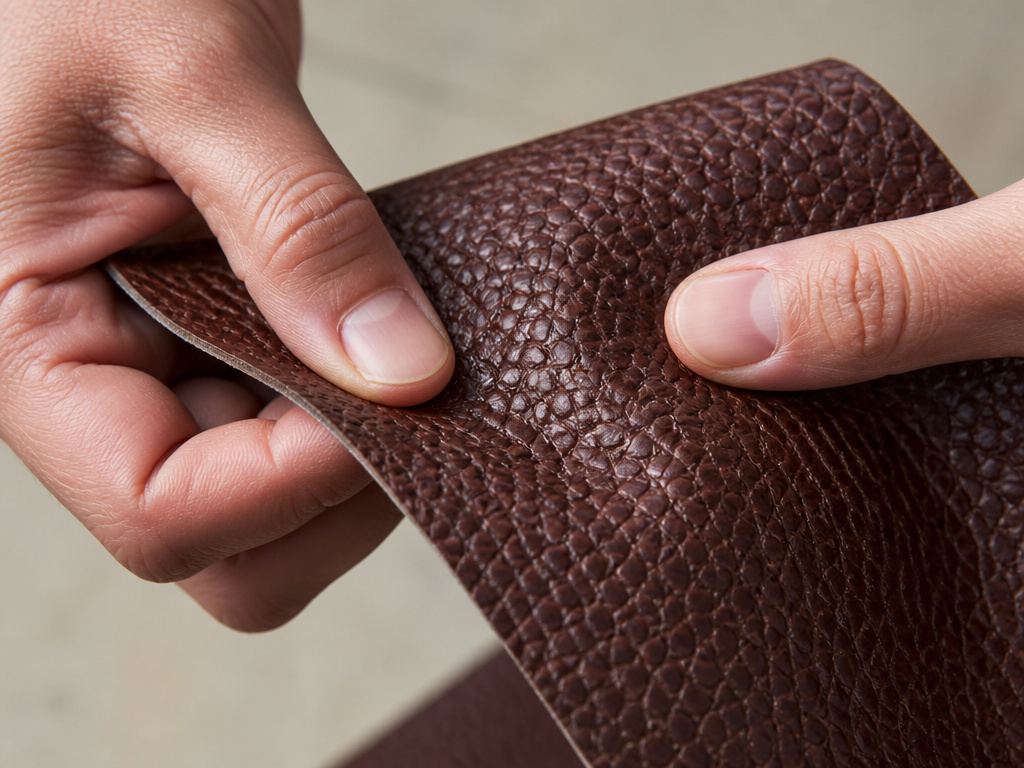
This is based on years of practical experience with all kinds of leather. When a new material hits the market, a flood of poor imitations usually follows. Fish leather is no exception. Here’s a straightforward guide to separating the well-made from the poorly processed.
First, use your nose. Properly tanned fish leather has zero fishy smell. It should smell like any other quality leather, earthy, slightly sweet, or neutral. If you catch a whiff of ammonia, rotting protein, or the ocean, put it down. The tanning chemistry failed.
Next, assess the hand-feel. It should be dry and supple, not tacky or slimy. Run your thumb across the surface. A slight, pebbled texture is good. A greasy residue is bad. The leather should flex easily without cracking or producing a dry, papery sound. Bend a corner. If you see a white stress line that doesn’t relax, the hide was over-dried or under-oiled.
Look at the edges and the back. The flesh side (back) should be smooth and evenly sanded, not fuzzy or ragged. The edges should be cleanly cut and, if painted, the edge paint shouldn’t chip with a light flex. The leather grain pattern should be consistent across the piece, not faded or blurred in spots, which indicates uneven dye penetration.
Common mistake: Assuming all fish leather is delicate. A quality piece, like that from a proven tannery, should pass the same basic testing leather checks as any other leather: good pull-up (lightening when bent), consistent color, and no surface coating that flakes off.
Finally, consider the source. Is the brand transparent about which fish species they use and where they tan? Salmon, perch, and cod are common and proven. Obscure species can be a red flag unless the tannery has a specific reputation for them.
Fish Leather vs. Traditional Leather: A Clear-Cut Comparison
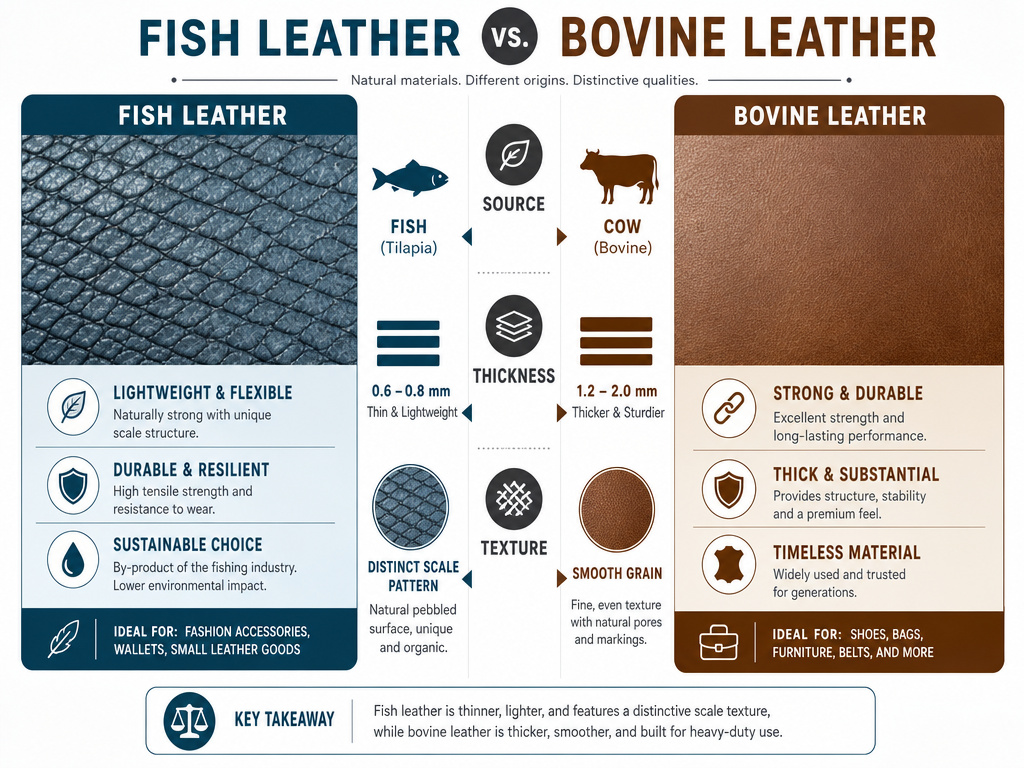
Let’s be clear about one thing: fish leather isn’t a wholesale replacement for cowhide. It’s a complementary material with a specific set of advantages and trade-offs. Understanding these helps you make confident choices.
The most obvious difference is aesthetics. Fish leather has an inherent, natural textural pattern, scales, a pebble, a subtle ripple, that is impossible to replicate with bovine leather. For designers, this is a gift. It provides visual interest without elaborate tooling or printing. Bovine leather offers a broader canvas: smooth, pebbled, embossed, or the pristine natural marks of full-grain hide.
Durability isn’t a simple win for either. As the strength data shows, fish leather is remarkably tear-resistant for its thickness. But its thinness is also a limit. A 1mm thick fish leather belt won’t have the same longevity as a 4mm thick bovine belt. It’s about matching the material to the stress profile of the product. Fish leather excels in lightweight, flexible applications; bovine leather rules in heavy-duty, structural roles.
| Aspect | Fish Leather | Traditional Bovine Leather |
|---|---|---|
| Primary Source | Byproduct of fishing industry | Byproduct of meat/dairy industry |
| Thickness Range | Typically 0.5mm – 1.5mm | Wide range, commonly 1.0mm – 4.0mm+ |
| Key Strength | High tear strength per mm; flexible | Overall structural durability; can be built thick |
| Texture | Inherent pebbled/scaled pattern | Can be smooth, pebbled, or embossed |
| Environmental Narrative | Utilizes a waste stream; often lower water use in tanning | Established recycling of meat industry byproduct; tanning can be chemical-intensive |
From a sustainability angle, both are byproduct stories. Fish leather taps into an underutilized waste stream from a massive global industry. Bovine leather uses hides from the equally massive meat industry. The better environmental choice often comes down to the specific tannery’s practices, their energy source, chemical management, and water recycling, more than the animal of origin. A chrome-tanned cowhide from a dirty tannery is less sustainable than a vegetable-tanned fish leather from a clean, efficient operation like Atlantic Leather.
The practical takeaway? Don’t get caught in absolute debates. Fish leather is a superb option for accessories, accents, and items where unique texture and lightweight strength are assets. For heirloom items that need to withstand decades of rough use, high-quality bovine leathers, especially vegetable-tanned ones, remain the benchmark.
The Future Hooked on Fish Skin
The leather will tell you what it needs, and fish leather is telling the industry to innovate. The current research isn’t just about making it; it’s about making it better. Scientists are developing bio-based hydrophobic coatings from epoxidized soybean oil that can give fish leather a water contact angle over 120°, similar to a non-stick pan, while reducing water absorption. This addresses a practical concern without resorting to heavy, plastic-based laminates that kill the material’s breathability.
The growth potential is also economic. Projects like the European Commission’s FISHSkin initiative aim to build bridges between mariculture and high fashion, developing industrial-scale techniques. In places like Kenya, companies are using Nile perch skins from Lake Turkana to create new income for fishing communities. This isn’t boutique hobbyism; it’s about building resilient, value-added local economies around a existing resource.
Will fish leather ever command 50% of the leather market? Unlikely. But its role is secure and growing. It forces a re-evaluation of what we consider waste, and it proves that strength isn’t a function of thickness alone. For the consumer, it offers a point of difference, a story of origin, a unique texture, a nod to smarter resource use. For the maker, it’s a challenging, rewarding material that demands respect and skill.
Before you go: If you’re considering a fish leather item, apply the same scrutiny you would to any leather good. Ignore the marketing copy about sustainability for a second. Focus on the craftsmanship. Check the seams, smell the material, flex the corners. A well-made piece from salmon or perch will feel substantial, dry, and silent in the hand. It won’t feel like a fragile novelty. That’s the sign you’ve found the real thing, a leather that stands on its own merits, scale by scale.
Frequently Asked Questions
Is fish leather actually strong?
Yes, and often stronger than expected. Due to a criss-cross collagen fiber structure, fish leather has a higher tear strength per millimeter of thickness than cow or lamb leather. Peer-reviewed studies on salmon and Nile perch leathers report tensile strengths between 14-22 N/mm², making them suitable for bags, shoes, and accessories.
Does fish leather smell like fish?
No, not if it’s properly tanned. A high-quality fish leather should have no fishy odor whatsoever. The tanning process removes proteins and fats that cause smell. If a piece has a strong aquatic or ammonia scent, it indicates incomplete processing and is a mark of poor quality.
How is fish leather tanned?
It undergoes a similar tanning process as traditional leather, using either chrome or vegetable tannins. The process is more temperature-sensitive, however, as raw fish skins degrade at lower temperatures. It also requires meticulous degreasing after the initial tanning stage to ensure finish stability.
Is fish leather sustainable?
It has strong sustainable credentials, primarily because it utilizes skins that are a byproduct of the global food fishing industry, reducing waste. Leading producers also implement eco-friendly practices like using geothermal energy and closed-loop water recycling. However, as with any leather, sustainability depends heavily on the specific tannery’s operations.
What are the disadvantages of fish leather?
Its main limitations are thickness and consistency. It is generally thinner than bovine leather, which restricts some heavy-duty applications. The size of individual skins is also limited by the fish, making large, uninterrupted panels rare. Finally, the tanning process is more delicate, requiring expert handling to avoid defects.
Can fish leather get wet?
It can handle moisture, but not prolonged soaking. Like most leathers, it’s best to blot away water and allow it to air-dry naturally away from direct heat. Modern treatments and coatings, like those documented in the Green Chemistry fish leather study, are also improving its water resistance without compromising breathability.
